
Caring Canines Bring Comfort
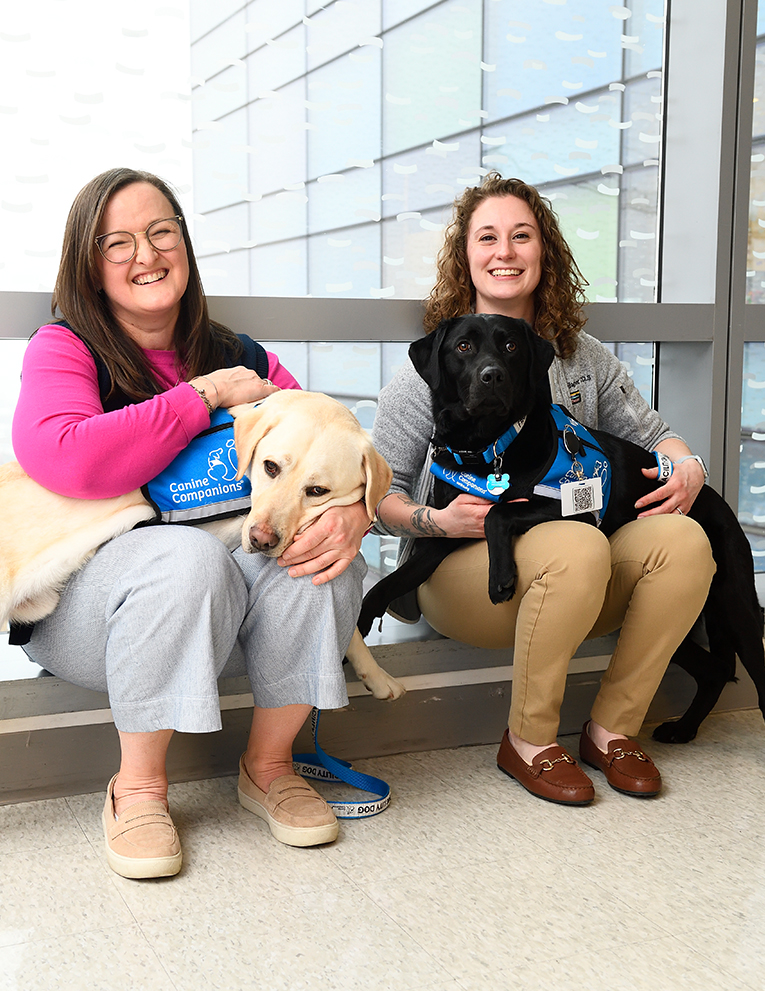
Carrie Potter with Yoda (left) and Molly Trippe-Gallagher with Rosie.
Photo by Will Kirk/JHU
Rosalina and Yoda are full-time Johns Hopkins Children’s Center employees, complete with Johns Hopkins ID badges that they wear pinned to their official-looking blue and white vests.
The highly trained facility dogs work 40 hours a week alongside their child life specialist handlers, bringing guidance and support to young patients and families, and cheer to their human co-workers.
The dogs arrived in Baltimore for training on Feb. 2 and quickly established themselves as local celebrities who can barely walk down a Children’s Center corridor without multiple stops for pets, snuggles, tail-wags and kisses.
“These dogs are such an amazing addition,” says Meghan Shackelford, a pediatric nurse practitioner, bending down one morning to greet them by name and soak up some doggie love. “They’re an immediate magnet for happiness.”
For Yoda and Rosalina (known as Rosie), “sit” and “stay” are just the beginning. They provide quiet support during infusions, demonstrate what it’s like to wear a blood pressure cuff, participate in activities like reading or painting, and encourage mobility by batting around a balloon.
"These dogs are such an amazing addition. They're an immediate magnet for happiness."
Meghan Shackelford
“It’s been amazing,” says Carrie Potter, the child life specialist paired with Yoda, a 2-year-old Labrador-golden retriever mix. “Kids respond so well to them. Whatever the goal is — taking medications, working to build rapport — it seems like the barriers fall away when Yoda is involved.”
One patient, she says, was nervous about getting out of bed after a procedure, but he forgot his fears when Potter attached a second leash to Yoda so the patient could walk him. Yoda also greeted him in the waiting room and laid down next to him during tests. And each time the child took his medication, Yoda would hold out a paw to shake his hand.
One of Rosie’s first patient visits was with a 2-year-old who was understandably unhappy about being in the hospital. “His face lit up when we walked in, and he started talking about his dog at home,” says Molly Trippe-Gallagher, the child life specialist paired with Rosie, a 2-year-old Lab-golden retriever mix. “When kids look back and think about being here, they’re going to look back and remember Rosie.”