A Struggle for Control
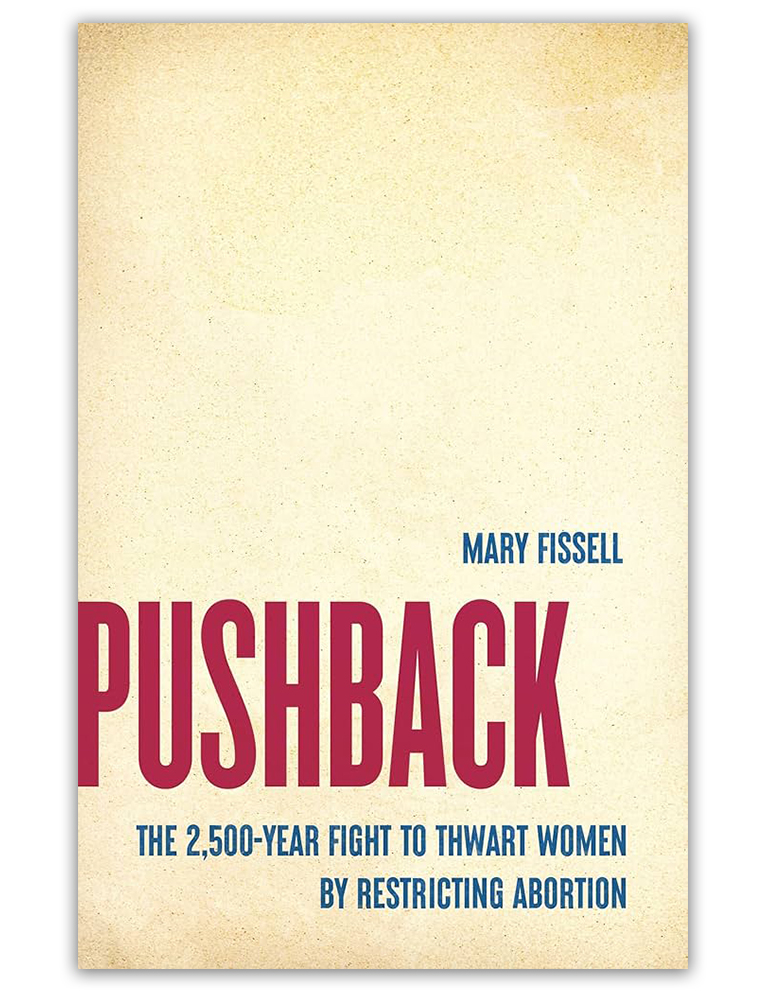
Pushback: The 2,500-Year Fight to Thwart Women by Restricting Abortion
By Mary Fissell
Seal Press, March 2025
In spring 2022, medical historian Mary Fissell’s literary agent asked her if she’d ever considered writing a book about abortion.
“I was working on another book, but we were both very concerned that Roe v. Wade was going to crumble, and I said, ‘Funny you should ask,’” says Fissell, the J. Mario Molina Professor of the History of Medicine at Johns Hopkins. “I’ve been a historian of reproduction for decades, and just felt like I had something to say.”
For Fissell, the project “just caught fire,” and in less than two years, she’d completed Pushback: The 2,500-Year Fight to Thwart Women by Restricting Abortion, published in March 2025.
Critical reaction could not have been more gratifying. The New York Review of Books pronounced Pushback “eye-opening.” Publisher’s Weekly declared it “elegantly written,” “bursting with insight” and a “must-read.” And the Times Literary Supplement called Fissell “a gifted writer whose keen historical imagination animates her stories of women’s struggle for reproductive control.”
Pushback is Fissell’s third book. Because it was so timely, she set aside her yearslong work on a book about a sex and midwifery manual first published in 1684. Titled Aristotle’s Masterpiece, the manual was not in fact written by Aristotle, and it was popular well into the 20th century. “I call it my endless project,” she says wryly.
Fissell is deeply interested in the experiences of ordinary patients, so Pushback is neither a legal nor a scientific history of abortion, “though I drew on many excellent works of that kind,” she says. Instead, it is a careful and empathetic teasing out, from often tantalizingly limited records, of the stories of ordinary women seeking to manage their reproductive lives.
“Much has changed. Modern drugs are safer than similar remedies used in the past. But the determination to control one’s own destiny is very familiar.”
Mary Fissell
It opens with a young woman in 4th century B.C. Greece, an enslaved singer and sex worker, whose job it was to entertain men. When the young woman thought she might be pregnant, her doctor, a follower of Hippocrates, instructed her to jump up and down vigorously, kicking her buttocks with her heels, until a tiny bit of something fell out of her vagina onto the floor. We know about her and women in similar predicaments from the careful records kept by this doctor and others. And thanks to those records, Fissell writes, we know that “neither sex work nor ending a pregnancy were morally repugnant in ancient Greece.”
Other stories in the book, gleaned from less tolerant times and places, are more harrowing. Women undergoing dangerous abortions in secret and dying painfully of sepsis. Women forced to choose between abortion, when the penalty was death, and public flogging or worse for bearing a “bastard” child.
But Fissell also describes a centuries-long tradition of women (and men) sharing information about abortion providers and self-help solutions, including the hundreds of herbs that act as abortifacients. American enslaved women, for instance, secretly chewed the roots of the cotton plants they harvested to avoid bringing enslaved children into the world. Though the record is sparse, it suggests that these methods were often effective, though sometimes not, and sometimes even fatal. But despite the risks, and despite recurring attempts by civil, medical and religious authorities to punish abortion, women always found ways to manage their fertility.
“Much has changed,” Fissell writes. “Modern drugs are safer than similar remedies used in the past. But the determination to control one’s own destiny is very familiar.”
She dedicates her book to her students, “because it’s now up to them to find a way forward, to end the cycles of tolerance and repression, and make the world anew.”
Celebrating First Magnet Designation | Johns Hopkins Howard County Medical Center