
New Partnership Expands Support for Eye Care in the Community
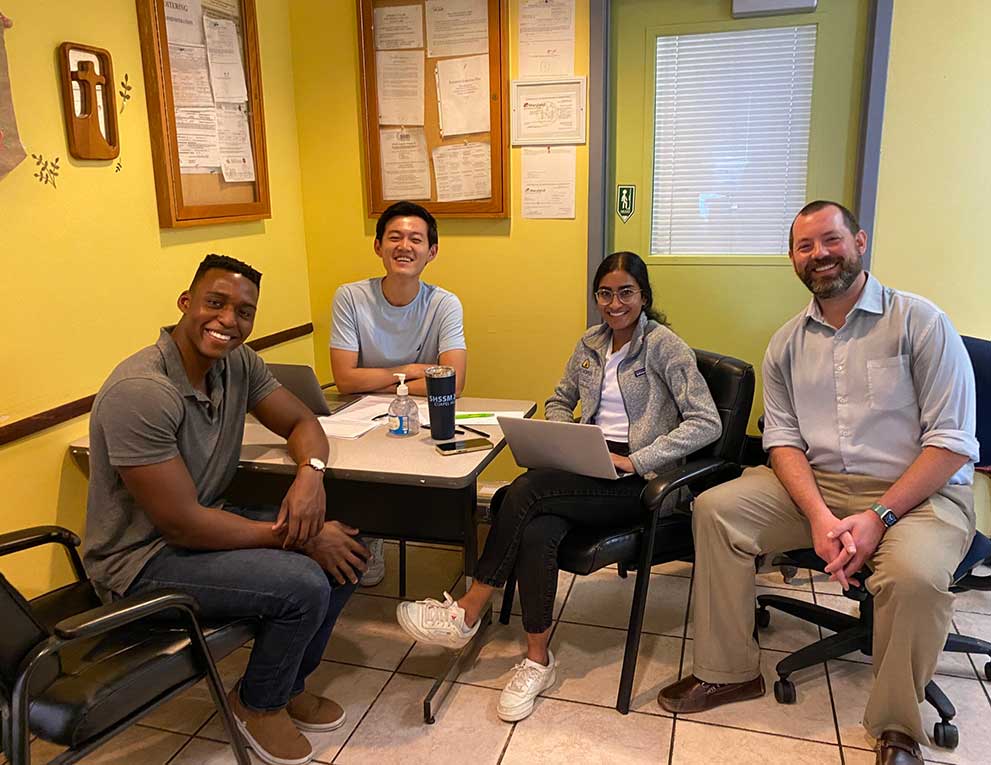
Left to right, medical student co-director Patrick Nnoromele; medical student volunteer Alex Zhu; senior student advisor Divya Manikandan; and Thomas V. Johnson, who founded the community screening program in 2011 as a medical student.
One of the many impressive things about the Wilmer Eye Institute, Johns Hopkins Medicine is its sheer size. At any given time, there are an untold number of projects and programs underway, designed ultimately to provide the highest quality care to the largest number of people. ViSION (Vision Screening in Our Neighborhoods) is one such program.
Originally founded as the SightSavers program in 2011 by then first-year medical student Thomas V. Johnson III, M.D., Ph.D., and faculty mentor Harry Quigley, M.D., the goal was to bring medical students into the community to screen people for eye disease.
Quigley, the A. Edward Maumenee Professor of Ophthalmology, had been involved in the Baltimore Eye Survey, one of the first population-based eye screening programs for disease, and he lent his experience to developing the ViSION program.
“He felt that it would be useless to tell people that they had eye disease if you weren’t going to do anything about it,” says Johnson, who is today the Shelley and Allan Holt Rising Professor of Ophthalmology at Wilmer. “Most of these people are disadvantaged and facing many challenges. It was Dr. Quigley who said, ‘If we’re going to do this, we need to set it up in such a way that we’re going to take care of these people as well,’” Johnson says. Quigley went about recruiting faculty members to care for those who screened positive for eye disease.
To ensure they were operating in such a way as to leverage trust in the community, the program partnered with existing community organizations that already had close relationships with the people they serve, such as the Esperanza Center in Fells Point. “We told them we would like to do vision screenings, and if you have people you work with that would benefit from this, maybe we can work together to set up a screening event,” Johnson says.
Over the ensuing years, the program partnered with the Esperanza Center and other community groups such as CASA to hold the screenings: People who screened positive for eye disease, as well as those who just needed eyeglasses, returned to Wilmer for a follow-up clinic staffed by doctors. There, those who needed care received it, and those who needed glasses underwent a refraction exam — the process by which the eye doctor determines the prescription needed. With their prescription and a voucher for eyeglasses in hand, they would visit Wilmer Optical to be measured for their glasses and, when the glasses were ready, they would return to the optical shop to pick them up.
Johnson remained the student director during his medical school years, with Quigley as the faculty mentor.
“It was tremendously rewarding,” says Johnson. “We would spend half a day and see 50 people. Maybe 40 of them were perfectly healthy, but it’s the few who we found had undiagnosed disease where we really felt like we made a difference. To be able to tell somebody we’re seeing signs of diabetic retinopathy, and I think it’s making your vision blurry, but we know how to fix this, and we can do something about it — I think people deeply appreciate that,” Johnson says.
Importantly, the experience also allowed medical students who were typically sitting in a classroom the majority of the time the opportunity to practice clinical skills, examining eyes in real people.
After Johnson graduated, new student directors took over the task of organizing the screenings. When Johnson joined the Wilmer faculty in 2019, he became the program’s faculty mentor. During this time, he collaborated with ophthalmology departments across the country on a survey of the characteristics of student-led free vision screening programs with the goal of identifying opportunities for program optimization. The work was published in a peer-reviewed journal. A second paper identified the benefits of standardizing student-led programs for both students and community.
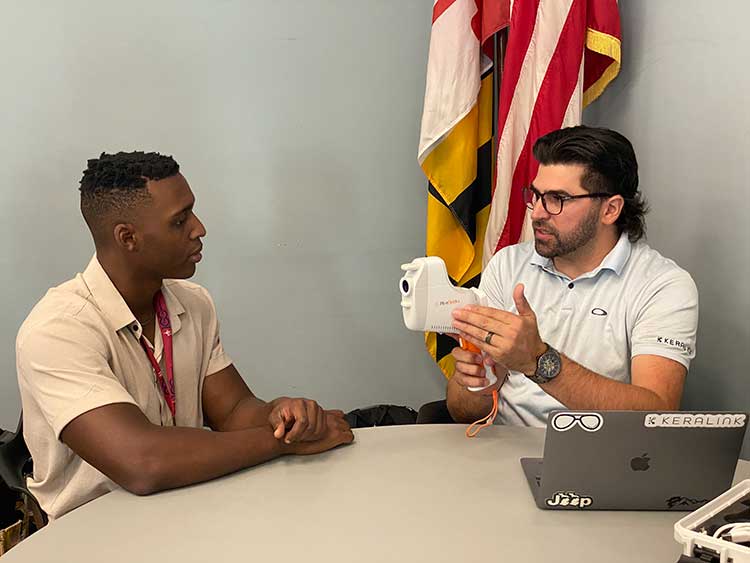 Medical student co-director Patrick Nnoromele, left, with Jeff Soulliere, director of strategic partnerships and initiatives at KeraLink
Today, 50–60 medical students volunteer with the ViSION program annually, along with around 30 faculty members. During his two-year tenure as co-director, outgoing student co-director Patrick Nnoromele, an M.D./Ph.D. candidate, established a program to train medical students on the use of a manual phoropter — a hand-operated instrument used in the clinic to determine a patient’s optical prescription for glasses. Currently, seven students fully trained in the technique are able to use it in the follow-up clinic, decreasing the faculty burden by half.
“We used to need one faculty member to do refractions and one to do comprehensive examinations,” says Nnoromele. “Now we only need one faculty member at each clinic, to perform the follow-up exams.”
While the program has increased its screening capacity, the follow-up clinic remains at capacity, with the ability to see 30 patients. “If we had autorefractors — a tool that provides a rapid, automated estimate of the necessary prescription for eyeglasses — at the screenings, patients who were just showing up to the follow-up clinic to get a pair of glasses wouldn’t have to anymore,” says Nnoromele.
That also touches on one of the key challenges to the success of the program: the attrition rate. In a patient population that is experiencing many challenges in life, glasses may not be their top priority. At every step — from screening, to getting their eyeglass prescription, to being measured for eyeglasses, to picking up their glasses — people drop off for various reasons along the way.
Not only do those people end up without their eyeglasses, but the resources used to get them to whatever stage of the process they attained — the students, faculty members and community partners who volunteered their time — were for naught.
Seeing an Opportunity to Do More
In another part of Wilmer, Kunal Parikh, Ph.D., the Boone Pickens Rising Professor of Ophthalmology, is also working to improve health outcomes for vulnerable populations. Parikh, an assistant professor in the divisions of glaucoma and nanomedicine at Wilmer and the Department of Biomedical Engineering at Johns Hopkins, leads an interdisciplinary lab working to create and translate novel biomedical solutions for a variety of medical conditions.
Through this work, Parikh became acquainted with KeraLink International, an organization founded in 1962 as the Eye Bank of Maryland, which works with clinicians, technology innovators and donors to train skilled eye-care workers, expand services and strengthen systems to provide quality eye care.
When Parikh learned that KeraLink was seeking to expand its work in the U.S., he introduced representatives from that organization to Johnson and the ViSION program. Jeff Soulliere, director of strategic partnerships and initiatives at KeraLink, saw opportunities to improve efficiency of the ViSION program while reaching an even larger number of people.
“Currently everybody, regardless of whether they have a simple refractive error or they need cataract surgery, are all being referred back to Wilmer, which is taking time and resources from patients with more serious conditions,” says Soulliere. To counter that problem, KeraLink plans to provide an autorefractor and a trial lens set that together can be used on-site at screenings to provide an exact eyeglass prescription that can then be entered into a computer, also on-site — allowing the eyeglass order to be placed then and there. Moreover, the eyeglasses will be shipped free of charge directly to patients, negating the need for them to come to Wilmer at all.
Chelsea Andrews, KeraLink’s programs and partnerships manager, says the approach will not only simplify the process for people who may find it challenging to complete the series of visits currently required, but it will help to ensure that the doctors volunteering their time are able to see more of the specialized cases. It will also allow the screening team to expand its reach to neighborhoods that are farther away from Johns Hopkins, since the people who need glasses wouldn’t have to visit Wilmer.
In October, KeraLink hosted Eyes on Baltimore, an event to raise funds and awareness of the ViSION program. Funding opportunities abound, says Soulliere. One possibility would be to purchase a portable optical coherence tomography (OCT) machine, which would allow the screening team to image the back of the eye as an additional tool for the detection of eye disease.
Soulliere and Andrews can envision the ViSION team testing various types of equipment, processes and procedures to determine which ones not only have an impact on people in Baltimore but, by sharing what they learn, could also begin having an impact on programs around the world.
Johnson says that with KeraLink’s help, the ViSION group is hoping to reestablish a national consortium to do just that. “The idea is that they’re going to work with us to see how to make a medical school-based vision screening program the best, most impactful thing it could be — and then help us expand and formalize a national program where groups all over the country do what we do, and we learn from each other,” says Johnson.
ViSION Participants
With gratitude to our doctors who worked with the program to provide care in 2025:
Attendings and Fellows
- Poojitha Balakrishnan (glaucoma fellow)
- Bryn Burkholder
- Nur Cardakli (glaucoma fellow)
- Jefferson Doyle
- Henry Jampel
- Moon Jeong Lee
- Thomas V. Johnson
- Jacob Kanter
- Harry Quigley
- Bo Wang
Optometrists
- Laura Goldberg
- Anthony Gonzales
- Colette Houssan
- Shashi Kant
- Bryce St. Clair
Residents
- Joana Andoh
- Omar Halawa
- Yvette Schein
- Yesha Shah
- Jeremy Shapiro