
Uncovering a Severe Clotting Tendency and Thriving: A Family’s Journey
Mark and Becky will never forget the agonizing time spent in the Emergency Department of Johns Hopkins All Children’s Hospital in St. Petersburg, Florida, as they tried to process what was happening to their 11-year-old daughter, Mallory.
In the two weeks prior, Mallory had been experiencing severe headaches. A visit to her Tampa pediatrician yielded no immediate answers. Was Mallory having cluster headaches? Was she undergoing hormonal changes? Or was it something else?
“I could hear sounds in my right ear with these headaches,” Mallory says. “It sounded almost like rushing water inside my head.”
When her pediatrician reviewed the results of her MRI scan, he urged the family to act.
“He said, ‘You need to get her to an emergency center immediately, and I recommend Johns Hopkins All Children’s, even though it’s more of a drive,’” Mark says.
And now, here they were.
“We were saying a lot of prayers,” Becky says. “Mallory was lucid, but they had her on a ‘stroke watch.’ That made me the most fearful.”
The idea that their child could be in danger was unthinkable.
An additional scan helped to confirm a diagnosis of cerebral venous sinus thrombosis (CVST). Mallory had developed large blood clots in the veins and “venous sinuses” inside her brain.
Fortunately, the blockage wasn’t complete, and no surgical intervention was required. She was admitted to the hospital and given “blood-thinners” (anti-clotting medications) to treat her condition.
Thankfully, Mallory would soon be discharged to go home with her family.
But the journey of managing her health was just beginning.
Thrombosis Care
Within days after her discharge from the hospital, Mallory had her first outpatient appointment at Johns Hopkins All Children’s with pediatric hematologist Neil Goldenberg, M.D., an internationally recognized leader in the research and management of pediatric thrombosis.
“It was the kind of meeting with a doctor that people wish they could have, but rarely do,” Mark says. “He and his team listened and shared information with us for an hour-and-a-half. Have you ever had a doctor’s attention for an hour-and-a-half?”
Long-term, and even life-long management of venous thromboembolism (VTE) is critical, because the risk of recurring blood clots can be high.
“We have many tools in our toolbox that we can offer,” Goldenberg says, “to help reduce the risk of thrombosis for patients like Mallory, as well as to keep any risk of bleeding as low as possible.”
The family quickly sensed they were in good hands. Johns Hopkins All Children’s Hospital has been a leader in the prevention, diagnosis and treatment of blood clots in children for many years.
The hospital was recently designated as a Venous Thromboembolism Center of Excellence by the National Blood Clot Alliance (NBCA) — the very first pediatric hospital in the nation to receive this distinction.
“The fact that NBCA has opened this designation for children’s hospitals shows the recognition that VTE is not only a problem for adults, but for children too,” says pediatric hematologist and Thrombosis Program Director Marisol Betensky, M.D., “as the rate of thrombosis has increased dramatically in children in recent decades.”
“Our intention at Johns Hopkins All Children’s has always been to provide the very best pediatric thrombosis care possible,” she adds, “to ensure that safety is a priority, and outcomes are excellent.”
A Plan for Mallory
To offer Mallory the very best treatment plan, Goldenberg and the team first needed to understand more about why she developed blood clots.
There had been no provoking factors for Mallory’s blood clots such as a significant infection, trauma or surgery.
But there was another possibility: a predisposition for blood clots, known as “thrombophilia,” can be inherited.
Lab tests revealed a possible explanation for Mallory’s CVST — one that didn’t come as a complete surprise to the family. Both Mallory and her older brother Brenden tested positive for something their mother had also inherited — a condition called “protein S deficiency.”
“Protein S deficiency is when the body has low levels of a natural anti-clotting protein, called protein S,” Goldenberg says.
The thrombosis team worked with Mallory on a plan for success that included anti-clotting medication, monitoring, and frequent screenings. Brenden would start with this medication as well.
The thrombosis team provided education and coaching to help the siblings lower their risk of clotting through adulthood. Guidance included things like staying hydrated, getting regular exercise, and avoiding smoking. There were lifestyle tips and modifications, such as avoiding long car rides with crossed legs.
Some riskier sports, including Mallory’s beloved gymnastics, were out, but there were many other athletic options she could choose.
The prognosis was hopeful: With proper care and medication, Mallory was expected to make a complete recovery.
Over the course of her first year of treatment, her family could see her progress.
“We could see the changes in the MRI scans, one to the next, the clots get smaller,” Mark says. “It was glorious.”
Embracing Life
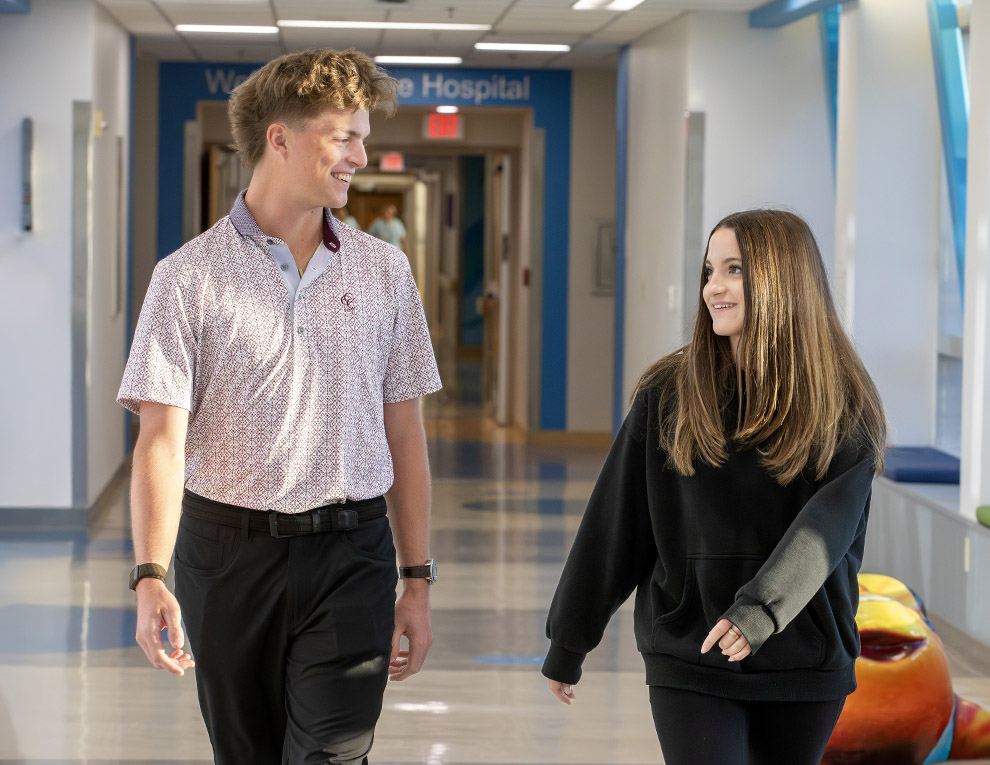
Mallory is now 15 and flourishing, a busy student with a love for volleyball and an entrepreneurial spirit. Her brother, Brenden, is thriving as well, with a focus on perfecting his golf game. He will soon transition to adult care.
Together, the family has found a way to embrace the level of comprehensive thrombosis care that will keep them healthy and safe, without compromising on desires and goals.
“We appreciate the opportunity to help a family weigh risks and benefits and make informed decisions,” Goldenberg says, “while realizing those decisions, much like a child’s circumstances and development, are not static.”
“Every parent wants the same things. We want our children to realize their potential, and to go out into the world and do good things,” Mark says. “Mallory and Brenden will look back on this experience and see the divine providence of how their needs were met. I think it will fuel their hope for the future.”