
Johns Hopkins Interventional Pulmonology Advances Diagnosis, Research and Global Collaboration
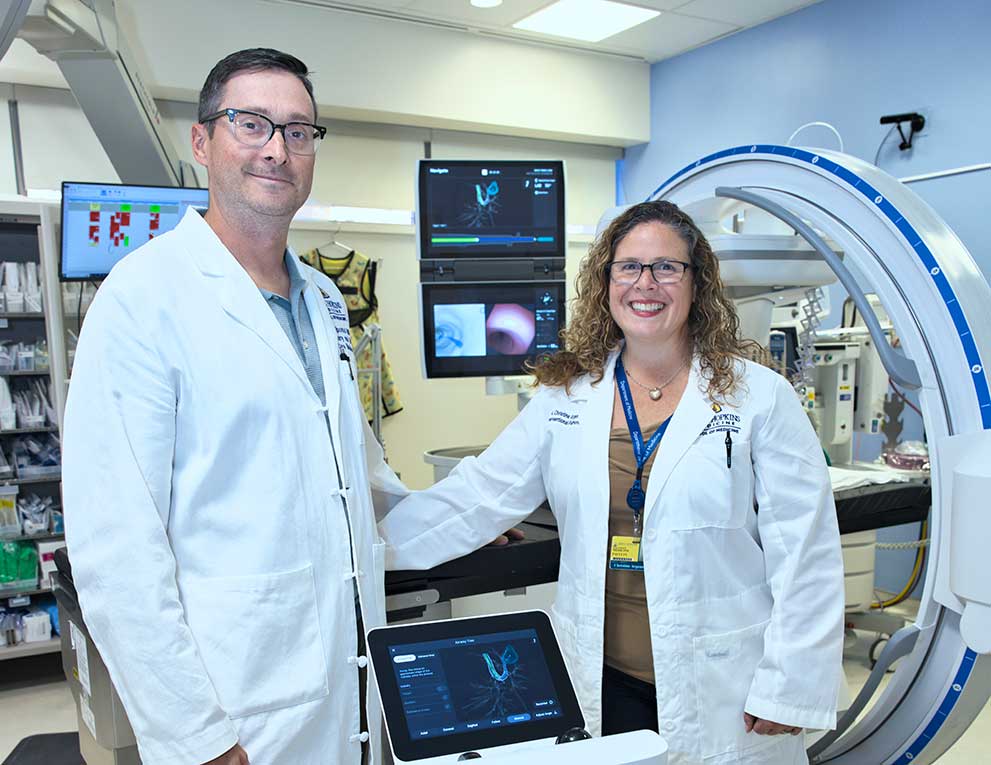
Drs. Jeffrey Thiboutot and Christine Argento
What if lung cancer could be discovered, evaluated and treated all in one visit? At Johns Hopkins, that is becoming a reality. The Interventional Pulmonology (IP) Group is pioneering techniques that make diagnosis, staging and even early treatment possible in a single visit.
 Dr. Hans Lee
The IP group is led by three acclaimed interventional pulmonologists, Hans Lee, Christine Argento and Jeffrey Thiboutot, who all specialize in minimally invasive procedures for lung and thoracic diseases. The team’s guiding principle is simple but ambitious: Combine excellent, patient-centered care with cutting-edge research and global education so that discoveries made in Baltimore can help patients around the world.
Innovation in Diagnosis and Patient Care
The IP team employs advanced, minimally invasive bronchoscopic technologies, including robotic bronchoscopy and endobronchial ultrasound (EBUS), procedures that are integral to evaluation and management of pulmonary nodules, which are often found via imaging. Robotic bronchoscopy is advantageous because it provides the ability to combine nodule biopsy with EBUS in a single session.
This strategy offers numerous benefits compared with traditional CT-guided or surgical approaches. Complication rates, including hemorrhage and pneumothorax, are significantly lower; recovery times are minimal; and patients receive both diagnostic confirmation and staging information in a single procedure.
Working with clinicians in thoracic surgery, radiation oncology and medical oncology, the IP clinic offers patients the advantage of multidisciplinary evaluation and, often, the ability to see multiple specialists in a single visit. For example, if a lung nodule appears to require surgery, thoracic surgeons are available to evaluate and discuss treatment.
Innovative Research
The Johns Hopkins IP team is involved in multiple research trials focused on improving the standard of care. One of the most compelling projects is investigating the feasibility of creating a new pathway for the treatment of early-stage lung cancer. With this procedure, researchers are exploring ways to detect, diagnose and treat early-stage lung cancer in one visit.
The average time it takes to treat lung cancer is approximately six weeks. With robotics and cone-beam guidance, physicians hope to deploy tools through the robotic scope to potentially treat cancer and destroy tumors in a single session.
As Thiboutot explains, “[The hope is that] in one procedure, we could do an EBUS, perform the staging, take a biopsy, confirm that it is a tumor, and kill and treat the tumor all at the same time.”
To evaluate this approach, researchers are conducting a series of large animal studies. These studies involve the induction of tumors in the lungs, which are then treated using EBUS and ablation instruments to assess effectiveness.
This translational approach, bridging animal models and future clinical trials, reflects Johns Hopkins’ commitment to moving discoveries from the laboratory to the bedside. By combining minimally invasive diagnostics, groundbreaking research and a culture of global collaboration, the Johns Hopkins interventional pulmonology group exemplifies how academic medicine can translate innovation into better patient outcomes.
For Clinicians Clinical Connection
Clinicians, discover the latest in research and clinical innovation from Johns Hopkins experts. Access educational videos, articles, CME courses and other resources from our world-renowned institution.