
Guardian of Medicine's Manuscripts
Q&A with curator Michael Seminara
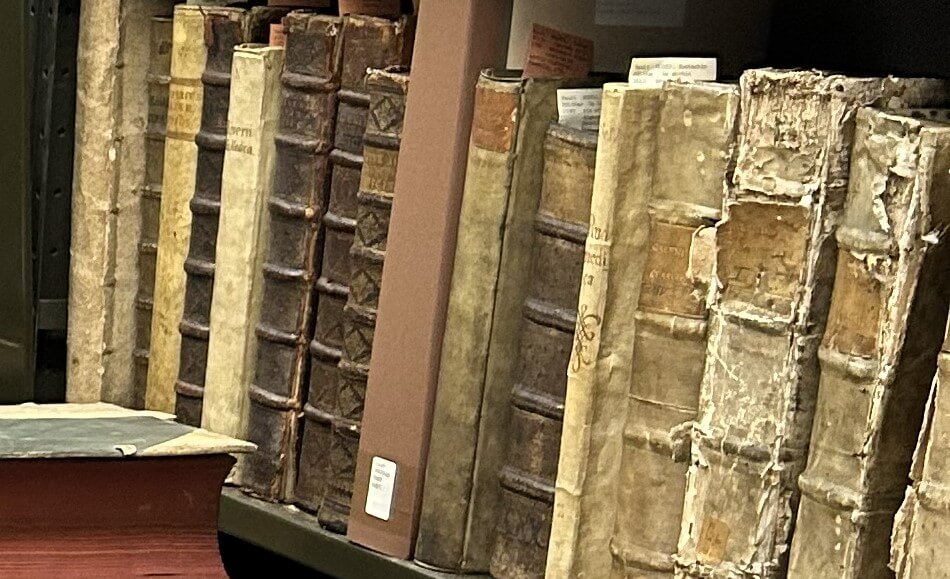
Rare books line shelves in the historical collection vault in the Institute of the History of Medicine.
A well-loved commentary from 1350, written in Latin, sits inside the locked, climate-controlled vaults in the Welch Medical Library. Clues point to how frequently the book has been used: The binding was repaired several times, the margins contain notes from different decades (and centuries) and there are even a few doodles.
“It’s a commentary on Constantinus Africanus, a physician who lived during the 11th century and translated earlier Greek and Arabic texts into Latin,” says Michael Seminara, curator of the historical collection in the Institute of the History of Medicine at The Johns Hopkins University.
Then there’s a Danish doctor’s manual from 1650, with signs of use extending way beyond that.
“All advances in medicine are built upon earlier advances in medicine,” Seminara says. “Seeing that progression on the page reminds us that our idea of medicine has been growing for centuries.”
The Africanus commentary and Danish doctor’s manual are two of 20,000 rare books win the library, all of which pertain to medical history in some way. These rare books, defined as published before 1800, are part of a larger collection of 70,000 historical and modern-day medical texts, open to visiting scholars from around the world. Day-to-day, Seminara collects, curates and catalogues the collection, working with faculty, students and staff to find the right texts for their research.
The collection was founded in 1929 by one of The Johns Hopkins Hospital’s founders, William Welch, and initially included a collection of medical historical texts collected by the “Big Four” founding physicians of The Johns Hopkins Hospital, Seminara says.
“It’s important to preserve and display rare books, because these are part of the material record, they tell us the history of what was being produced and what ideas were prevalent at a particular time,” Seminara says. “What’s the point in keeping these rare books locked up if no one ever gets to see them?”
Today, one of the most requested books by scholars is a foundational text of anatomy: a first edition version of anatomist Andreas Vesalius’ book De humani corporis fabrica libri septem, which translates to On the Fabric of the Human Body in Seven Books, printed in 1543. The illustrations contain extraordinary detail based on Vesalius’ work on human cadavers, and played an important role in the beginnings of the science of anatomy, Seminara says.
The library includes formative texts from many medical disciplines including cardiology, neurosurgery and gynecology, Seminara says. Some of the rare books fall on the more obscure side. This year, an undergraduate class at The Johns Hopkins University studied a French text from 1746 that debunked the existence of vampires.
Up next, Seminara is planning the spring 2026 exhibition on the Welch Medical Library’s second floor, which will be open to students, staff and faculty. The exhibit will incorporate medical texts collected by Howard Atwood Kelly, one of the “Big Four” founders and the first gynecologist on staff at The Johns Hopkins Hospital.
“The exhibition will focus on Kelly’s interest in book collecting, as well as his travels to Japan,” he says. “We’ll include a collection of rare Japanese medical books, mostly works on anatomy, some on diagnosis and pathology.”
Q: How did this collection get started?
A: The historical collection in the Welch Medical Library was founded when the library opened in 1929. William Welch was the first dean of medicine at the Johns Hopkins University School of Medicine and one of the “Big Four” founding physicians of The Johns Hopkins Hospital. After that, he was first to lead the Johns Hopkins Bloomberg School of Public Health, and then, as a retirement project, he became heavily involved with the establishment of the Welch Medical Library, becoming the first director of the Institute of the History of Medicine.
When Welch decided to populate a library with books, he went on trips all over the world to buy for the circulating collection because, at the time (1929), this was a modern medical library. To build out the rare collection, he contacted his colleagues, the remaining members of the “Big Four”: internist William Osler, surgeon William Stewart Halsted and gynecologist Howard Kelly. Welch asked the three of them to contribute books from their personal libraries or to buy rare books for the beginning of this historical collection.
The goal was always for the top floor of the Welch Medical Library building to be devoted to the history of medicine, and to have a historical books collection.
All advances in medicine are built upon earlier advances in medicine. Seeing that progression on the page reminds us that our idea of medicine has been growing for centuries.
Michael Seminara
Q: What’s in the collection?
A: The collection is unique because it’s both a rare book collection and a circulating collection. We have 70,000 volumes of books that are all on-site and available for students and researchers at Johns Hopkins and elsewhere to use and study.
Of these, about 20,000 are considered rare books, and the rest are circulating modern scholarship on the history of medicine. We have a good mix in our collection that allows people to really engage with contemporary and older works. It’s also unique because of the scope: This collection is focused exclusively on the history of medicine, and that covers a wide range of books on the subject. We encourage research and invite scholars to study them.
Q: How do you define what is and is not a rare book?
A: A book may be considered rare for a couple different reasons: It could be old, it could be fragile, it could be from a limited print run, or it could just be a highly sought-after book. In the context of our reading room, students and researchers may take a look at rare books printed before the year 1850.
Q: Who is the collection for?
A: We’re lucky that we have a built-in audience here, that being faculty and students in the Department of History of Medicine, as well as faculty across the school of medicine and on the Johns Hopkins University Homewood campus. We also invite researchers and historians of medicine from around the world to examine a particular source.
We are on the third floor of the Welsh Medical Library. We’re open to anybody interested in studying the history of medicine. If you’re studying to become a physician, if you are a physician, or even if you’re a student working in the humanities, we have something here that could benefit your research.
We’re open to anybody interested in studying the history of medicine. If you’re studying to become a physician, if you are a physician, or even if you’re a student working in the humanities, we have something here that could benefit your research.
Michael Seminara
Q: What are some notable books in the collection?
A: As I mentioned earlier, we have a first edition version of De humani corporis fabrica libri septem, by Andreas Vesalius, printed in 1543. This text revolutionized the way people taught and thought about anatomy. The book was a hit. It was sold all over Europe, and today, it’s highly sought-after by physician collectors, which is why physicians always want to see it when they come to our reading room.
Osler’s name is in the book because he gifted it to Lewellys Barker, who became physician-in-chief of the hospital after Osler. Barker then gifted it to us, and both Osler and Barker’s names are written in this book. It’s in beautiful condition. Prior to this book, illustrations of anatomy had never been so detailed. The quality of the illustrations is striking.
I’d also like to highlight our collection of medical manuscripts from Sri Lanka etched into dried palm leaves known as ola leaves. These are not yet catalogued, but they are treasures, and I hope they can be utilized more.
Q: What are some of the oldest books you have here?
A: We have a book-length manuscript produced around 1350. It’s a commentary on Constantinus Africanus, a physician who lived during the 11th century and translated earlier Greek and Arabic texts into Latin. The commentary was produced in Paris, and the physician writing it wanted to add his thoughts to Africanus’ work.
I love looking at old books that have a lot of evidence of use over decades or centuries. We’ll see repairs on the bindings, lots of notes in the margins, or even some doodles drawn on the insides of books. We may also see multiple ownership stamps or bookplates. One of my favorites is a Danish doctor’s manual from 1650. It’s been repaired many times over the years, and it has signs that it was used well past its publication date. Multiple people treasured this information and found it useful for doctoring well beyond 1650.
We’ll see notes written in the margins from different centuries on the same page. All advances in medicine are built upon earlier advances in medicine. Seeing that progression on the page reminds us that our idea of medicine has been growing for centuries.
We see notes in the margins — especially in certain disciplines; for example, in texts by William Harvey, an English physician who first documented blood circulation. This 17th-century book is the foundational text of cardiology, and many cardiologists like to see it because it’s the first piece of the puzzle for subsequent cardiology texts that build on it.
In another example, neurosurgeons are often interested in works by Thomas Willis, a 17th-century English physician who discovered the Circle of Willis, a critical loop of arteries at the base of the brain. His work allowed the field of neuroanatomy to flourish.
Q: Can you tell us about some of the exhibits you curate at the Welch Medical Library?
A: We have a great exhibition space right next to the West Reading Room. Most recently, we had our exhibit “Eyes on Wilmer: 100 Years of Ophthalmology at Johns Hopkins,” with a focus on the 1925 founding of the Wilmer Eye Institute.
Our spring 2026 exhibit will be on Japanese medical texts collected in large part by Howard Atwood Kelly. We’ll include a collection of rare Japanese medical books, mostly works on anatomy, some on diagnosis and pathology. About 70% of them were collected by Kelly, who was also the first gynecologist on faculty here. The exhibition will focus on Kelly’s interest in book collecting, as well as his travels to Japan.
Q: Is there anything you’d like to add?
A: Our collection is always growing. Most of our books are catalogued and accessible, but we do have books that are in the process of being catalogued. It’s always good to ask a librarian or curator about what we have, because the catalog is the tip of the iceberg most of the time.
Day In The life: History of Medicine Librarian
Meet Michael, a rare books Librarian at Welch Medical Library.
Watch Here
Guardian of Medicine's Manuscripts


