
Forever Changed: One Family’s NICU Story
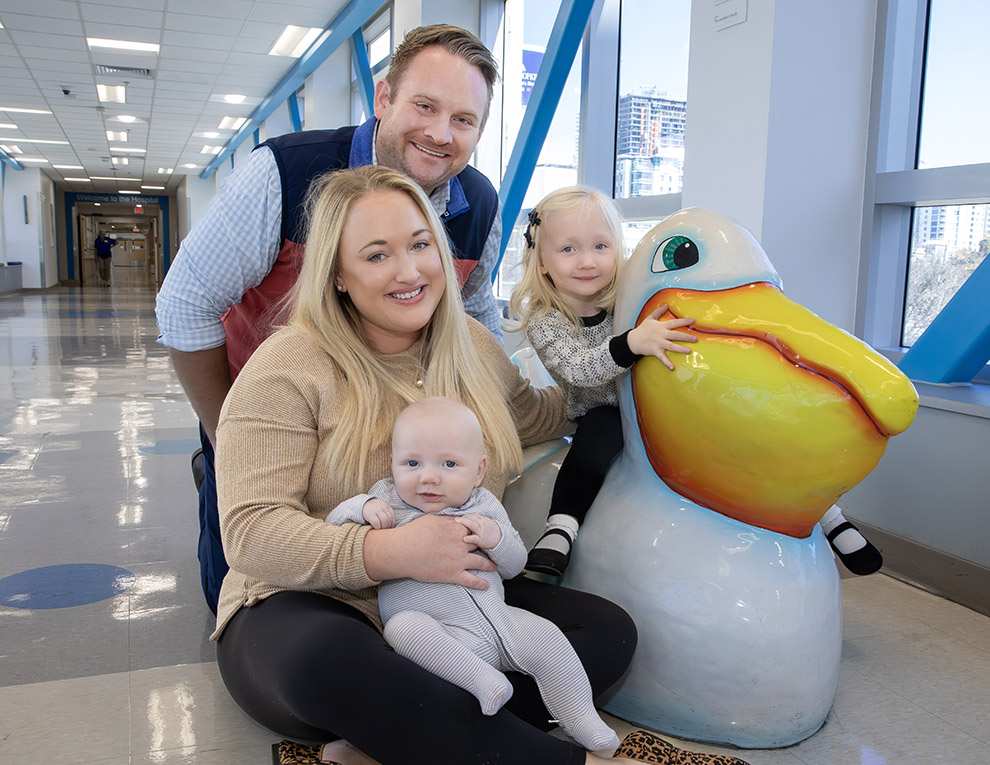
Stephanie and Ryan were thrilled to be growing their young family.
Two-year-old Brynn was the perfect little girl (just ask her dad), and soon, Stephanie would give birth to a boy.
The prospect of a little brother for Brynn was a joyful thing to think about — but Stephanie was taking nothing for granted.
“I have always had challenging, complicated pregnancies,” Stephanie says.
Brynn’s start to life had been a rocky one. Struggling for her first breaths at birth, she had been whisked away to the neonatal intensive care unit (NICU) in Johns Hopkins All Children’s Hospital in St. Petersburg, Florida, and treated for a range of issues, including transient tachypnea of the newborn (TNN), a common condition where the fluid in the baby’s lungs needs time to clear as it should after birth.
Brynn’s parents were grateful for the expert and compassionate care they received during their daughter’s week-long stay in the NICU, but they were determined to do everything in their power to give the next baby a smoother start to life.
They had no way of knowing the challenges ahead.
Rhett’s Birth
This pregnancy and delivery would be different, Stephanie had decided. Armed with the knowledge and experience from the birth of her first baby, and even her own medical knowledge as a nurse practitioner, she availed herself of the additional prenatal care and birth planning that would offer her baby boy the very best beginning.
During this second pregnancy, she received additional monitoring. Because of Stephanie’s health complications, a C-section was planned for 37 weeks, a few weeks shy of what is considered full-term.
Beautiful baby boy Rhett entered the world on Nov. 4.
His very first cry was music to the ears of Stephanie and Ryan — met with a moment of joy and relief.
But then, quickly, things took a downward turn.
Their newborn went into respiratory failure.
Stephanie could only briefly touch her baby’s tiny hand before he was rushed to the NICU for the critical care required to save his life. Once again, this mother would not have the experience of feeling her newborn on her chest.
“It made me sad that the whole ‘skin to skin’ thing you’re supposed to do right after the baby is born, Stephanie was deprived of that for a second time,” Ryan says.
Ryan rushed to follow his son to the NICU, where the infant was intubated and treated with surfactant to support his lungs.
It was surreal and overwhelming to be back in the NICU with a second baby, but Ryan and Stephanie took comfort not only in seeing some familiar faces, but also in the level of care that they had come to know and trust.
Johns Hopkins All Children’s has a Level IV designation from the Florida Agency for Health Care Administration (AHCA). That’s the highest level available, complete with a team of skilled neonatologists and advanced technology to provide exceptional care for critically ill babies.
Puzzle
For baby Rhett, the first 48 hours of life proved to be a puzzle.
Despite therapies, medications, and support, he continued to struggle with severe respiratory illness.
All signs began to point toward infection. As lab reports, X-rays and monitoring yielded more information, doctors were able to confirm a diagnosis: Rhett had congenital pneumonia, a severe infection found in only a fraction of 1% of all newborns.
“Of all of the respiratory problems a baby can be born with, the evolution of the illness is what determines the final diagnosis,” says Joana Machry, M.D, a neonatologist and program director of the Neonatal-Perinatal Fellowship program.
“With a baby with TNN, you provide support, give them some time, and they tend to get better quickly. But a baby with congenital pneumonia doesn’t get better right away. They require antibiotics to begin improving.”
Stephanie and Ryan were relieved to have a diagnosis and a treatment pathway, but they struggled through the ups and downs of Rhett’s recovery. Many days felt like a stride forward and then a discouraging step back.
It was an exhausting and emotional journey, but the couple was buoyed by the comprehensive and thoughtful care provided to their family. Doctors were intentional about including the parents when they rounded each day. Rhett benefited both from the leadership of the more seasoned neonatal experts — as well as those experts’ collaboration with the talented doctors in training at this trusted teaching hospital.
Stephanie and Ryan recall two clinical professionals in particular who went the extra mile to help heal their baby: first-year pediatric resident Elizabeth Fletcher, M.D., and first-year neonatal-perinatal fellow Christina Miller, M.D.
“People in health care, especially those who care for sick babies, don’t do it for recognition or pay,” Stephanie says. “They do it because it’s a calling. I feel like you can see that in every person you encounter there at Johns Hopkins All Children’s.”
Progress
Gradually, baby Rhett began to get better.
His bloodwork improved. His color came back. At last, after many long days of intubation, Rhett was strong enough to breathe on his own.
Now their little boy needed to wean off medications, to learn to eat, to swallow, to do the things his illness had put on hold.
Ryan remembers some nights when he simply couldn’t sleep. He would get in the car and drive to the hospital in the wee hours — just to gaze at his baby boy — and dream about a future with him.
“My own dad set the bar extremely high,” Ryan says. “He’s my best friend. The chance to develop such a relationship with my own son means everything to me.”
After 17 days in the NICU, Rhett was able to go home.
Today, he is thriving.
“He is the sweetest baby,” Stephanie says. “He’s going to be smart and communicative. He smiles all the time.”
Soon after Rhett’s NICU stay, each of the parents wrote heartfelt letters of gratitude to Johns Hopkins All Children’s.
In her letter, Stephanie took the time to name and to lift up nearly every individual whose care touched their family in a positive way.
But it was Ryan’s words that crystallized just how much that care meant:
When Rhett arrived struggling to breathe, when pneumonia stole his cry,
when machines had to do what his body couldn’t, you gave us not just our son,
but every “I love you, daddy,” I’ll hear, every birthday, every laugh, and every
bedtime story we’ll ever share with him (as many of you did for Brynn).
Twice now, you’ve transformed our terror into triumph,
stories we’ll tell at his graduation, wedding, when he holds his own child —
all because you pour your hearts into saving babies whose futures you’ve
forever changed.