
Cell-Free DNA Testing May Help Patients Live Longer After Lung Transplant
For decades, lung transplant survival has been constrained by the difficulty of detecting rejection before irreversible damage occurs. About 50% of patients who received transplants would die within five to six years. Traditional monitoring methods, such as bronchoscopies and biopsies, are invasive, carry risks and often identify problems late in the process. Cell-free DNA testing is helping to change these outcomes by providing a less-invasive procedure that also allows for earlier detection of infection and organ rejection. With medical advances such as this, lung transplant recipients may now live a decade or longer.
A Breakthrough in Early Detection
In 2014, Hannah Valantine and Steve Quake, pioneers in noninvasive genomic diagnostics at Stanford University, performed proof-of-concept experiments showing that clinicians could detect organ rejection using donor-derived cell-free DNA. Cell-free DNA testing identifies fragments of donor DNA released into the recipient’s bloodstream during organ injury.
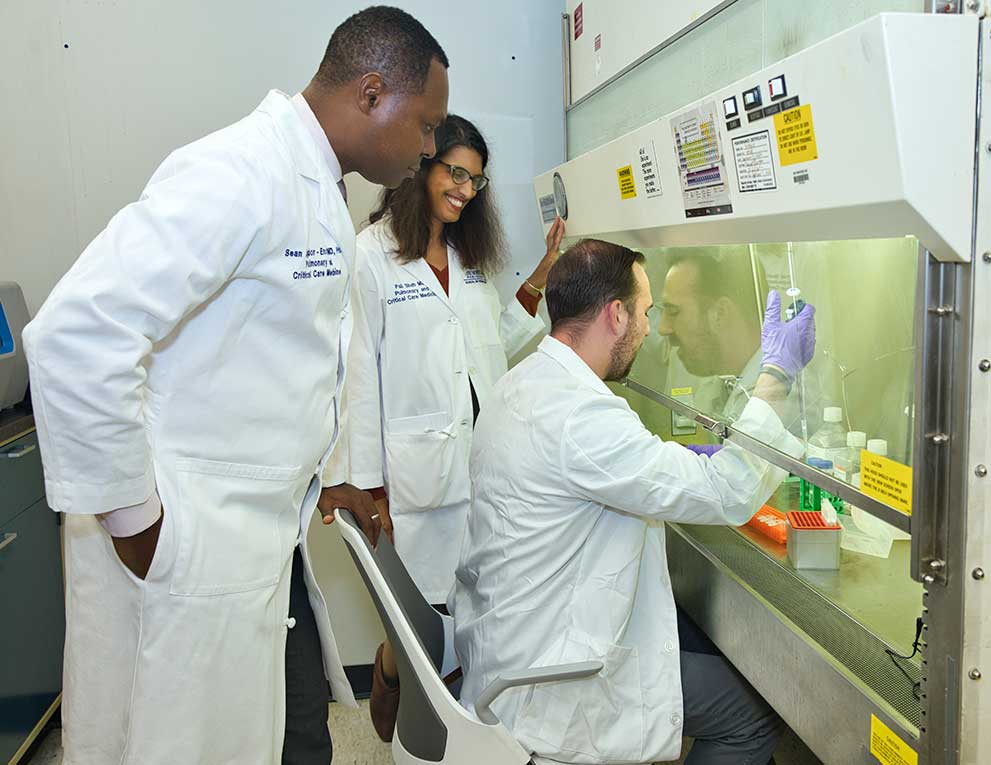
A pulmonologist specializing in lung transplantation, Sean Agbor-Enoh holds a joint appointment as a senior investigator with the National Institutes of Health (NIH) and Johns Hopkins Medicine. He was recruited to work in the lab of Valantine, a tenured investigator at the National Heart, Lung, and Blood Institute. Valantine conducted her work in the intramural research program, where she established the Laboratory of Transplantation Genomics. Through collaboration across cardiac and pulmonary research, Agbor-Enoh contributed to the discovery that cell-free DNA testing could improve the detection of organ rejection in patients who had undergone a lung transplant.
Agbor-Enoh worked with world-renowned lung transplant specialist Jonathan Orens to establish the Genomic Research Alliance for Transplantation (GRAfT), a multicenter study of the NIH National Heart, Lung, and Blood Institute to advance cell-free DNA testing as a noninvasive method to monitor patients after lung transplant. GRAfT’s research showed that this test could detect rejection earlier than traditional approaches while reducing the need for invasive procedures.
Innovation During the Pandemic
This work became essential during the COVID-19 pandemic due to the constraints on in-person patient visits. For years, the only way to detect lung transplant rejection was through a biopsy, which is an invasive procedure that requires sedation and carries a slight risk of complications.
Pali Shah, medical director of the Johns Hopkins Lung Transplant Program, led a study partnering with a company that tested donor cell-free DNA samples from home blood draws as a means of detecting lung injury in transplant recipients. Despite fewer in-person visits during the pandemic, home-based cell-free DNA testing supported timely clinical decision-making and follow-up care, and clinical outcomes such as lung function and hospitalization rates were comparable to those seen with standard in-person surveillance.
Integrating Technology for the Future
Cell-free DNA testing is now FDA-approved and covered by insurance, but widespread adoption remains uneven. Shah emphasizes that a randomized clinical trial across different centers may be needed to validate its effectiveness. She also notes the limitations: While the test signals injury, it does not specify the cause, meaning follow-up procedures are still necessary.
To achieve more precise diagnoses, Johns Hopkins is exploring how best to combine cell-free DNA testing with bronchoscopies and emerging tools such as deep molecular sequencing. In addition, the lab allows researchers to look at patient samples soon after transplant to provide insight into patients’ immunity and how immune issues can lead to downstream rejection. The lung-transplant research laboratory is also initiating a xenotransplant program.
Shah highlights that survival for patients after lung transplant has improved dramatically — from a historical average of five years to more than a decade for many recipients, with some patients surviving greater than 15 years. These gains reflect both better monitoring and more personalized care strategies.
Collaboration That Extends Lives
Looking ahead, Johns Hopkins aims to lead multicenter studies that will define the optimal role of cell-free DNA testing in transplant medicine.
Agbor-Enoh emphasizes that success in this work comes not only from scientific discovery, but from the dedication of the entire transplant team.
“We are physicians who really care about our patients and want to create better outcomes, but we could not do this without the work of our transplant coordinators, research coordinators, nurses and everyone we are so fortunate to have on our team,” he says.
As Shah explains, “Our goal is not just to extend survival, but to give patients safer, fuller lives after transplant.”
For Clinicians Clinical Connection
Clinicians, discover the latest in research and clinical innovation from Johns Hopkins experts. Access educational videos, articles, CME courses and other resources from our world-renowned institution.