
A Surprise Find in New Scale Assessing Risks of Acoustic Neuroma Surgery
Key Points
- Johns Hopkins researchers developed a three-item scoring system to assess facial injury risks associated with acoustic neuroma surgery.
- The online calculator can help clinicians and patients make treatment decisions and set expectations.
- Researchers were surprised that kidney disease was an important factor in assessing risk.
Johns Hopkins neurosurgeons and otolaryngologists developed a simple-to-use scoring system to determine the risk of facial nerve injury from microsurgical resection for vestibular schwannoma.
The acoustic neuroma-7 scoring tool, available online, has just three items. It relies on tumor size, whether the patient has kidney disease, and how well the nerve responds to electrical stimulation at the end of surgery.
“What I like about this score is that it simplifies things to the bare minimum,” says James Feghali, neurosurgery resident and lead author of the study that validated the tool, published in Neurosurgery in December 2025. “There are only three variables, and because we did this in a very robust statistical way, we can see the weight of each individual variable.”
 James Feghali, M.D.
Feghali says the researchers did not expect a correlation between kidney disease and risk of facial nerve injury, and they are studying the relationship further.
“The thought is that when your kidneys don’t work well, they can’t filter out toxins as efficiently,” he says. “These toxins might be related to nerve health. And people with kidney disease also a lot of times have diabetes, which is also related to nerve health.”
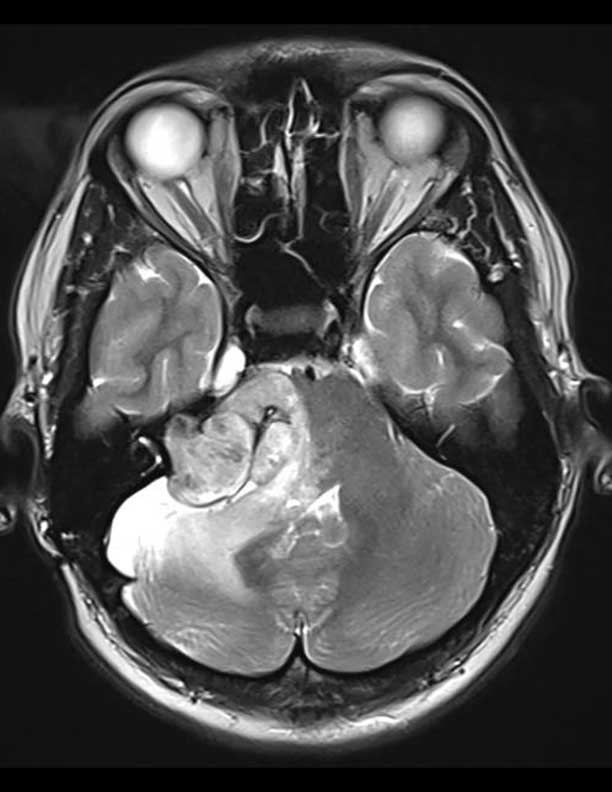
Relatively rare at about 3 people per 100,000, acoustic neuromas, also known as vestibular schwannomas, are noncancerous and usually slow-growing tumors that form on vestibular nerves. As they get larger, they can interfere with hearing, balance, facial movement and facial sensation, and may eventually compress the cerebellum and brainstem.
Treatment can include radiation, surgery or simply monitoring the tumor. The scoring is important as neurosurgeons and patients weigh treatment choices preoperatively and make intraoperative decisions.
“Surgery is a curative option for these patients, but there is risk to the facial nerve,” says neurosurgeon Christopher Jackson, the senior author on the study.
 Christopher Jackson, M.D.
To assess that risk, neurosurgeons have traditionally relied on their own experience and weighed factors including tumor size, location and characteristics, as well as the integrity of the involved nerves, which can only be tested during surgery.
The Johns Hopkins researchers say their calculator, which shows results as a seven-point scoring system, is more precise because it was developed by following the data.
To create their acoustic neuroma-7 score, Feghali, Jackson and others analyzed 360 surgical cases. They took into account demographics, comorbidities, imaging, tumor size, whether the tumor has a cyst, whether the patient had radiation therapy in the past, and other factors.
They found that a tumor of larger than 2.2 centimeters, the presence of kidney disease and weak nerve sensitivity were most likely to yield significant facial weakness.
“We looked at a lot of variables, and at the end of the day, those are the ones that emerged as the most important,” says Feghali.
The score has two variations: one that can be used before surgery and one for use during the procedure. “One of them only relies on the data that we have before the surgery, which is mainly size and whether the patient has kidney disease,” Feghali says. Nerve integrity is assessed during surgery based on response to electrical stimulation.
The system was tested at Johns Hopkins, Stanford University and the University of Cincinnati, showing that it works with different hospitals and surgeons, says Feghali.
“People have developed scores based on their own data, but they never tried it at different institutions,” says Feghali.
“It’s really about using data to inform conversations with patients,” says Jackson.
For Clinicians Clinical Connection
Clinicians, discover the latest in research and clinical innovation from Johns Hopkins experts. Access educational videos, articles, CME courses and other resources from our world-renowned institution.