
Running Through Resilience
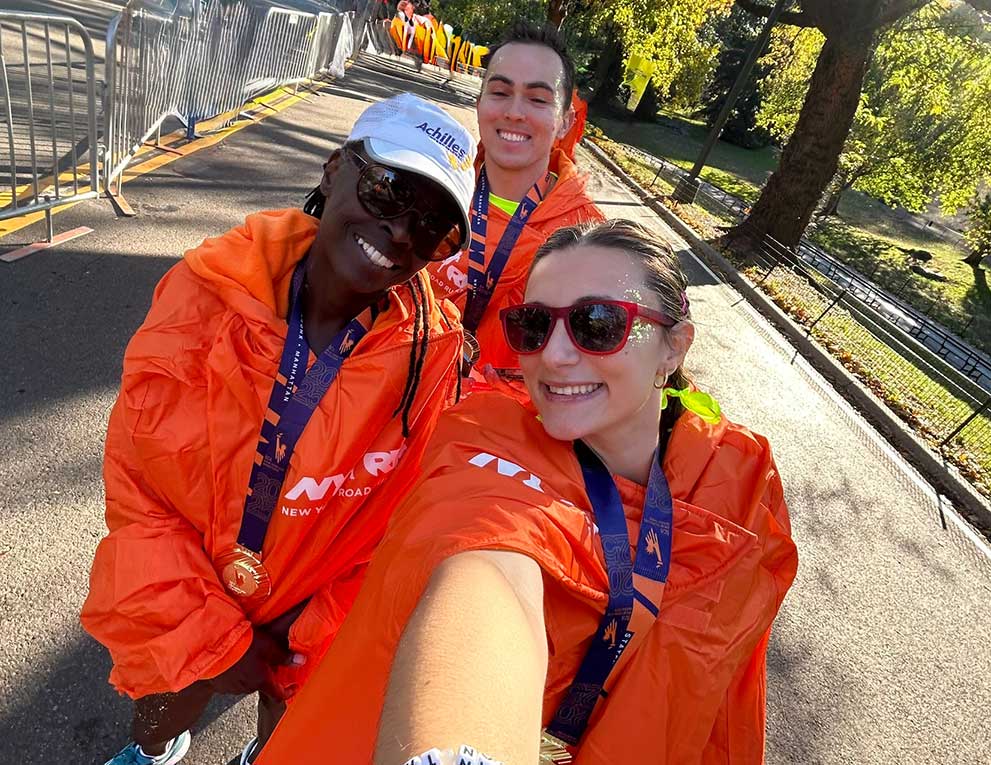
Jackie King wanted to run the New York City Marathon. She had run four marathons before, but none since her vision began to decline.
King first visited the Wilmer Eye Institute, Johns Hopkins Medicine, in 2003, when she sought a second opinion about a glaucoma diagnosis. Meeting with Henry Jampel, M.D., the Odd Fellows Professor of Ophthalmology, he confirmed that she did not in fact have glaucoma, but there was an issue with her retina. She was later diagnosed with retinal degeneration and, later, retinitis pigmentosa, a disease caused by a genetic mutation that resulted in a slow decline in her field of vision and overall eyesight.
King says she can see broad outlines and contrast, but fine detail is lost, and her peripheral vision is poor. She struggles to see in the presence of dim lighting and shadows. For King, an avid runner for more than two decades, the lack of peripheral vision and depth perception has led to challenges, such as not seeing hazards off to the side. Dark pavement could look like a puddle or a hole. The bright sun can create hard shadows, and her eyes don’t adjust quickly between sun and shade.
In 2018, King visited Wilmer’s Lions Vision Research and Rehabilitation Center to learn how to use the vision she had to her advantage. Working with occupational therapist Kristen Shifflett, King learned how to use assistive technology that would improve daily living and work, which proved helpful for reading mail and communications about upcoming races. For running, she learned some best practices, including using a baseball cap and sunglasses for shade and eyesight protection. Shifflett also provided information about United in Stride, a running group that provides guide runners to those who need them. She says she was grateful to access the tools before she needed them. “Wilmer has been very supportive,” she says. “The team aspect and sense of community mean a lot.” Today, her care team at Wilmer includes Shifflett; Jampel; Mandeep Singh, M.D., Ph.D., the Andreas C. Dracopoulos Professor of Ophthalmology; and Everardo Hernandez-Quintela, M.D., M.Sc.
In 2023, after running the Baltimore Half-Marathon, she no longer felt confident to run on her own, but this did not deter her from her dream. In April 2024, she started running with the newly formed local chapter of Achilles International — a nonprofit that matches guide runners to people with disabilities — when a guide told her that the group would supply guides for races around the world. She ran the Baltimore Half-Marathon with guides from United in Stride and Achilles in 2024.
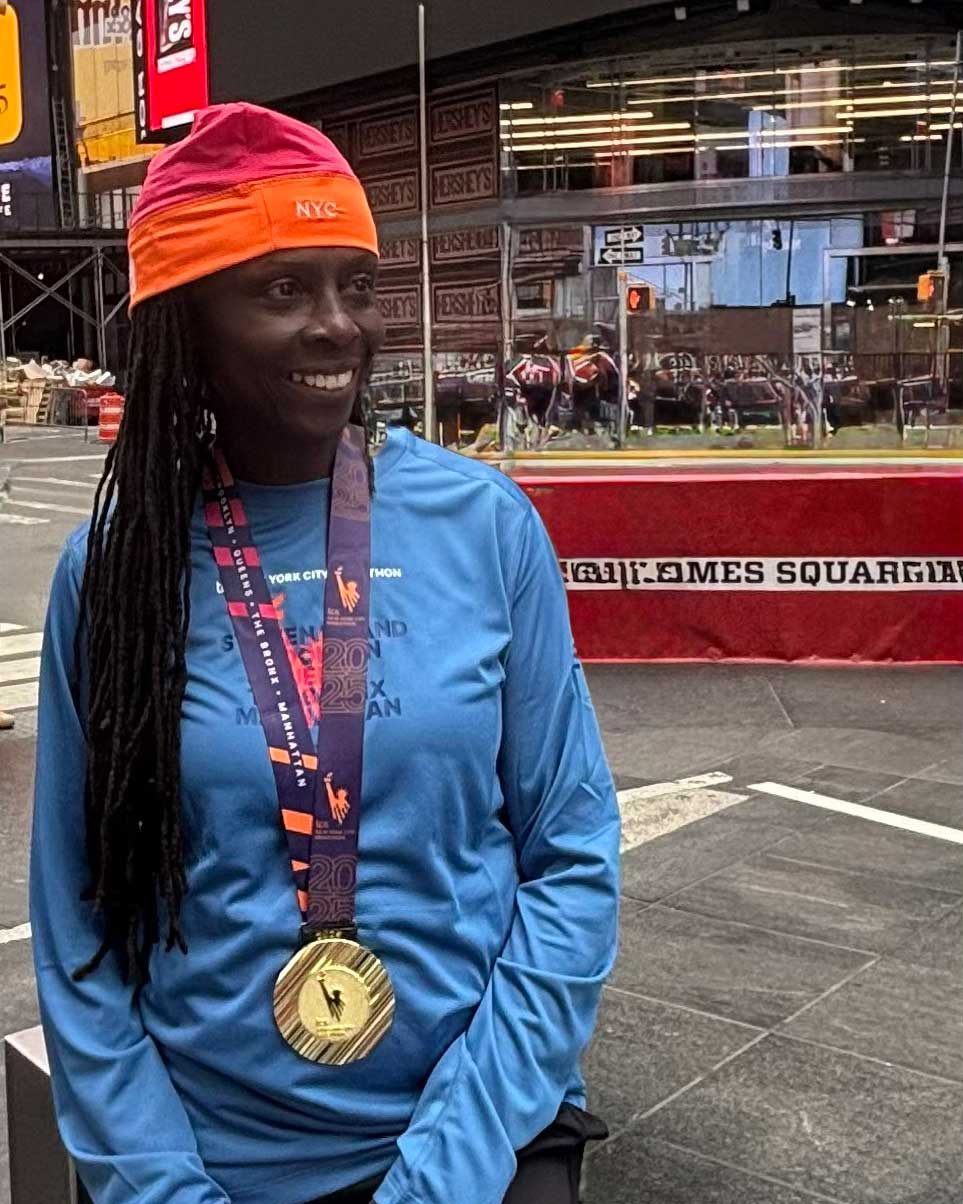
Knowing she’d have training partners and the chance to run with a guide, King was inspired to take on the New York City Marathon, and in February 2025, she entered the lottery for a coveted spot to race, knowing the odds were slim that she’d be chosen. A month later, she got the email that told her she was selected to participate in the iconic race. She then spent the summer training for the big day in November. In September, when sharing the news with Jampel, he reveled in her excitement and he, a past New York City Marathon runner himself, shared a tip about running on one of the course’s bridges.
On the day of the marathon, King ran the streets of New York City with two guides from Achilles and finished the 26.2-mile race in five hours and seven minutes. The day continues to be a precious memory, she says. “There were throngs of people being pushed by others, using hand cycles and running with guides,” she says. “I was so moved to see how many of us are living our best lives by running.”
Shifflett says King has embraced being a low-vision patient and adds that she is happy to see her thriving. She has a photo of King with her medal from the marathon in her office, which she says serves as an inspiration for other patients. She says King’s story shows that visually impaired people can still achieve their ambitions. “With any of our patients, we just want to give them some guidance, but that’s her taking the information and running with it,” she says. “We give a lot of advice and not everyone takes it, but this is something she really wanted to do and I’m so proud of her.”
After her experience in New York, King has a new goal in sight: running the original marathon in Athens, Greece, which she hopes to do in 2026.
For Clinicians Clinical Connection
Clinicians, discover the latest in research and clinical innovation from Johns Hopkins experts. Access educational videos, articles, CME courses and other resources from our world-renowned institution.