
Interactive Effect of Alcohol and Cannabis on Impaired Driving
Johns Hopkins researchers are searching for novel tools beyond roadside tests and breathalyzers to detect cannabis-impaired driving.
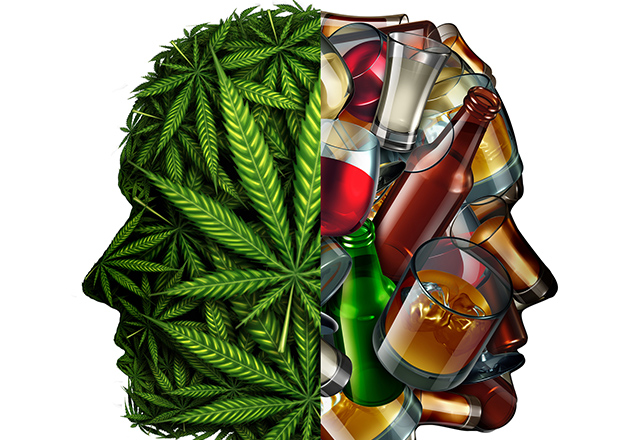
Imagine a scenario in which someone has two beers at a bar, and they safely drive home afterward.
Now, imagine a similar scenario in which the same person had also used cannabis before drinking those two beers.
In the second scenario, they would likely be far too impaired to drive, but they might be more inclined to do so because they don't perceive cannabis to be harmful.
In his research, Tory Spindle, Ph.D., associate professor of psychiatry and behavioral sciences, found an interactive effect on impaired driving for people under the influence of both alcohol and cannabis. “In our studies, if you give people cannabis in combination with a low dose of alcohol up to about 0.05% BAC (blood alcohol level equal to two to three beers for most people), they actually exceed impairment from .08 BAC, which is the legal intoxication limit in most of the U.S.,” says Spindle. “And so, based on a breathalyzer, the person who used both cannabis and alcohol wouldn’t necessarily be judged as impaired, even though they would be actually more impaired than someone who just drank alcohol to the legal limit.”
In the 1980s, researchers designed and validated a core battery of field sobriety tests to detect alcohol-impaired drivers. Even though alcohol and cannabis effects are different, these tests are also being used for cannabis today.
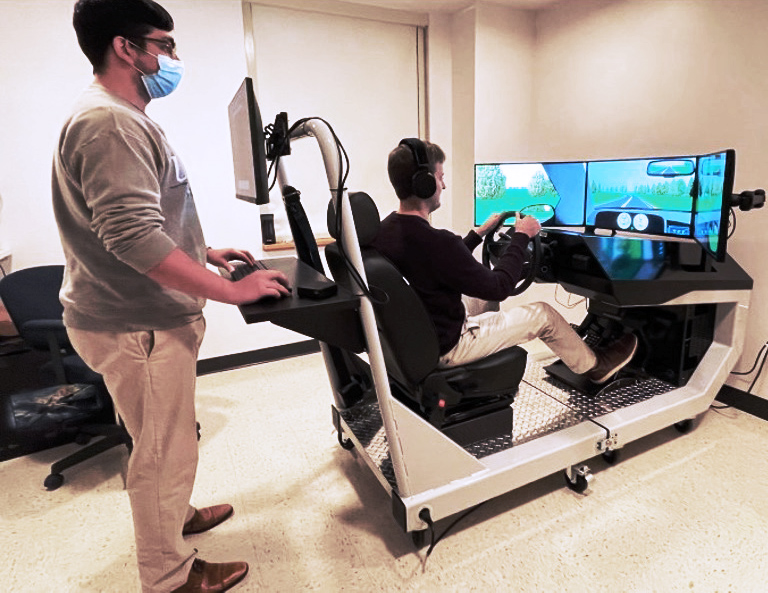
Spindle is working to study how different cannabis products, taken alone or with alcohol, impair driving ability and other aspects of performance. To accomplish this, he recruits healthy volunteers to his lab, where they use cannabis (or cannabis plus alcohol) under controlled conditions, and then complete computer-based cognitive tasks, field sobriety tests and, of course, driving performance tests using a state-of-the-art, high-fidelity driving simulator.
Starting from Scratch
When Spindle began his driving impairment research, he quickly realized that he had his work cut out for him. There were very limited resources available to facilitate this type of research, and the few researchers studying impaired driving from drugs were all using vastly different approaches. “There is little consistency in how researchers across different labs study drug-impaired driving. Investigators use different types of driving simulators, different driving scenarios of varying complexities, and different outcome measures, which makes comparing findings across studies very challenging.”
“And so, another initiative that I have in the context of my research is that I’ve shared the driving simulations we created publicly, and now other researchers are beginning to adopt them,” says Spindle. “What is really great about that is that we could more easily compare our findings to other researchers,’ including those who study drugged driving and those who study other conditions that can impair driving — for example, sleep deprivation and neurological disorders.” Spindle adds, “If researchers doing that work start to use these simulations that we’ve made available, then we can compare, for example, what does sleep deprivation look like compared to various doses of cannabis or compared to alcohol at the legal intoxication limit of 0.08% BAC?”
The driving simulators weigh over 1,000 pounds and take up space. “At first, I was like, OK, are people really going to get immersed in this? It’s just graphics on a screen after all,” recalls Spindle. “There's one part of the drive where you have to merge onto the highway, and I knew the people were immersed when they started to look over their shoulder as they were at that merge point of the driving simulation. I think the simulator is an excellent proxy for real-world driving and allows us to model different driving scenarios in a controlled and safe manner.”
Novel Tests and Biomarkers for Cannabis Impairment
Spindle’s research found roadside sobriety tests are not sensitive to impairment due to cannabis. “A big part of my research is trying to figure out if there are novel tools that we can use to detect cannabis-impaired drivers,” says Spindle. “Novel biomarkers and behavioral tests that might be more sensitive to cannabis than what is currently being used, which were all actually developed and validated for alcohol.”
One of the potential novel behavioral tests is called Druid. It is a tablet-based test that could be administered at the roadside or workplace. Spindle’s team is trying to figure out if this test has better predictive validity of driving impairment compared to these conventional tests.
Spindle’s team is also analyzing blood samples in a search for a biomarker of exposure that might be more predictive than THC levels — which is not reliable for deciphering recent acute exposure from chronic exposure to cannabis, and is not nearly as accurate an indicator of one’s current impairment state as blood alcohol levels are for alcohol.
Keeping Up with Consumers and New Directions
Spindle’s team is keeping up with the wide range of products that are rapidly expanding and changing as cannabis laws evolve. For example, they are studying simulated driving impairment from Delta-8 THC, which is an intoxicating cannabinoid and close chemical relative to THC, but more widely available (often found in gas stations throughout the country).
Spindle’s team is also keeping up with the different forms of cannabis. His research has evaluated the impairing effects of various routes of administration, including smoked cannabis and cannabis vaporizers as well as various types of oral cannabis products, or “edibles,” including drinks, gummies and brownies; he is also studying how different routes of administration interact with alcohol. His studies that have focused solely on cannabis have found that different routes of administration and formulations can greatly influence the effects people feel.
“Dose, route of administration such as smoking versus vaporizing versus edible use, and other cannabis product features can drastically influence how fast people feel the effects of cannabis and the magnitude or strength of the effect. I suspect that when you give people cannabis with alcohol, the effects that you see — whether there are interactive effects or not — are going to be dependent, at least in part, on what form of cannabis they used” hypothesizes Spindle.
Exploring another uncharted territory, Spindle will be collaborating on a pilot study with researchers in the Johns Hopkins University Department of Neurology to assess how driving ability is affected among people in different phases of Huntington’s disease. "I am hopeful that the groundwork we laid to study driving impairment associated with cannabis use will allow us to expand into new areas of inquiry, including how neurological conditions and other non-drug related factors impact driving performance.”