
From Crisis to Stability: One Family’s Journey Through Rare Disease and Resilient Care
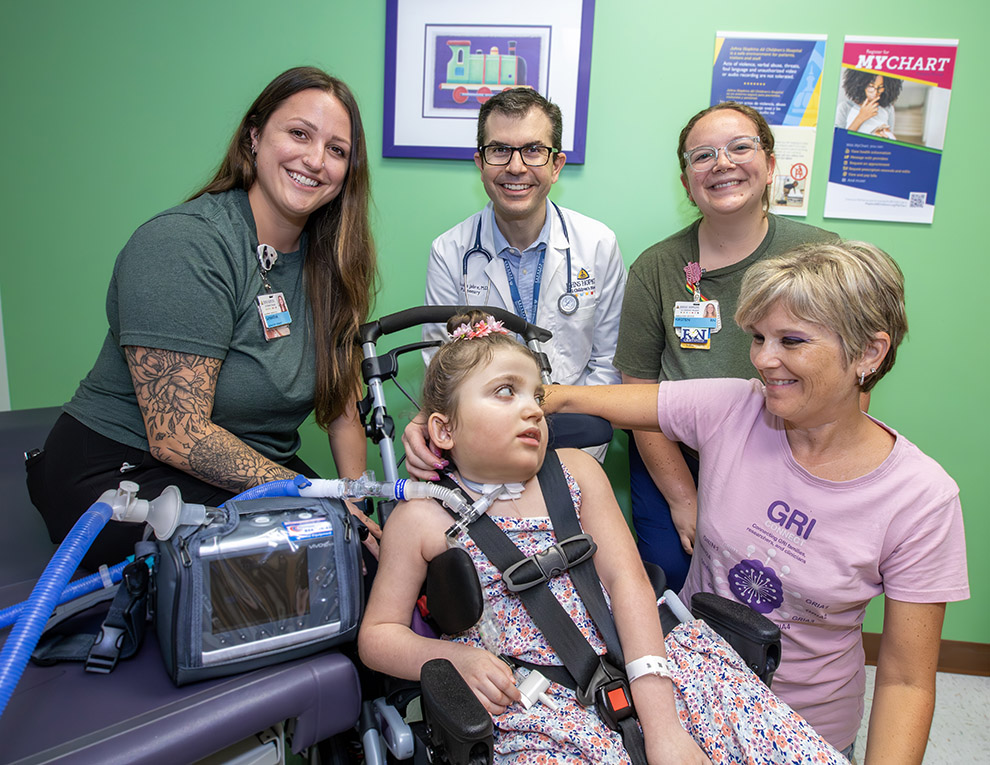
Aurora’s life began like that of any other healthy infant.
“She seemed like a very healthy baby,” her mother, Alyssa, recalls. “We didn’t really notice anything unusual.”
But within a few months, Alyssa noticed Aurora’s eyes beginning to cross — a subtle sign that would mark the start of a long and unexpected medical journey.
At just seven months old, Aurora experienced her first seizure. Alyssa rushed to call 911. “That was very emotional,” she says. “I couldn’t stop shaking. I had no idea it was coming — she had seemed so normal.”
Despite medication, Aurora’s seizures worsened. Doctors eventually referred her to Johns Hopkins All Children’s Hospital, where advanced imaging and genetic testing revealed a rare GRIN2A genetic mutation affecting her brain and optic nerve — the underlying cause of her seizures.
As the family worked to manage the seizures, Aurora faced another serious medical challenge. At age three, she contracted COVID-19, followed closely by a rhinovirus infection. The illnesses severely impacted her breathing, causing high fevers and respiratory distress. She was admitted to the hospital with respiratory failure and eventually transferred to the Pediatric Intensive Care Unit (PICU), where she struggled with a life-threatening infection.
That hospitalization marked the beginning of ongoing care with the Johns Hopkins All Children’s Hospital pulmonology team.
“At that time, she showed signs of upper-airway obstruction, difficulty clearing secretions, and a high risk for aspiration,” says Nicholas Jabre, M.D., a pediatric pulmonologist with Johns Hopkins All Children’s.
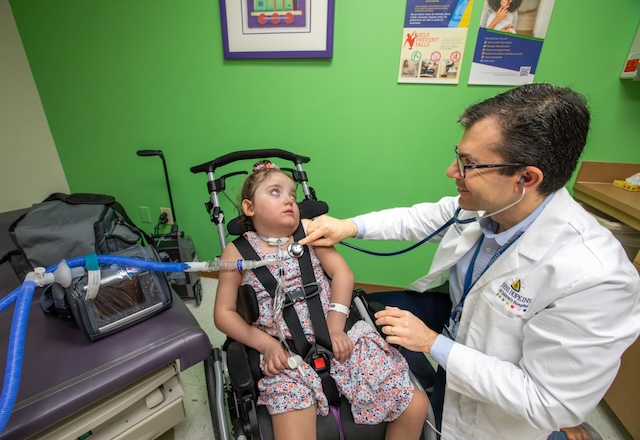
Over the next year and a half, Aurora required multiple hospitalizations for respiratory failure caused by viral infections.
Despite outpatient support and repeated adjustments to her medical equipment and medications, her breathing continued to worsen.
By late 2024, Aurora was experiencing frequent respiratory infections and dangerous mucus blockages that sometimes required emergency placement of a breathing tube.
“She was not looking good,” Alyssa says. “I stayed by her side almost constantly. I didn’t want to leave her alone.”
Given the severity and frequency of her respiratory crises, Aurora’s care team and family made the difficult decision to pursue a tracheostomy and home ventilator — a step aimed at providing a safer, more stable airway and reducing the risk of repeated emergencies.
Following the procedure, Aurora began regular follow-up visits in the Pediatric Home Ventilator Clinic, which offers specialized home care for infants and children requiring tracheostomies and mechanical ventilation, providing ongoing support and education for families. This team of experts helps patients transition from hospital to home, ensuring each child's unique needs are met throughout their development. Aurora initially required round-the-clock ventilator support and high levels of supplemental oxygen.
Over the following months, her medical team focused on fine-tuning her ventilator settings, improving airway clearance, and preventing infections.
“We made several ventilator adjustments during clinic visits, including switching her to a different mode after a sleep study showed it would improve her breathing,” Jabre explains. “These changes were also important to improve Aurora’s comfort using the ventilator. We also spent a great deal of time fine-tuning her airway clearance routine. It was challenging to find the right routine that would reduce mucus plugs while still allowing her to spend meaningful amounts of time not having to receive breathing treatments. This was a very delicate balance, and I could tell that this was important to Aurora’s mom and for Aurora’s quality of life, so we worked hard on that.”
With the efforts of her loving family and her care team, Aurora began to show signs of improvement: fewer mucus blockages, less wheezing, fewer infections, and a significant reduction in hospitalizations.
Meanwhile, Alyssa made a life-changing decision of her own. She left her job as a waitress and enrolled in the nursing program at Pasco-Hernando State College.
She wanted to provide the most help possible to her little girl.
“Because of all her respiratory issues, I felt I needed to learn more so I could properly take care of her,” Alyssa says. She is working toward becoming a licensed practical nurse.
While Aurora continues to experience intermittent airway issues, her overall health has stabilized. “There is uncertainty about whether she will ever be able to wean from the ventilator,” Jabre says. “But we will continue optimizing her care and supporting her quality of life.”
Today, Alyssa says her daughter is thriving.
“She just had a bronchoscopy, and the doctors said everything looks pristine,” she said. “She hasn’t been hospitalized in over a year, but I have high hopes for her future. We’re lucky to have such a strong support system, and I’m incredibly grateful for her medical team.”
For Alyssa, that partnership has made all the difference — helping turn a story once defined by crisis into one marked by resilience, stability and hope.