
Exploring New Paths for Patients with COPD: Innovative Interventions Targeting Environment-Host Interactions
 Nadia Hansel
The Johns Hopkins BREATHE Center (Bridging Research, Lung Health and the Environment) has long been a leader in understanding how environmental exposures shape lung health across the lifespan. Founded with an initial focus on childhood asthma, the center has expanded its mission to address adult lung diseases, including chronic obstructive pulmonary disease (COPD). The goal remains clear: Identify environmental drivers of lung disease, and develop interventions that meaningfully improve respiratory health.
Understanding the Scope of COPD
COPD is among the most common and burdensome chronic illnesses worldwide, affecting an estimated 5%–10% of adults. While cigarette smoke remains the leading risk factor, the disease also develops in people who have never smoked, often due to exposure to indoor pollutants and allergens. Despite advances in inhaled therapies, there is a critical need for cost-effective strategies that address early disease mechanisms and prevention, not simply symptom relief.
 Niru Putcha
Two BREATHE Center investigators, Nadia Hansel and Niru Putcha, are leading transformative clinical trials funded by the National Institutes of Health in collaboration with research partners across the country. Their work takes a dual approach: Improve the home environment and target immune pathways to reduce inflammation and prevent disease progression.
Clean Air 2: Improving Indoor Air Quality to Reduce COPD Morbidity
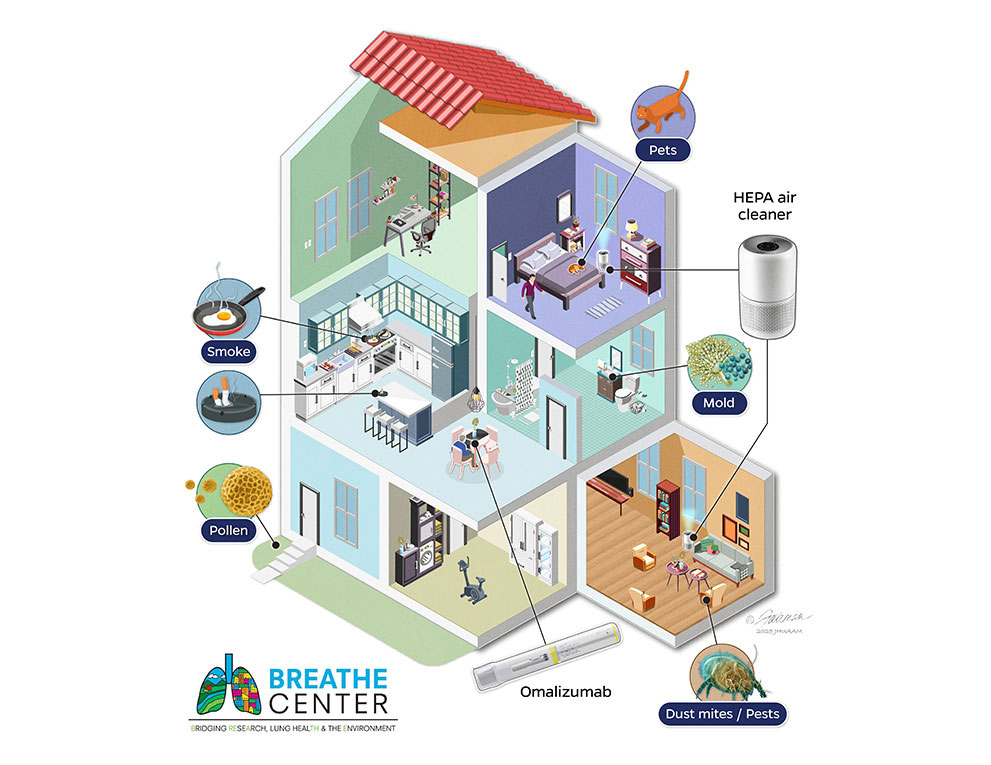
Building on the success of the original Clean Air trial in Baltimore, Clean Air 2 expands to approximately 800 participants at multiple sites nationwide. The study evaluates whether patient-directed placement of home air purifiers can improve indoor air quality and reduce respiratory symptoms and exacerbations.
By empowering participants to monitor and manage their indoor environments, the trial explores a scalable and sustainable model for reducing pollutant exposure. This approach is particularly important for vulnerable populations disproportionately affected by COPD, in whom environmental triggers often exacerbate health disparities.
Our priority is clear: evidence-based, real-world solutions that move the needle on COPD outcomes.”
Nadia Hansel
COPD-OMA: Targeting Allergic Pathways in COPD
Conducted through the American Lung Association Airways Clinical Research Centers, the COPD-OMA trial examines whether omalizumab, a monoclonal antibody commonly used to treat asthma, can reduce exacerbations in patients with COPD and allergic sensitization. The national, multicenter study also assesses home environmental exposures, such as pet dander, pests and dust mites — all of which are closely linked to COPD morbidity.
There has been interest in the COPD world in repurposing treatments that have been successful in other diseases, whether that’s in asthma or even in diabetes, with drugs like metformin.”
Niru Putcha
This approach reflects a growing momentum of repurposing therapies that modify immune responses earlier in the disease course, when interventions may have the greatest effect on long-term lung health.
Shifting the Treatment Paradigm
By the time COPD is diagnosed, irreversible lung damage has often occurred, leaving many patients and clinicians frustrated by the lack of disease-modifying options. The dual strategies being tested through Clean Air 2 and COPD-OMA represent a promising shift toward prevention and early intervention. Together, these studies aim to explore:
- Mitigating environmental and allergic risk factors
- Reducing inflammation before advanced lung damage develops
- Slowing disease progression
- Improving daily functioning and quality of life
Recent federal approvals of monoclonal antibody therapies for COPD highlight how rapidly the field is advancing and underscore the importance of continued innovation.
Building a Healthier Future
These initiatives demonstrate how the Division of Pulmonary and Critical Care Medicine and the BREATHE Center are redefining COPD care by moving beyond symptom management toward prevention, intervention and transformation. Through groundbreaking research, national collaboration and a steadfast focus on patient-centered innovation, Johns Hopkins continues to advance the understanding and treatment of chronic lung disease.
For Clinicians Clinical Connection
Clinicians, discover the latest in research and clinical innovation from Johns Hopkins experts. Access educational videos, articles, CME courses and other resources from our world-renowned institution.