
Johns Hopkins Medicine Offers Free Platform for Young People to Take Control of Their Sexual and Reproductive Health
The Violet Project website is designed for the population most at risk of contracting infections: people younger than 26.
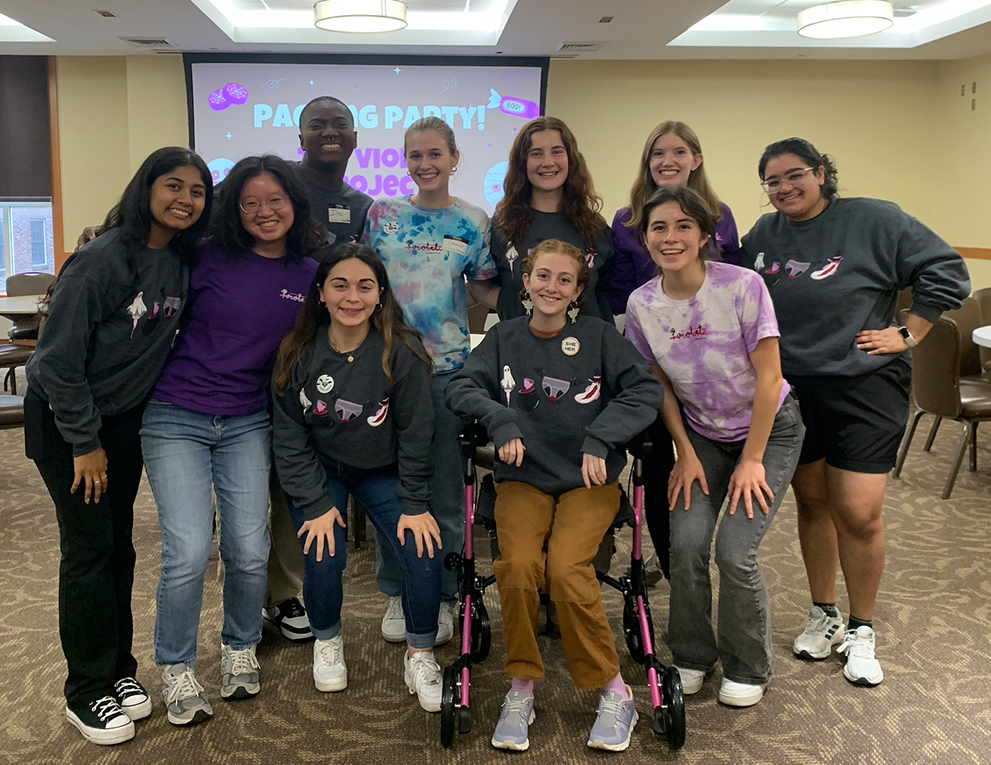
The Violet Project was created in 2020 by Jenell Coleman, M.D., M.P.H., a board-certified gynecologist and the former division director of gynecologic specialties at the Johns Hopkins University School of Medicine, and Saumya Sao, a public health researcher and aspiring physician. Coleman and Sao wanted to create a reliable and accessible platform for young people to take control of their sexual and reproductive health.
“Sexual and reproductive health can be taboo, and is often overlooked,” says Coleman. “Some communities don’t talk about periods. Nearly all people with a uterus experience it, but no one wants to talk about it. The Violet Project is a trusted, reliable source to get information. We make the resources convenient for young people, and are empowering them to make decisions about their own bodies.”
Coleman says the project began as a website with resources and supplies for sexually transmitted infection (STI) testing. Coleman and Sao created a youth advisory board in 2021 by partnering with three Baltimore high schools. The students were asked what they wanted to see on the website, and they contributed their ideas while also recommending that peer educators be present in the clinics.
“Our goal was to let young people take the lead,” Coleman says. “Baltimore is composed of a network of people who want to better their community. If you work among people, you see that they really want to help each other.”
According to Coleman, the Violet Project website is designed for the population most at risk of contracting infections: people younger than 26. About half of the website’s visitors are Black adolescents and identify as female.
“We don’t want people to miss school because they don’t have menstrual products, so they are free on the website,” explained Coleman. “Pregnancy tests are also available. Visitors have access to free STI testing and treatment, and for those who test positive, I would have a conversation with them and provide free treatment for them and their sexual partners, if desired.”
Program manager Margaret Greer says visitors to the website can have their questions answered anonymously.
“Our mission is to provide accessible and reliable sexual and reproductive health resources and education to youth in Baltimore and improve their health literacy,” Greer says.
Greer says it is important to know that there’s a lot of misinformation online. In addition to the website, Violet Project volunteers visit schools and teach lessons on sexual and reproductive health.
“Our goal is to reach the youth within Baltimore,” Greer says. “We have a lot of repeat customers. You can see them retesting via the website, which is very important to stop the spread of infections.”
Greer says the Violet Project partnered with Samuel Kojo Ntow, a student in the Johns Hopkins Bloomberg School of Public Health. Ntow and his colleagues at Bloomberg had started a program called Project RISE, with the aim of getting menstrual education and products into the local public middle and high schools. The groups worked together to source products and visit schools to educate students about reproductive and sexual health.
“Everyone who has needs related to reproductive health needs access to resources,” Ntow says. “We reached out to other local youth-focused organizations, including the Youth Opportunity Academy and the National Academy Foundation to talk to students, and told them about the Violet Project website.”
Ntow says that students were at first shy to ask for help, but found the anonymity of the Violet Project reassuring.
“The Violet Project’s resources meet a need,” he says. “It helps fill a gap in schools because they lack the resources for day-to-day needs. Some schools have resources, but they run out.”
The Violet Project also has peer educators stationed in clinics. Valeria Macri, director of the Violet Patient Volunteer Program, trains college students in the Baltimore area as peer educators in the community. Peer educators are present in The Johns Hopkins Hospital’s pediatric and adult emergency departments, as well as the Harriet Lane Clinic and the clinic at Bayview Yard 56.
“The main thing that volunteers try to promote is open conversations,” Macri says. “They talk candidly about sexual and reproductive health with patients, as well as about getting tested to try to make it not so scary and overwhelming.”
Macri says the way volunteers approach the patients makes all the difference.
“Sexual and reproductive health can be hard to navigate,” Macri says. “There are so many options. You can get your questions answered at the clinic. We encourage them to explore the Violet Project website and check out the different resources we have available.”
Macri says it is essential for the community to have free resources, because all the products cost money. She says a menstrual cup costs $30, but the Violet Project can ship one for free.
“It alleviates a factor that could cause stress for young people,” she says. “We can see that we have people who use it consistently. We’re reaching a lot of people.”
For more information, visit https://www.violetproject.org