
IR Residency Prepares Trainees for Clinical Success
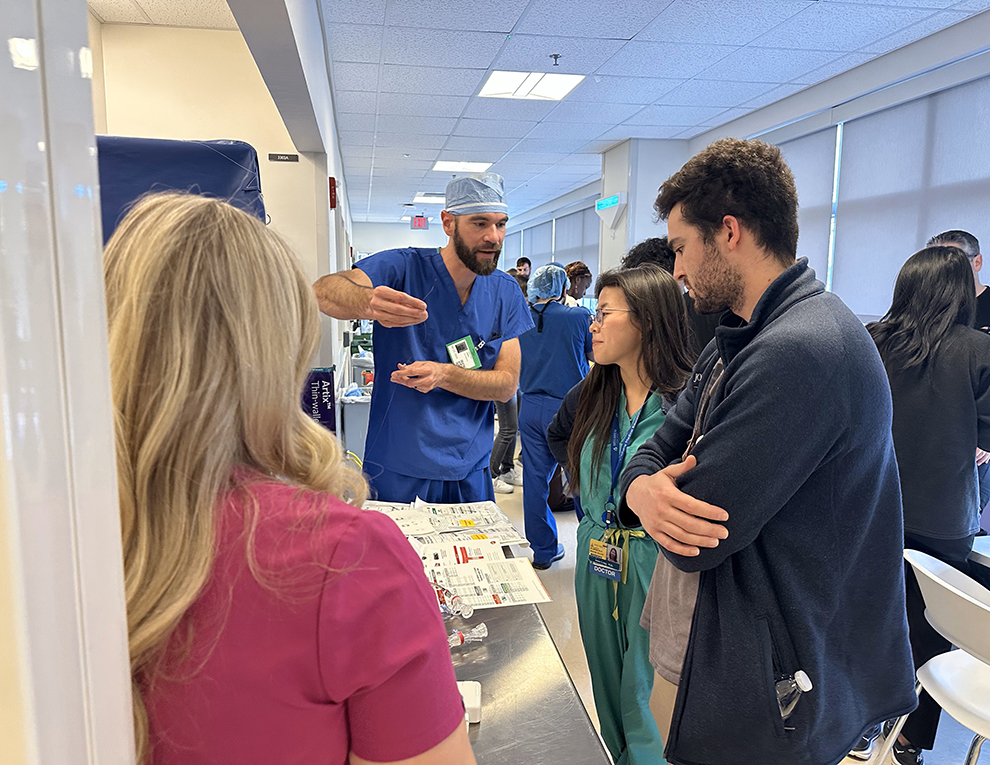
IR residents receive rigorous training from experts in cutting-edge interventional procedures.
For interventional radiology (IR) residents seeking to experience the whole gamut of IR procedures, Johns Hopkins’ Interventional Radiology/Diagnostic Radiology Integrated Residency Program stands apart.
Interventional radiologists diagnose and treat diseases using a range of imaging methods. In many cases, IR procedures can replace the need for more invasive surgical intervention.
Johns Hopkins is a pioneer in postgraduate interventional radiology training, establishing one of the nation’s first IR fellowship programs in 1969. As the need for more structured IR training became clear, Johns Hopkins developed a six-year integrated IR/DR residency program. The current iteration of the program, led by Brian Holly, was established in 2020.
At Johns Hopkins, IR residents receive rigorous training and exposure to a variety and high volume of procedures, as well as experience with cutting-edge interventional procedures that are performed at few other institutions.
The intensive, hands-on program trains residents in imaging complicated vascular pathology. During the program, residents can expect to interpret more than 500 CT and MR angiography exams and perform at least 1,000 procedures.
“Johns Hopkins Interventional Radiology focuses on all of the clinical aspects of interventional radiology,” explained Holly, adding, “Our residents see patients throughout the hospital, in pre-op, in recovery, in the outpatient clinic, and in the procedure suite.
“Hopkins IR program offers a rare blend of clinical excellence, innovative research, and a deep commitment to education,” explained Tony Tae Kyung Him, chief resident.
Fellow chief resident Carolina Lugo-Fagundo echoed this sentiment, noting, “The training at Hopkins is second to none. We’re exposed to a diverse and complex case mix, and we have the privilege of learning from world-renowned experts who have helped shape the field of Interventional Radiology.”
The results of this intensive and varied training are clear, as several IR residents participated in the 2024 Radiological Society of North America annual conference, including David Gullotti, who received the RSNA’s Roentgen Resident/ Fellow Research Award as a 5th-year IR resident.
Other IR residents who participated in RSNA include Rebecca Choi, who co-authored an online educational exhibit on the features and management of Abernathy malformations with Harjit Singh, radiology professor.
“I am so proud of our training program, and all of the credit goes to our incredible residents,” Holly said. “He concluded, “They are a wonderfully diverse group of physicians from different backgrounds and geographic locations who have come together, almost as family, to take excellent care of our patients, while at the same time making our department an incredibly enjoyable place to work.”
Nuclear Medicine Residency Celebrating Growth
With access to world-class mentors, state-ofthe-art equipment, and a range of clinical experiences, Nuclear Medicine trainees at Johns Hopkins are at the forefront of their field.
“The Nuclear Medicine Residency at Johns Hopkins is ranked first in the U.S.,” explained program director Seyed Ali Mosallaie, citing rankings released by Doximity and U.S. News and World Report.
Mosallaie began his role as director of the Nuclear Medicine Residency in May 2024.
According to Mosallaie, several elements distinguish the program. Johns Hopkins residents interpret cardiac SPECT/CT studies, a responsibility typically handled by cardiologists at other institutions. Trainees also benefit from exposure to an array of cases, strong teaching, and research opportunities.
An advancement for the program has been the addition of new scanners within the division. Over the past three years, four SPECT/CT and PET/CT scanners have been installed across Johns Hopkins Medical Imaging sites.
“The division continues to enhance its imaging capabilities by investing in advanced technologies,” Mosallaie said. “These innovations strengthen patient care, research, and education.”