
Intervening Early
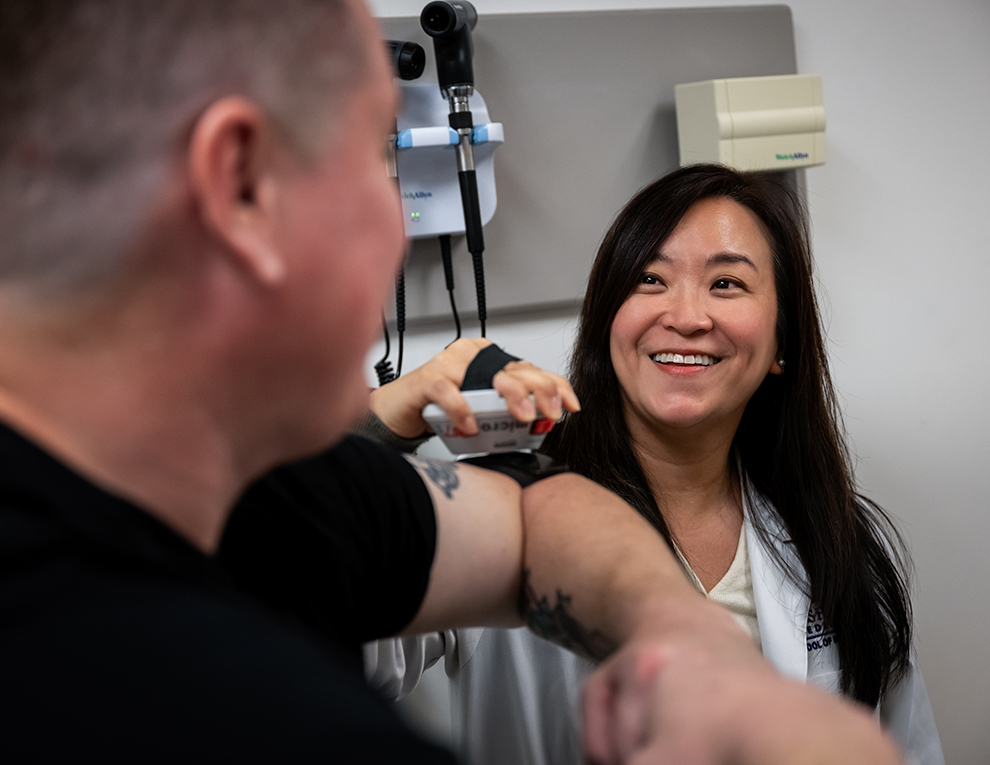
For Johns Hopkins rheumatologist Julie Paik, M.D., one phone call from a long-time patient is unforgettable.
“She was crying with joy. She said, ‘I just can’t believe it! For the first time in 10 years, I can go to the beach with friends and wear a swimsuit!’” says Paik.
The patient had lived for years with refractory dermatomyositis (DM), a rare autoimmune rheumatic disease that can cause severe skin inflammation, profound muscle weakness and, for many patients, interstitial lung disease or cardiac involvement. The patient had exhausted standard therapies, and nothing had provided meaningful, durable relief.
Around that time, tofacitinib, a Janus kinase (JAK) inhibitor, had been approved by the U.S. Food and Drug Administration for the treatment of rheumatoid arthritis. JAK inhibitors control inflammation by decreasing the activity of the immune system.
Paik recognized that tofacitinib’s targeted mechanism could be highly relevant to dermatomyositis, in which interferon-driven pathways play a central role in activating and propagating disease activity.
“We had tried everything for her DM, including multiple conventional immunosuppressants, and nothing had worked,” recalls Paik, an associate professor of medicine. “I thought a JAK inhibitor might be exactly what this person and many of my refractory DM patients needed,” she recalls.
 “That early myositis study taught me how clinical trials can directly change the lives of patients who have run out of options. It solidified my commitment to integrating clinical care with thoughtfully designed trials to advance therapies for patients with complex autoimmune diseases.”
Acting on this insight, Paik initiated discussions with a pharmaceutical company and then designed and led a 12-week, proof-of-concept clinical trial of tofacitinib at Johns Hopkins. The trial proved successful: All 10 patients showed marked improvement in their DM symptoms after just three months of treatment, as measured by a validated assessment of improvement (the ACR/EULAR Total Improvement Score). In addition to clinical improvement, mechanistic studies conducted in collaboration with Livia Casciola-Rosen,Ph.D., in the rheumatology division’s NIH-funded Rheumatic Diseases Resource-based Core Center, and Liliana Florea, Ph.D., in the genetics research core, demonstrated downregulation of STAT1 signaling in skin biopsies as well as in type I IFN signaling in skin and muscle biopsies**.
The experience turned out to be a pivotal step in establishing Paik’s trajectory as a clinical trialist and leader in autoimmune myositis therapeutics research.
“That early myositis study taught me how clinical trials can directly change the lives of patients who have run out of options,” she says. “It solidified my commitment to integrating clinical care with thoughtfully designed trials to advance therapies for patients with complex autoimmune diseases.”
What’s more, that initial project launched Paik on a research path that ultimately led to an NIH grant to establish an Autoimmunity Center of Excellence (ACE) in the Johns Hopkins Division of Rheumatology. The ACE launched in fall 2024 with Paik as principal investigator.
NIH/NIAMS Autoimmunity Center of Excellence
Establishing an ACE has far-reaching impact because it has a multiplying effect, allowing for increased collaboration among researchers within Johns Hopkins and at the eight other ACE sites across the country.
“It connects investigators across specialties and across institutions so we can design smarter trials and give patients access to emerging therapies more quickly,” notes Paik.
At Johns Hopkins, the ACE brings together expertise in rheumatology, neurology, immunology, radiology and precision medicine to support complex autoimmune-disease trials while integrating state-of-the-art mechanistic studies. Operating within the broader national network, the program also provides access to a shared biorepository, which standardizes sample collection and processing across all ACE sites.
“This will be an indispensable resource to support clinical research projects here at Johns Hopkins and at the other academic medical centers in the ACE network — allowing us to speed up efforts to advance our understanding and treatment of a wide range of autoimmune diseases,” Paik says.
As part of the Johns Hopkins ACE portfolio, Paik is the principal investigator of a multicenter, phase II, randomized double-blind clinical trial of ublituximab, a monoclonal antibody that depletes B cells and is already FDA approved for multiple sclerosis.
“There is compelling scientific evidence and clinical rationale for targeting B cells in immune-mediated necrotizing myopathy,” she notes. “B cells generate pathogenic autoantibodies and help sustain inflammatory pathways.”
This trial focuses specifically on patients with immune-mediated necrotizing myopathy who are positive for anti-SRP and anti-HMGCR antibodies early in their disease course, a deliberate shift toward potent upfront combination therapy. “Our current therapeutic paradigm too often relies on delayed step-up approaches, by which point significant and potentially irreversible muscle injury has already occurred,” Paik says.
To directly test this paradigm shift, Paik is enrolling patients in the multi-center phase II trial, which will unfold over the next several years. The central hypothesis of this study is to explore if early treatment (less than one year disease duration) with ublituximab at a critical time of disease trajectory will lead to a durable clinical response in auto-antibody positive immune mediated necrotizing myopathy.
Collaborating with Pharma
While federal support from NIH/the National Institute of Arthritis and Musculoskeletal and Skin Diseases — which launched the ACE program — has been indispensable, Paik has also forged collaborations with the pharmaceutical industry to evaluate the efficacy of novel therapeutic agents.
Across all her projects, Paik’s vision centers on a unifying goal: integrating precision immunology with early therapeutic intervention to change the natural history of myositis. “We now have the tools to identify molecular pathways driving disease and to test targeted therapies in thoughtfully designed clinical trials,” she says. “My hope is to begin treatment earlier, personalize it and prevent disability before it starts.”
“It always comes back to the patients,” she says. “They are the reason we push the science forward.”
** Study of Tofacitinib in Refractory Dermatomyositis: An Open-Label Pilot Study of Ten Patients. Arthritis Rheumatol. 2021;73(5):858-865. PMID: 33258553
** Long-term extension study of tofacitinib in refractory dermatomyositis. Arthritis Rheumatol. 2022 Feb;74(2):371-372. PMID: 34369109
For Clinicians Clinical Connection
Clinicians, discover the latest in research and clinical innovation from Johns Hopkins experts. Access educational videos, articles, CME courses and other resources from our world-renowned institution.