
Histotripsy Offers New Hope to Patients With Liver Tumors
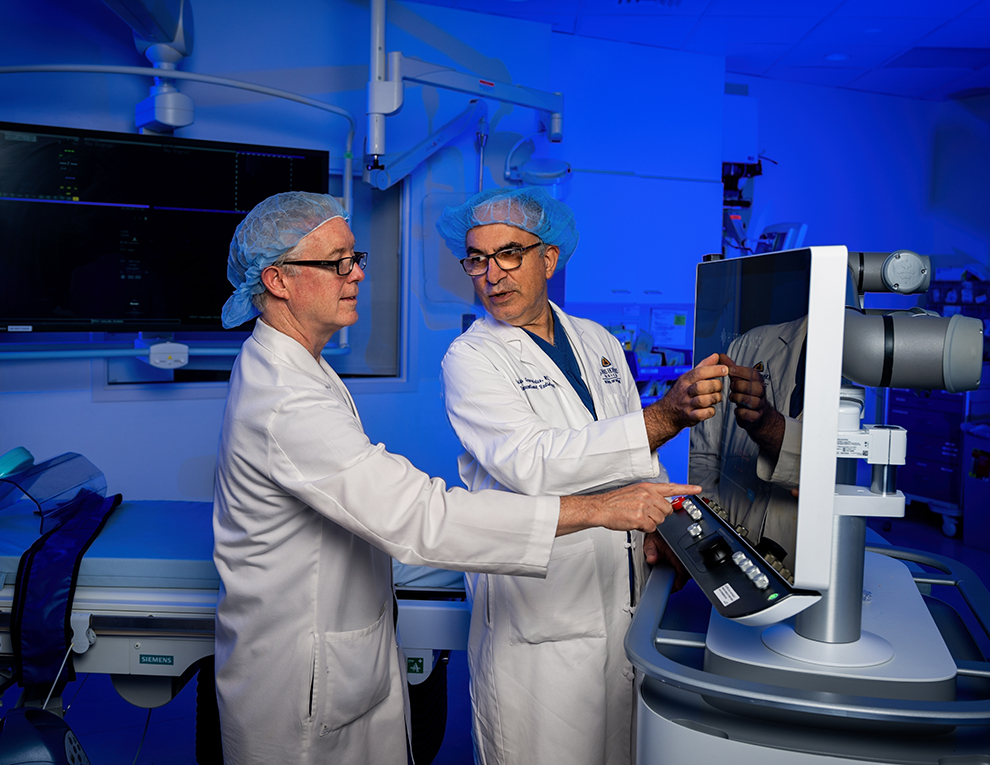
Robert Liddell and Christos Georgiades in an IR Suite demonstrating the histotripsy equipment.
Histotripsy, derived from Greek words “histo” (soft tissue) and “tripsy” (break down), is a new procedure first approved by the FDA in 2023 for the treatment of liver tumors. The technology uses ultrasound waves to focus energy, creating microbubbles within the tumor. Pressure from these bubbles builds, destroying the tumor tissue while leaving healthy tissue intact. The broken-down tumor tissue is then processed as waste by the body’s immune system.
Currently, histotripsy procedures are done at The Johns Hopkins Hospital in Baltimore. Several interventional (IR) clinical faculty have trained in the technique, including Robert Liddell, division chair, and Christos Georgiades, professor of radiology and director of interventional oncology.
The procedure is done on an outpatient basis and takes just a few hours, with much of that time used to calibrate the machine to ensure precise targeting.
Patients are put under general anesthesia to limit their movement during the procedure. Interventional radiologists use ultrasound to both visualize and target the tumor and then treat it. Patients are able to go home the same day with minimal downtime for recovery.
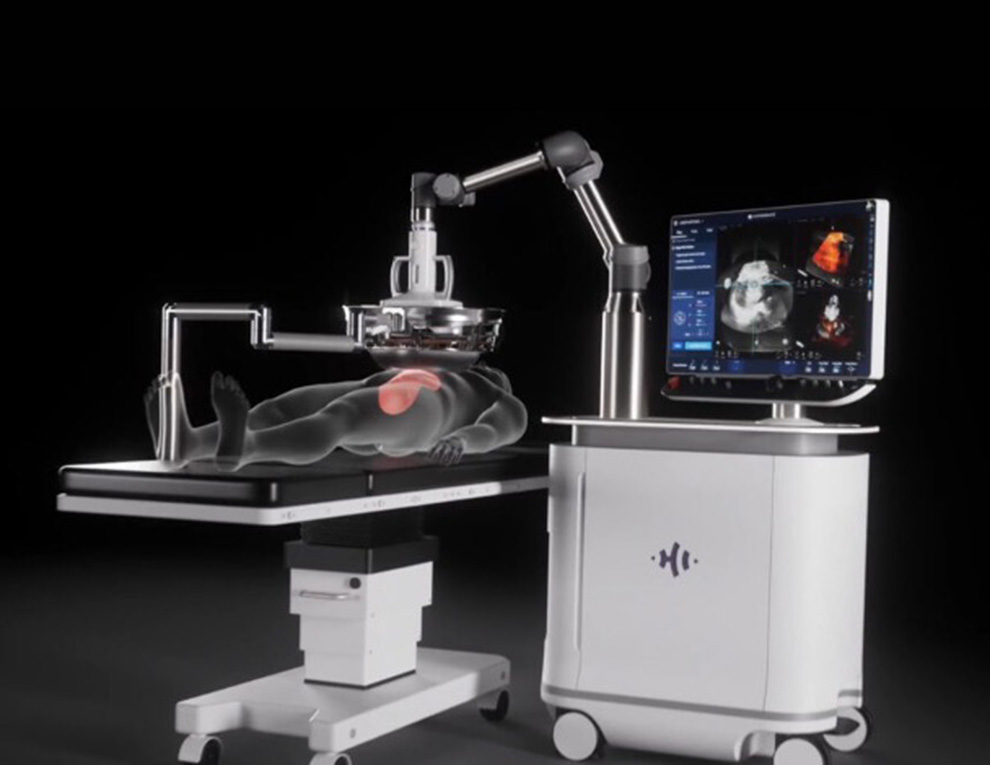 Histotripsy is a non-invasive procedure that uses ultrasound waves to
destroy tumors.
Histotripsy is a non-invasive procedure that uses ultrasound waves to
destroy tumors.
Traditional methods for treating liver tumors include surgery and ablation. Ablation involves introducing heat, cold, or chemicals into the tumor to shrink it. Doctors use needles to freeze or heat the tumors or, alternatively, may use image guidance to place catheters through the arterial system to the liver’s blood supply, delivering chemotherapy to the tumor. These procedures are somewhat invasive and often require a more extensive recovery.
Histotripsy can be a more appealing option for patients. The procedure is completely non-invasive (requiring no needles, catheters, or incisions), is done on an outpatient basis, and includes minimal to no downtime for the patient.
Histotripsy is still a new technology, and Johns Hopkins was the first institution in the state, and remains one of the few in the region, to offer histotripsy.
Another unique aspect of histotripsy at Johns Hopkins, Liddell explained, is that it is under the purview of the radiology department. Other systems may share the technology with other departments, or it is likely controlled Histotripsy Offers New Hope to Patients With Liver Tumors RADIOLOGY UPDATE • WINTER 2026 • 5 by the oncology department. At Johns Hopkins, the equipment lives within the radiology department under the supervision of Liddell and Georgiades.
Liddell acknowledged Karen Horton, chair of the Department of Radiology, for not only pursuing the new equipment, but also making sure it was housed within the department.
“I have to give a lot of credit to Dr. Horton for being so proactive in this,” he explained, adding, “She had the foresight to not only embrace the technology, but that radiology should offer it.”
Offering the treatment within the radiology department is beneficial to patients because the IR physicians are already well-versed in conducting procedures using live imaging, whereas physicians in other areas may not have the same level of experience.
Since starting to offer histotripsy at The Johns Hopkins Hospital, Interventional radiologists have treated a number of patients, most for liver tumors, and one for a kidney tumor. While histotripsy is currently only FDA-approved to treat liver tumors, clinical trials are underway for use in the kidneys.
So far, according to Georgiades, the success rate has been very promising
“I am very enthusiastic, but it is early. Early results are encouraging, but long-term data is not yet available,” he explained.
“It’s another tool within the armament of IR and cancer doctors here at Johns Hopkins,” Liddell explained. “Along with surgery, radiation, and chemotherapy, this is another tool in the toolbox and another option.”
In just a few months, Georgiades noted, he has seen some tumors completely regress, though he is quick to note that there are several limitations in selecting patients for the procedure.
Currently, patients must have one or just a few small tumors (less than 4 centimeters) that are in areas of the liver that are easily visualized with ultrasound. Ultrasound has trouble penetrating air and bone, which means it is not appropriate for tumors in locations such as the lungs, chest, brain, or deep in the pelvis. Patients with large or numerous tumors, or tumors hidden by ribs or overlaid by bowel, are not good candidates for histotripsy at this time.
The general rule for tumors best treated with the technology, according to Liddell noted, is “small, accessible, and few.”
The future of histotripsy is bright. Currently, global research is looking at the procedure’s effectiveness in treating kidney tumors. The FDA is expected to approve histotripsy for this use by late 2025 or early 2026. Researchers are also hard at work evaluating other potential targets, like tumors in the thyroid, pancreas, uterus, and soft tissue tumors in muscle and fat. Studies are currently underway in animal models.
Early pre-clinical results are promising, with the technology being proven to be able to target relevant areas for treatment without damaging nearby healthy structures.
Researchers are even working on more advanced applications, such as use in brain tumors (an application that is complicated by bone interference from the skull, which blocks and absorbs ultrasound).
While histotripsy is not a “miracle cure”, it is a promising treatment for patients who have tried other (often far more invasive) options with little success. While doctors are currently extremely selective in choosing patients for the procedure, the rapid development of the technology makes it likely that use of histotripsy will continue to develop.
As Georgiades concluded, “Histotripsy truly presents new hope for some patients.”