
Bob Gayler Reflects on 1985 JH MRI Acquisition
 MRI Magnet, 1986
In a first-person recollection, Dr. Bob Gayler, retired associate professor in the Johns Hopkins Department of Radiology, recalled the 1985 acquisition of MRI scanners at The Johns Hopkins Hospital.
By 1985, the Food and Drug Administration had approved three American companies to begin marketing magnetic resonance scanners. That same year, Martin Donner, head of radiology, was authorized by Richard Ross, dean of The Johns Hopkins University School of Medicine, and Robert Heyssel, president of The Johns Hopkins Hospital, to purchase an MRI scanner. A selection team, of which Bob Gayler was part, was organized to visit the three manufacturers – Picker International, General Electric (GE), and Technicare.
Technicare and Picker were centered in Cleveland, so the Johns Hopkins team went to the Cleveland Clinic, which had two Picker MRI units in special buildings constructed to allow for dissipation of the magnetic field that the machines generate. They made a separate trip to GE in Milwaukee. The vendors provided scale diagrams of the field strength for room size planning, with provision for increased magnetic strength.
The Picker, Technicare and General Electric scanners used supercooled magnets brought up to field strength and maintained at strength by the cold magnet. In 1985, the magnets were 0.5 T. The assumption was that the field strength would be 1.5 T within a couple of years.
Ross stipulated that two scanners would be acquired, one for research and one for patient care. The purchase decision was largely based on the best price. Technicare’s proposal was accepted, and site planning began.
Site selection was critical. Remember, self-shielded magnets were not yet available. The problem of maintaining distance from large moving metal was the first consideration, followed by patient safety, magnet access, and overall room size. The only “green space” that met the criteria was a parking lot for full professors between the Phipps Building and Wolfe Street. This required careful measurement to ensure that traffic on Wolfe Street would be outside of the area that could influence the magnetic field. Putting the magnets in a partially underground location turned out to fit all criteria, so plans were drawn.
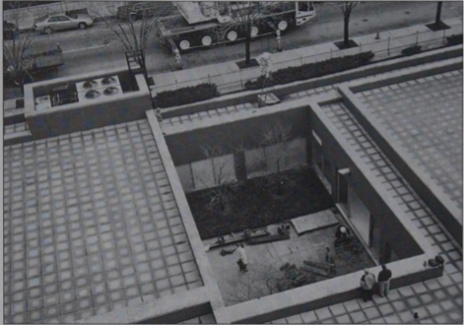 MRI Courtyard,1986
The next step was to get government approval. It was very long and painful. There was enough delay that the vendor company was sold twice, and the department was now working with GE. Fortunately, GE was very professional and fulfilled the delivery and pricing of two scanning units, even upgrading both from 0.5 T to 1.5 T.
This work involved all of Gayler’s non-clinical time for more than two years. He considers it his major contribution to radiology at Johns Hopkins in his almost 50-year tenure.
As he said, “It’s odd when I think about it, since I have no authorship on any MRI papers and never signed a single MRI report. But we got the equipment. The Hopkins magnetic resonance program is what brought Elias Zerhouni back to Hopkins, and he became radiology department director and, later, director of the National Institutes of Health. And it brought William Brody to Hopkins as radiology director, and he subsequently became president of The Johns Hopkins University. So those two years surpassed anything else I worked on at Hopkins.”