
A Conversation with Nishant Agrawal, M.D.
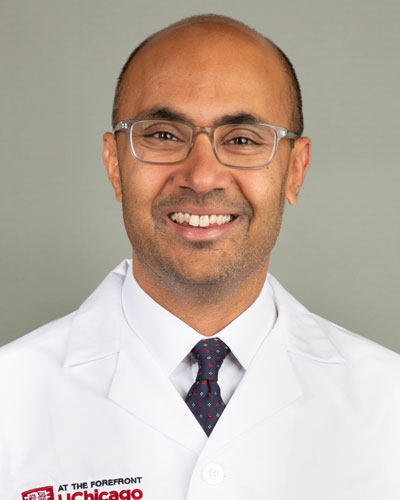 Nishant Agrawal, M.D.
We checked in with Nishant Agrawal, chief of otolaryngology–head and neck surgery, professor of surgery, and director of head and neck surgical oncology at the University of Chicago Medicine. Agrawal completed his residency in otolaryngology–head and neck surgery at Johns Hopkins in 2007, and was a faculty member in the department between 2009 and 2015.
Tell us about what you’re doing at the University of Chicago.
My clinical practice focuses on advanced head and neck surgical oncology. My research program is centered on translational head and neck cancer biology, including cancer genetics, mechanisms of progression from pre-cancer to invasive cancer, mechanisms of immune resistance and biomarker development. A major area of interest is the use of liquid biopsy and HPV DNA to deescalate or escalate treatment for HPV-associated oropharyngeal squamous cell carcinoma and salivary diagnostics to enable earlier detection of oral cancer and pre-cancer.
Talk to us about how your training at Johns Hopkins shaped the direction of your career.
My schooling, training and early career at Johns Hopkins were foundational in shaping both my clinical rigor and academic mindset. The culture of intellectual curiosity, scientific discipline, translational science, and uncompromising excellence and mentorship from extraordinary giants such as Bert Vogelstein, Charles Cummings and Lloyd Minor instilled in me the importance of asking meaningful questions and pursuing answers that can directly improve patient outcomes. Hopkins provided an environment where surgery and science were seamlessly integrated, which strongly influenced my decision to pursue a career that combines high-level clinical care with translational research and academic leadership.
You were on faculty for 6 years. What was the one accomplishment that you are most proud of during that time?
During my years on faculty at Hopkins, I am most proud of our team-science efforts that defined the mutational landscape of many types of head and neck cancers and laid the foundation for liquid biopsies when they were still just in the conceptual stages.
Finally, we’d like to know how your time at Johns Hopkins influences your work today.
Hopkins continues to influence my life and work every day. The standards I hold for patient care, scientific integrity, mentorship and institutional stewardship are deeply rooted in my Hopkins experience. I continue to strive to maintain an environment of rigor, curiosity and generosity that empowers patients, students, trainees and faculty. My time at Hopkins was deeply fulfilling, formative and memorable. My years at Hopkins remain some of the most meaningful chapters in my life.
For Clinicians Clinical Connection
Clinicians, discover the latest in research and clinical innovation from Johns Hopkins experts. Access educational videos, articles, CME courses and other resources from our world-renowned institution.