
With Patients Every Step of the Way
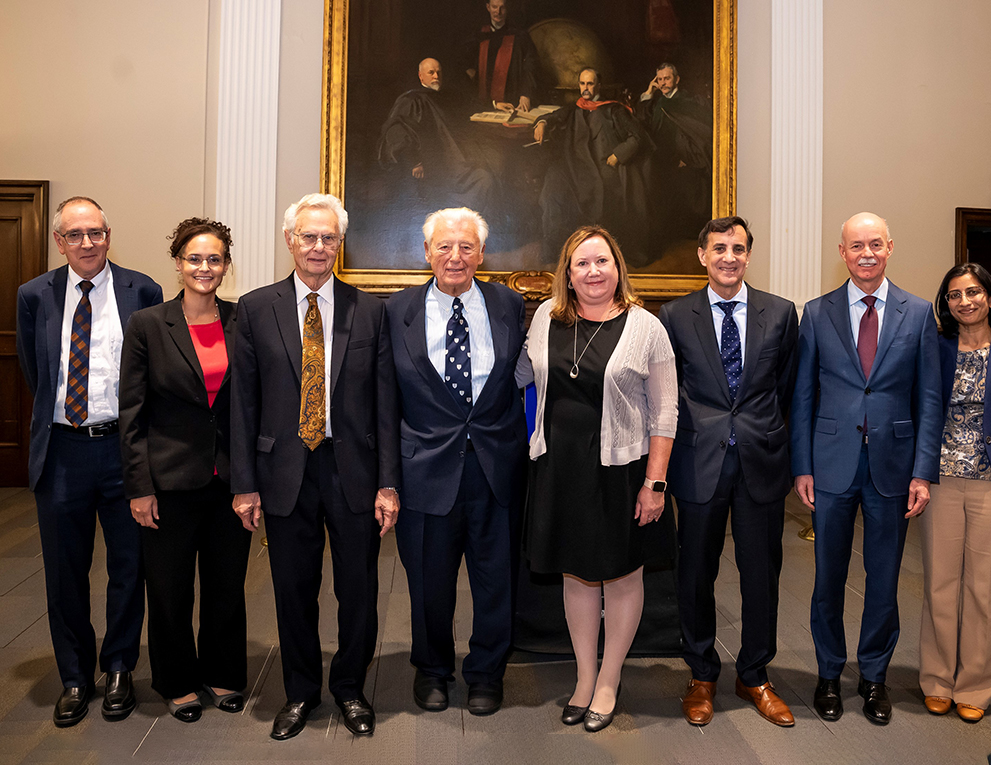
(From left to right) Antony Rosen, MBChB, Nadia Hansel, M.D., Mike Weisfeldt, M.D., Thomas Zizic, M.D., Laura Hummers, M.D., Ronald J. Daniels, Theodore L. DeWeese, M.D., Ami Shah, M.D.
Laura Hummers, M.D., had just started her Johns Hopkins rheumatology fellowship in 2000 and was rotating through the Rheumatology Clinic at Good Samaritan Hospital when she noticed a packed waiting room across the hallway, day after day.
She soon learned it was the private rheumatology practice of Johns Hopkins-educated and Johns Hopkins-trained Thomas Zizic, M.D., and partner Peter Holt, M.D. “They were absolutely beloved by their patients,” recalls Hummers. “Patients knew they would have to wait but when they got in to see them, both would take all the time they needed to care for them. It was such an amazing example of just how important it is to devote time and form long-lasting relationships with our patients,” Hummers says.
Zizic, now retired and looking back over a wide-reaching career in rheumatology, remains committed to the ideal that guided his work as a clinician-researcher since he himself was a fellow in the early 1970s.
“Patients with rheumatic disorders frequently have systemic disease that can impact any organ in the body — the kidneys, heart, skin, eyes, liver, muscles, pancreas — and not always at the same time,” says Zizic. “It takes you two to three times as long to see a patient properly as it does for an internist, but the reimbursement is the same. We have got to change the system so that physicians get rewarded for the quality of care they provide, rather than the quantity of patients they see.”
In 2024, Zizic took an important step in leading that change by establishing the Thomas M. Zizic, M.D., Professorship in Rheumatology and Immunology. “It’s just as difficult in the academic setting to see patients properly as it is in private practice,” he says. “I felt that if I could support one person’s salary, then they could devote the time they needed to their research and teaching while also providing outstanding patient care.”
Hummers, clinical director of the Division of Rheumatology and co-director of the Johns Hopkins Scleroderma Center, is the inaugural holder of the Zizic professorship. “I am incredibly grateful and honored to be associated with Dr. Zizic, a man who really helped change the face of rheumatology at Johns Hopkins,” she says.
Experiments That Paid Off Big
Zizic’s roots at Johns Hopkins are both deep and broad. A proud member of the school of medicine class of 1965, he remained at Johns Hopkins for his internship and Osler residency in internal medicine. Then, after a two-year stint with the U.S. Air Force School of Aerospace Medicine in Texas, he returned in 1969 as a fellow under renowned rheumatologist Mary Betty Stevens, M.D. He was appointed to the faculty as an instructor and after promotions to assistant and associate professor he left Johns Hopkins in 1984 to go into private practice, remaining an adjunct faculty member throughout his career.
Two important “experiments” indelibly shaped his early years at Johns Hopkins, Zizic says. The first was in medical school, when administrators aimed to address a “cutthroat culture” by recruiting students with well-rounded interests (Zizic was a competitive undergraduate swimmer at the University of Wisconsin) and by moving away from publishing grades.
“It was no longer about competition; we all wanted to help each other become the best doctors we could be,” Zizic says. “To this day, so many of us stay in touch because we truly care about each other. The experience was life-changing in terms of our entrance to medicine — about how we thought about the career we were embarking upon.”
Classmate Myron “Mike” Weisfeldt, M.D., an influential cardiologist who enjoyed a long career at Johns Hopkins, concurs. “There was a spirit to our class that was distinctive,” says Weisfeldt, who chaired the Johns Hopkins Department of Medicine from 2001 to 2014. “There were so many ‘greats’ who went on to lead in medicine. Tom Zizic is one of them, distinguishing himself as a rheumatologist and entrepreneur.”
Zizic notes that the second seminal experiment was due to the vision of his mentor Stevens, chair of the rheumatology division, who was the first woman to be appointed a division chief in the Department of Medicine. Her advances dramatically improved care of people with lupus, arthritis and other connective tissue diseases.
Together Stevens and Zizic conceived of a Rheumatic Disease Unit that was based on the second floor of Good Samaritan Hospital in northeast Baltimore. “Mary Betty recognized that all of internal medicine revolves around rheumatology,” says Zizic, so the unit cared for patients admitted for a wide range of conditions, whether it was the need for a new diagnosis; being in the throes of a rheumatic disease flare; experiencing pneumonia or congestive heart failure; or undergoing hip or knee replacements.
What’s more, to help prepare new doctors to see the connections between internal medicine and rheumatologic disease, the duo created a “sub-intern” position, for senior students who had finished their medicine clerkship and wanted to prepare for an internship in internal medicine. “It proved so popular that by the second year we had to move to a lottery system because there were so many volunteers. Then we expanded the program further,” recalls Zizic.
The Rheumatic Disease Unit experienced significant growth, expanding to serve patients from both Johns Hopkins and University of Maryland. Zizic and Stevens became full-time faculty members at both institutions, with Zizic serving as associate director of the unit. “We grew from one 36-bed unit to two 36-bed units, training 10 to 12 students and residents,” he says.
I felt that if I could support one person’s salary then they could devote the time they needed to their research and teaching while also providing outstanding patient care.
Thomas Zizic, M.D.
Extending the Legacy of Clinical Research
Zizic recalls that period in the 1970s and early 1980s as a fertile opportunity for clinical research. “Because you had a large concentration of patients with rheumatic diseases all in one place, we could find associations between diseases that we would otherwise not be able to appreciate,” he says.
Zizic’s collaborations with Johns Hopkins orthopedic surgeon David Hungerford, M.D., were particularly fruitful. The duo published influential studies on osteonecrosis, showing that reducing steroid levels when treating patients with rheumatic disease such as lupus could prevent the development of bone tissue death. Another collaboration resulted in Zizic and colleagues identifying mesenteric arteritis as a frequent cause of death in lupus. “Once we became aware of the clinical and laboratory manifestations (e.g., thrombocytopenia and rheumatoid factor), we were able to diagnose the condition earlier and implement more aggressive therapy so that these patients rarely had a fatal outcome,” he notes.
As a leading rheumatologist who was there to witness the launch of rheumatology as a specialty at Johns Hopkins in the early 1970s, Zizic is proud of the past while also excited about the future of the field.
Through the Zizic Professorship in Rheumatology and Immunology, he aims to ensure that the legacy of his beloved mentor Mary Betty Stevens can continue through the work of Hummers, who is deeply committed to improving patient treatments and is a major force in her own right. A nationally and internationally recognized thought leader in the scleroderma community, she is a prolific scholar focused on scleroderma disease manifestations, its mimics (particularly scleromyxedema), and state-of-the-art therapeutics.
As co-director of the Johns Hopkins Scleroderma Center, Hummers manages a large clinical practice, seeing patients two days a week and participating in a range of clinical trials and clinical investigations in scleroderma. Hummers also co-directs the Scleroderma Precision Medicine Center of Excellence, where she works with colleagues to develop modeling techniques to identify predictors of the disease and increase patient understanding and advocacy in treatment.
“My passion lies in caring for patients and doing meaningful work in scleroderma research to improve the lives of our patients,” says Hummers.
She continues, “As clinical director of the Division of Rheumatology, I see my main job as minimizing the ‘noise’ for our faculty and patients — growing complexities involving insurance requirements, electronic medical record-keeping, financial pressures — to preserve what has always been fundamentally important: focusing on longitudinal care, being with our patients every step of the way, to gain a better understanding of their disease and how it develops, and ultimately to improve care.”
For Clinicians Clinical Connection
Clinicians, discover the latest in research and clinical innovation from Johns Hopkins experts. Access educational videos, articles, CME courses and other resources from our world-renowned institution.