
The Fight of His Life
An amateur boxer, John Paredes was used to shielding himself from blows to the face. But nothing prepared him for an injury he sustained while lifting weights at the gym.
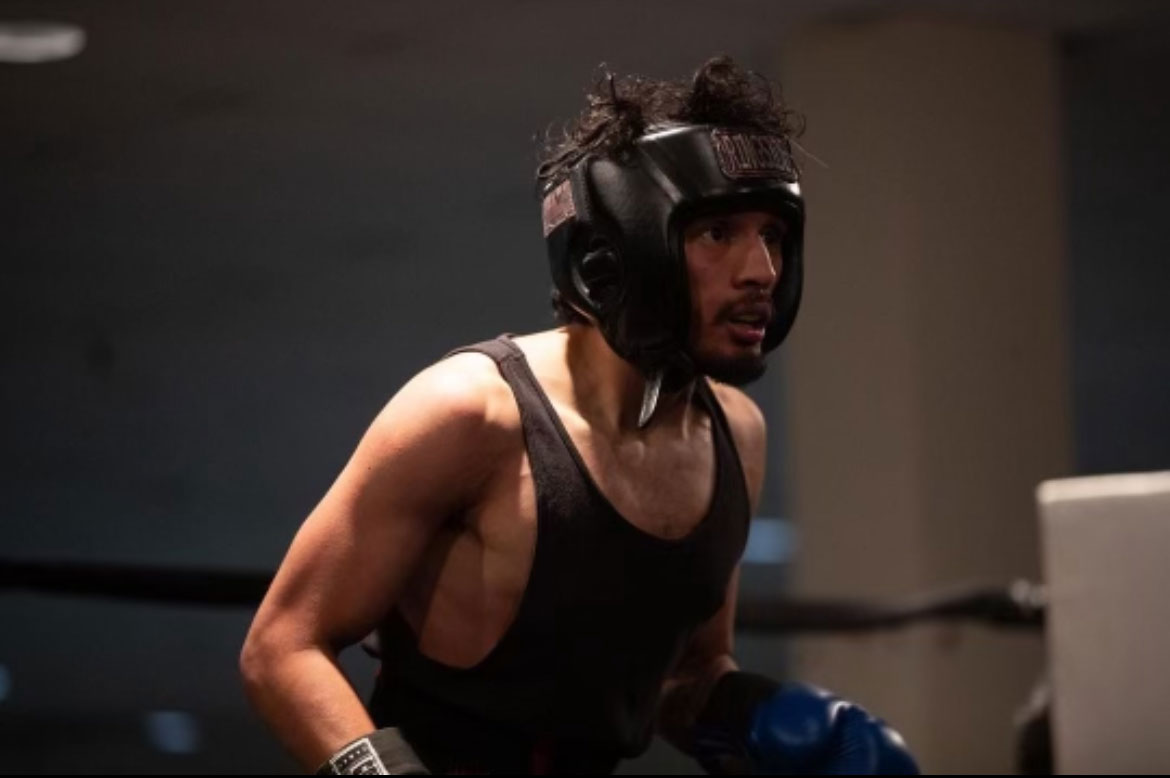
John Paredes
An amateur boxer, 23-year-old John Paredes was used to shielding himself from blows to the face. But nothing prepared him for the injury he sustained one day in February 2024, while lifting weights at the gym. He was doing arm extensions, which involved pulling up on a weight attached to the floor by a carabiner. His arm was fully extended when the carabiner suddenly detached from the floor. Like a slingshot, the lanyard hit him in the eye.
The pain was unbearable. Paredes’ vision was blurry, and he couldn’t open his eye completely. He drove himself to an urgent care clinic, where an exam revealed a cut below his eye and some blood in the eye, but no fractures of the orbital bone surrounding the eye. He was given medication for the pain and sent home. He remembers thinking, “Okay, I’m hurt, maybe it will take some time to heal, but no bones are broken.”
An IT tech, Paredes tried to work, but the pain continued to worsen. He sought care at an eye care center in his community, where he was found to have elevated eye pressure. The doctor prescribed eye drops to lower the pressure, but when it continued to rise, he was referred to the Johns Hopkins emergency department for complex subspecialty ophthalmologic care.
Paredes was examined by Omar Halawa, M.D., then a third-year ophthalmology resident at the Wilmer Eye Institute, who found Paredes’ eye pressures to be extremely elevated, up to 60 mmHg (normal eye pressure is around 20 mmHg or less). He also had damage to the drainage channels of the eye, inflammation and bleeding in the eye and damage to the delicate structures that hold the eye’s natural lens in place.
As glaucoma fellow Nur Cardakli, M.D., explains, “When the balance of fluid production and fluid drainage is disrupted, eye pressure can become elevated, and when the elevated eye pressures cause damage to the optic nerve, glaucoma occurs.”
Halawa prescribed several rounds of topical eye drops as well as intravenous medications to bring down Paredes’ eye pressure, but the pressures continued to be uncontrolled — and he still couldn’t see out of the injured eye.
At the time of his injury, he had been preparing for the Golden Gloves tournament, one of the biggest contests for amateur boxers. Now, not only were his hopes of competing threatened, but his eyesight was threatened as well.
Halawa conferred with Cardakli, then a fourth-year ophthalmology resident, who recommended emergency glaucoma surgery to relieve the pressure and prevent irreversible vision loss. Given Paredes’ young age and the concern for damage to the lens structures, he underwent combined retina and glaucoma surgery at Wilmer’s Bendann Surgical Pavilion. First, retina specialist Jacob Light, M.D., a Stephen J. Ryan Assistant Chief of Service, performed a vitrectomy, removing the damaged lens and the vitreous jelly in the back of the eye to make space for a glaucoma implant. Then Cardakli, working with Stephen J. Ryan Assistant Chief of Service Jasdeep Sabharwal, M.D., Ph.D., inserted the implant to improve fluid drainage and help keep Paredes’ eye pressure controlled for the long term.
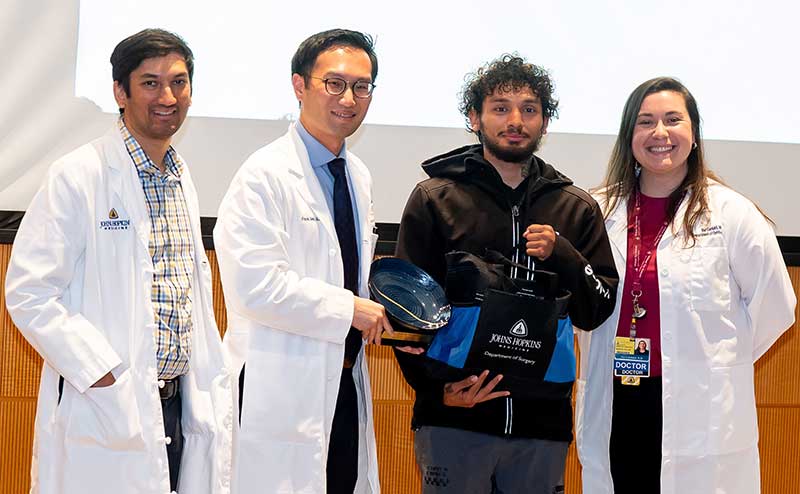 John Paredes, third from left, with Anupam Garg, Frank Mei and Nur Cardakli at the Johns Hopkins Trauma Survivors Day celebration, May 21, 2025.
The day after the surgery, Paredes’ eye pressure was well controlled, to the point of not requiring eye drops or oral medications. The ophthalmology team was then challenged with the next task — implanting an intraocular lens in Paredes’ right eye to help him see more clearly. “Without a lens to focus images on the retina, vision is extremely blurry,” says Cardakli.
After giving sufficient time for healing after the first surgery, measurements were obtained to decide the best possible lens to implant into Paredes’ eye. Because the lens structures that ophthalmologists typically rely on to secure the lens implant in place were damaged by the original injury, Light sutured a special type of lens implant to the sclera, or the eye wall.
Within a month, Paredes’ vision had returned to what it had been before his injury.
Cardakli recently re-evaluated Paredes in the clinic, where his eye pressures remain well-controlled. Importantly, testing showed no evidence of damage from the high pressure to the optic nerve — a testament to the prompt intervention and complex care coordination he received at Wilmer.
In spring 2025, Paredes was able to return to boxing, competing in the Golden Gloves competition he’d been preparing for when the accident happened. He made it to the championship, and it was, he says proudly, a close fight: “I didn’t win, but the fact that I was able to box is a miracle.”
For Clinicians Clinical Connection
Clinicians, discover the latest in research and clinical innovation from Johns Hopkins experts. Access educational videos, articles, CME courses and other resources from our world-renowned institution.