
Radiogenomics in Action: Advancing Glioblastoma Imaging and Diagnosis
Glioblastoma is one of the most aggressive and treatment-resistant brain cancers, often recurring despite surgery, radiation, and chemotherapy. To better understand and ultimately predict its behavior, Shanshan Jiang, associate professor in the Division of Magnetic Resonance (MR) Research, is using an advanced magnetic resonance imaging (MRI) technique called amide proton transfer (APT) imaging.
Unlike conventional MRI, which primarily shows anatomy, APT-MRI captures molecular-level information by detecting the natural exchange of protons between water and mobile proteins in the brain. This capability allows Jiang and her team to visualize biochemical changes within tumors, providing a direct readout of the tumor’s protein concentrations — a window into its biology rather than just its structure.
Johns Hopkins scientists originally invented APT-MRI, and Jiang has been instrumental in applying it to patient care. Since clinical use began around 2010, her group has collected over 500 patient scans, building one of the largest and most detailed APT-MRI datasets to date. “By connecting what we see on imaging to the tumor’s molecular makeup, we hope to better understand and predict its behavior,” Jiang explains.
Through a radiogenomic approach, her team integrates APT-MRI with genomic sequencing to identify imaging patterns linked to tumor genetics (Ref. 1). These insights could help clinicians predict whether a patient’s tumor is likely to recur and how soon. “If we can forecast recurrence even a few months earlier, it gives doctors time to prepare and families time to plan,” Jiang said.
Her research also aims to guide therapy selection by revealing which tumors are responding to treatment and which are developing resistance (Ref. 2). This kind of predictive imaging could help clinicians adjust treatment in real time, improving outcomes and reducing unnecessary interventions.
Working closely with clinicians in the departments of neurosurgery and neurology, Jiang is advancing these imaging tools to support clinical decision-making in neuro-oncology. Her long-term vision is to move imaging beyond simple visualization, transforming it into a predictive, molecular-level tool that helps personalize brain cancer care for every patient.
Jiang’s academic journey reflects this multidisciplinary focus. With a Ph.D. in biomedical imaging, she has built her career at the intersection of molecular biology, imaging physics and clinical application. Her work brings together the precision of imaging science and the depth of molecular research to create new diagnostic possibilities for patients with brain cancer. Today, her research in radiogenomics exemplifies how Johns Hopkins researchers are bridging basic science with patient-centered innovation.
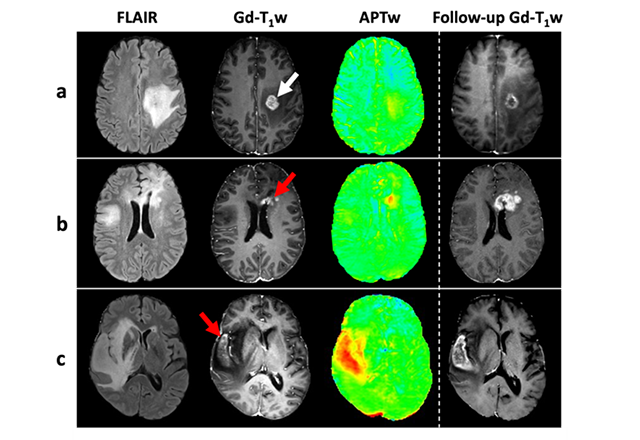
- Jiang et al. NMR in Biomedicine (2023) 36 (6), e4731.
- Jiang et al. Clinical Cancer Research (2019) 25 (2): 552–561.
For Clinicians Clinical Connection
Clinicians, discover the latest in research and clinical innovation from Johns Hopkins experts. Access educational videos, articles, CME courses and other resources from our world-renowned institution.