
A Pinnacle in Residency Training
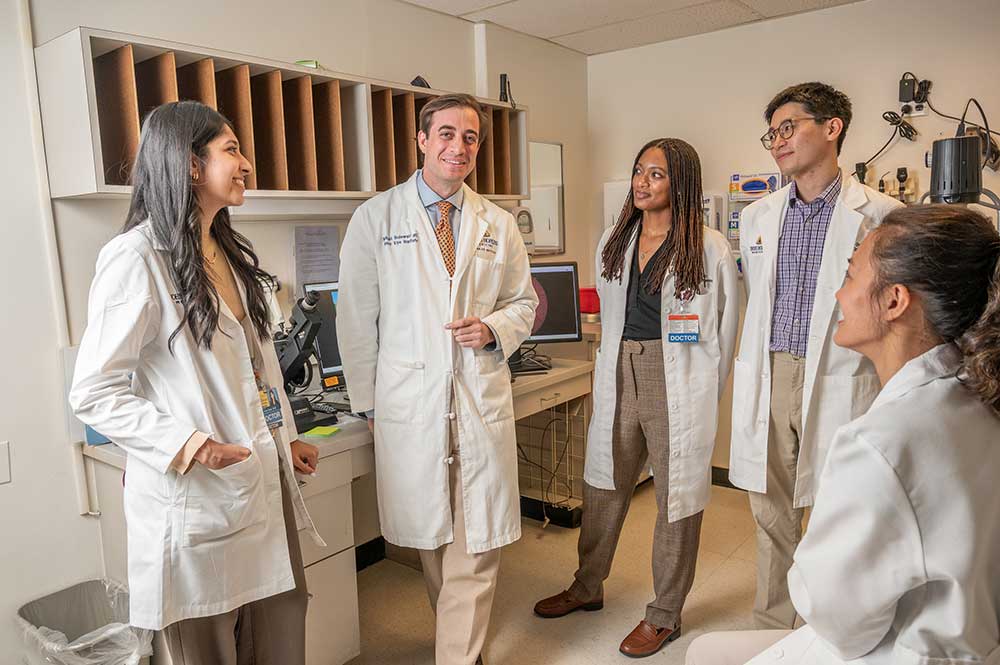
Michael Sulewski, second from left, with residents Yesha Shah, Khala Webb, Nathan Pan-Doh and Maggie Hsu
Since 1925, the Wilmer Eye Institute Residency Program has been one of the world’s foremost training grounds for aspiring ophthalmologists. Last year, there were 650 applicants for just six positions. And the program’s graduates — among them recipients of prestigious research awards such as the Lasker Award; American Academy of Ophthalmology presidents; and chairs of ophthalmology departments around the country — have always been among the top educators, researchers and physicians in the field.
Looking ahead to the next 100 years, program leaders plan to redouble their efforts, says Michael Sulewski Jr., M.D., the James P. Gills, Jr. and Heather Gills Rising Professor of Ophthalmology who in 2025 became the residency program’s new director.
“It’s a great honor,” says Sulewski. “I have always loved teaching — training the next generation is one of the most important things we do. It makes it even more enjoyable that our residency program is valued and cherished by all of our Wilmer faculty. We plan to continue to expand the program, be the top choice for future academic leaders and improve the tools we provide to ensure their success.”
Sulewski had already been serving as associate residency program director when he was tapped to succeed his mentor, Fasika Woreta, M.D., M.P.H., the Eugene de Juan, Jr., M.D. Professor of Ophthalmic Education, who has now been named vice chair for education. In that role, she is involved in overseeing all of Wilmer’s trainees, from medical students to residents to fellows.
In 2021, Sulewski and his father, Michael Sulewski, Sr., M.D., himself a renowned educator and ophthalmologist who completed his fellowship at Wilmer, both won the resident surgical teaching awards at their respective institutions, Sulewski at Wilmer and his father at Scheie Eye Institute, University of Pennsylvania.
“Michael clearly inherited his father’s gift for teaching — he is just naturally gifted at it — and having someone of his caliber ready to step into this role really made it easy for me to transition to my new role,” says Woreta, a beloved and dynamic educator who during her six years as director (plus five years before that as associate program director) helped implement a host of exciting innovations, from the use of ever-improving technology that allows residents to perform simulated surgeries before operating on patients to the addition last year of a new research-focused residency position.
“Under the leadership of glaucoma division chief Pradeep Ramulu, M.D., Ph.D., the Sheila K. West Professor of Ophthalmology, we were able to secure National Eye Institute funding for the StARR (Stimulating Access to Research in Residency) program, which enables a resident to take a dedicated year for mentored research to help launch their career as a physician-scientist,” Woreta says. “In doing so we expanded the number of our residents from five to six each year, which is really important because of the busy clinical load of our residency.”
Wilmer residents serve as frontline physicians in one of the busiest fully resident-staffed eye clinics in the country, the Patient Access Center for the Eye (PACE). “The experience is invaluable as residents advocate for patients with the most advanced eye disease and provide world-class care in our surrounding East Baltimore community,” Woreta says, adding, “Over the past decade, we’ve seen a lot of changes, including a permanent PACE director and more hands-on faculty involvement.”
More residents are also presenting their research findings at national meetings, as well as working as patient advocates, whether it be advocating on their behalf in the PACE clinic or lobbying on Capitol Hill during the American Academy of Ophthalmology’s Mid-Year Forum every spring in Washington, D.C. “I am so proud of what they are achieving,” she says.
Woreta is especially delighted by what she describes as a “cultural evolution at Wilmer” under the leadership of Peter J. McDonnell, M.D., the Alan and Marlene Norton Director of the Wilmer Eye Institute and the William Holland Wilmer Professor of Ophthalmology — one that rewards faculty who are passionate and talented educators, as exemplified by the School of Medicine’s new clinician educator track and a new emphasis at Wilmer on recruiting physician educators. Both Sulewski and Woreta themselves hold endowed professorships supported by former Wilmer physicians who were gifted teachers and were passionate about the institute’s educational mission.
“Our faculty has always put trainees first,” she says. “I can’t tell you how gratifying it is to be part of that tradition.”
Woreta also points to an expanded education infrastructure, as exemplified by her own new job as Wilmer’s vice chair for education (a position created in the past decade), plus two new associate residency program directors, assistant professors of ophthalmology Isa Mohammed, M.D., and Edward Kuwera, M.D., as well as education champions in every division. They are all prepared to support Sulewski in his new role.
“We recruited Michael in 2020 because of his passion for surgical education,” Woreta says. “And after just a few months, all of us knew, residents and faculty alike, that he was not only an exceptional surgeon but a gifted educator. He is already bringing new energy and ideas to the residency program. It’s an exciting time for Wilmer residents and for education at Wilmer.”