
New Promise in Spinal Muscular Atrophy

Two recent studies led by Children’s Center researchers offer new hope for children with spinal muscular atrophy (SMA), one of the most common genetic neuromuscular disorders. Though SMA affects individuals of all ages, most are weak from infancy or early childhood.
The first study found that children with SMA could regain muscle with the help of a new monoclonal antibody treatment. The second showed that gene therapy treatments delivered in utero via amniotic fluid injection could improve treatment outcomes for patients with SMA.
The new antibody treatment builds upon findings from Johns Hopkins researchers led by Se-Jin Led in 1997 that discovered myostatin, a hormone that regulates muscle mass. In the recent work, a team led by pediatric neurologist Thomas Crawford investigated whether apitegromab — a monoclonal antibody shown in a proof-of-concept study to alter myostatin — could safely improve muscle function in a large study of patients with SMA.
There is significant interest in determining how we might utilize emerging genetic therapies in utero because there are many very severe diseases that start very, very early. This work really opens up the idea that you can use ASOs for SMA, but also for lots of other disease indications with in utero onset.
Charlotte Sumner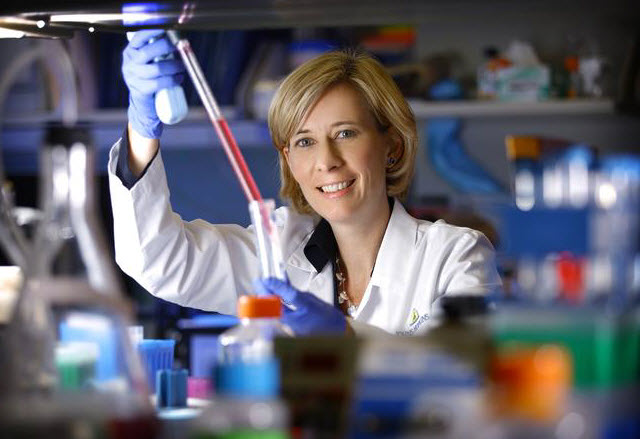
At 12 months, the research team says participants receiving apitegromab showed statistically significant and potentially clinically meaningful improvements in motor function compared with participants receiving the placebo.
“Based on our findings, apitegromab has the potential to positively impact people with SMA, particularly those with weakened muscles who are unable to walk, allowing them to build muscle again and improve quality of life,” says Crawford, whose team published their findings in Lancet Neurology.
The gene therapy study, co-authored by Charlotte Sumner, professor of neurology, neuroscience and genetic medicine at the Johns Hopkins University School of Medicine, finds that prenatal amniotic injections of gene therapies known as antisense oligonucleotides (ASOs) improve outcomes in two mouse models of severe SMA.
Furthermore, ASOs delivered in this manner showed broad distribution to the brain and spinal cord of fetal lambs, which are similar to humans in their fetal physiology. ASOs are a class of gene therapies that bind to and change messenger RNAs to alter their processing.
The implications are vast, says Sumner, both for treatment of SMA and for other neurologic diseases with onset before or at birth.
“There is significant interest in determining how we might utilize emerging genetic therapies in utero because there are many very severe diseases that start very, very early,” she says. “This work really opens up the idea that you can use ASOs for SMA, but also for lots of other disease indications with in utero onset.” The findings appear in Science Translational Medicine.
The next step, Sumner says, is finding the right ASO for a clinical trial. The ASO currently used for patients with SMA was approved nearly 10 years ago. “We would envision that a new-generation ASO would be more appropriate for testing in utero,” she says.