
Innovating Cancer Care Through Pre-Targeting Therapy
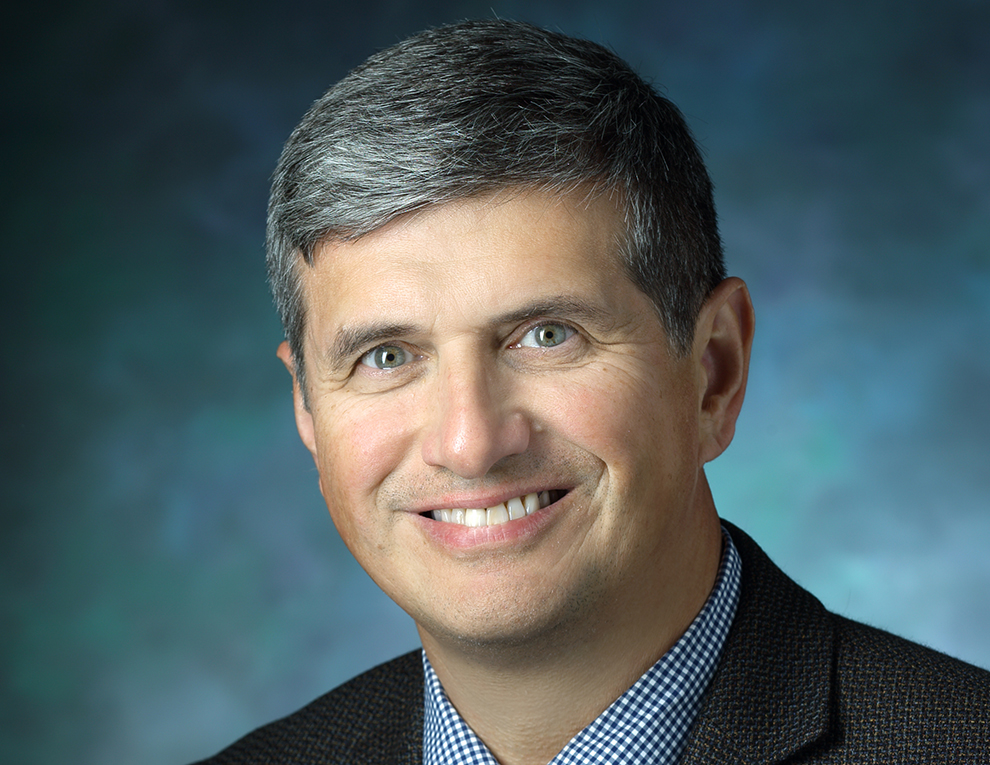
Dmitri Artemov, professor in the Division of Cancer Imaging Research, has spent his career at the intersection of physics, molecular imaging and oncology, developing technologies that make cancer treatments more precise, personalized, and safe.
His latest project, known as pre-targeting therapy, takes a novel approach to drug delivery by separating the “targeting” and “treatment” phases to minimize side effects and maximize accuracy.
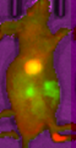 Registration of Sacituzumab (red) and NK cell (green) distribution by in vivo fluorescence imaging. Yellow indicates colocalization between the channels in the tumor.
The process begins when a nontoxic antibody is injected to seek out and bind to cancer cells. Once that targeting step is complete, a second “effector” molecule such as a drug, immune cell, or therapeutic bacterium is administered. This molecule attaches only to the prepositioned antibodies on the tumor, leaving healthy tissue largely untouched. Using advanced imaging techniques like positron emission tomography (PET) scans, magnetic resonance imaging (MRI), and single-photon emission computerized tomography tests (SPECT), Artemov and his team can visualize this interaction in real time, monitoring exactly how and where the treatment is working.
Currently in the preclinical stage, his group is testing the strategy on HER-2–positive and triple-negative breast cancers, investigating HER-2 and TROP-2 receptors as promising molecular targets. The researchers are also expanding their approach to include aggressive prostate cancer models. “The idea is to separate targeting from therapy, making treatment more precise and much less toxic,” Artemov said. “Our ultimate goal is to create therapies that are not only highly effective, but also significantly less harmful to patients.”
Collaboration is central to his success. Artemov credits Sudath Hapuarachchige, assistant professor of Radiology and Radiological Science within the Division of Cancer Imaging Research, as a key collaborator in refining and validating preclinical models.
The project is supported by the U.S. Army Congressionally Directed Medical Research Breast Cancer Research Program and Swim Across America, which have been instrumental in advancing the work toward potential clinical application.
Beyond this project, Artemov serves as associate director of the Cancer Functional Imaging Core at the Sidney Kimmel Comprehensive Cancer Center. His lab focuses on molecular imaging innovations, including dual-contrast MRI for tracking drug release, angiogenic PET tracers for tumor vascular mapping, and “click therapy,” a concept that combines multi-component targeting with image guidance for precision drug delivery.
Trained in molecular physics at Moscow State University and holding a Ph.D. in physics and mathematics from the Russian Academy of Sciences, Artemov later completed an Humboldt Research Fellowship in MR imaging at the University of Würzburg and postdoctoral training at Johns Hopkins. After joining Johns Hopkins as a radiology department instructor in 1997, he earned an M.S. in biotechnology and went on to pioneer imaging methods that now support translational research across the Division of Cancer Imaging Research.
 a) Biodistribution of [89Zr]Trastuzumab-TCO in mouse tumor models. b) Co-registered PET-MRI images at 28 h after injection of [89Zr]Tz-TCO. c)-d) 3D PET-MR volume-rendered fused images.
A fellow of the International Society for Magnetic Resonance in Medicine and longtime member of the World Molecular Imaging Society, Artemov embodies the collaborative, cross-disciplinary innovation that defines Johns Hopkins Radiology and Radiological Science. Through his work, the future of cancer therapy is not only more advanced but also more compassionate.
For Clinicians Clinical Connection
Clinicians, discover the latest in research and clinical innovation from Johns Hopkins experts. Access educational videos, articles, CME courses and other resources from our world-renowned institution.