
‘He’s Hearing Us’: Life-Altering Technology brings Gabe his first sounds
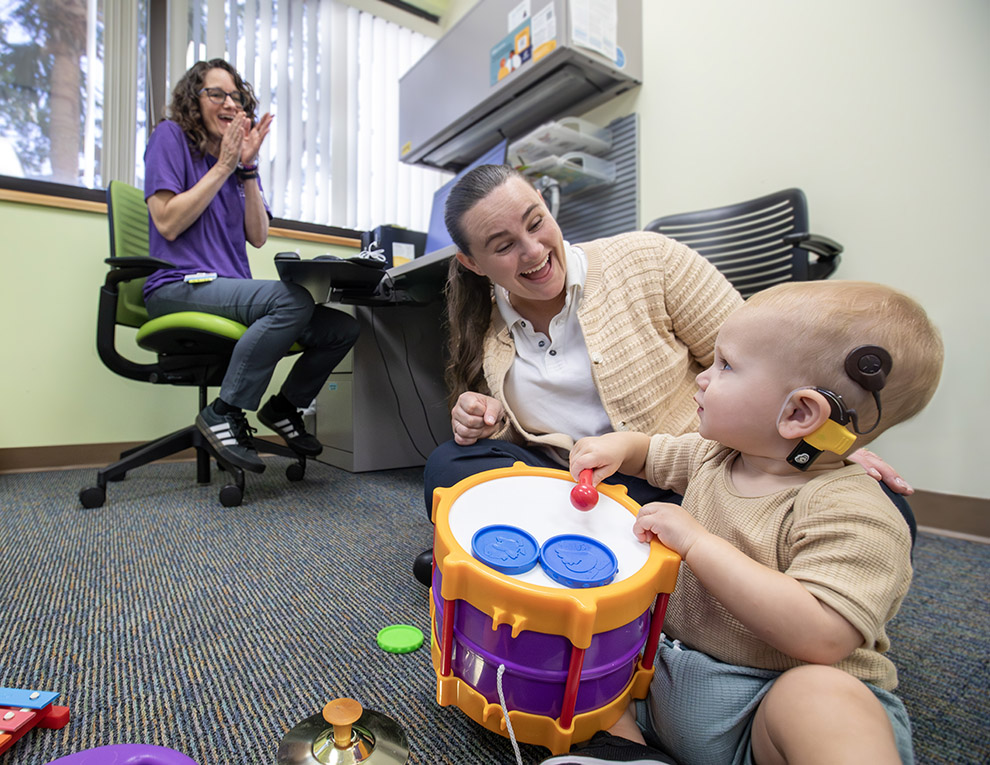
Courtney wipes back tears. Her husband, Elia, beams with pride. Their 13-month-old son, Gabriel, just heard sound for the very first time. He scrunches up his nose and looks around trying to figure out where those high-pitched beeps are coming from. “This is literally the first time we've ever seen him react to sound. It’s the first time ever. It’s emotional,” Courtney says as tears streak down her cheeks. A year of hearing tests, hearing aids and audiology appointments have all led up to this moment: cochlear stimulation day.
Gabriel smiles and coos as he plays with a drum and xylophone for the first time. Moments later, he’s bouncing to the beat as Elia enthusiastically bangs a drum with both hands. The proud dad laughs, experiencing a moment with his son he didn’t know would ever be possible. “I'm so excited,” Elia says. “It's just unbelievable.”
In October, doctors surgically placed cochlear implants behind Gabe’s ears. The implants work by sending sound past the damaged parts of the ear straight to the cochlear nerve. Cochlear implants pair with a sound processor that fits behind the ear and pulls in outside sound. It then sends sound signals to a receiver that is placed under the skin behind each ear.
Cutting-Edge Care
For Gabe, it’s a game changer. He was born profoundly deaf, and hearing aids didn’t seem to allow him to hear the world around him. Pediatric audiologist Teri Deniro, Au.D., at the Johns Hopkins All Children’s Outpatient Care Center in Sarasota, was the first in the hospital’s audiology team to meet Gabe and his family. “When I first saw him as an itty-bitty baby, he was not hearing anything,” she explains. “He's never really had great responses with the hearing aids, so seeing his reaction and look of wonder as the cochlear implants were turned on was adorable. Seeing his parents take that deep breath and go, ‘OK, he's hearing,’ is such a wonderful feeling.”
A team of professionals led Gabe and his parents to this day. A successful cochlear implant takes a team approach: audiology, ear nose and throat specialists, speech language pathologists, imaging teams and surgeons. “So many people played a role in making sure that Gabriel could hear,” Deniro adds. “He still has a long road ahead of him with other therapies, like speech therapy, so he can learn to listen and learn to hear, but Gabe is going to be amazing. He already is amazing.”
“It’s fun to watch them have access to the world around them in ways they wouldn’t have … hearing their parents’ voices for the first time, realizing toys or instruments make noise and that they can make noises too,” audiologist Sybil Faylo, Au.D., CCC-A explains. “He stared at my face when my mouth was moving because I think that was probably the first time he connected the mouth moving with sound. That’s really exciting to see.”
An Ear on the Future
Courtney and Elia have a lot they’re now looking forward to. They hope Gabe plays soccer one day, just like his dad. They hope he learns to speak English and Arabic, to be able to communicate with both sides of their families. First: reading to their son. “The whole pregnancy Courtney was reading to Gabe when he was inside her belly. When we found out he was profoundly deaf, she thought, ‘Oh, no, it was for no reason, he couldn’t hear me,’” Elia explains. “But now, it’s time.”
“I have so many books,” Courtney adds. “I keep buying books,” she says with a laugh.
Gabe and his parents attend weekly Listening and Spoken Language sessions at the Sarasota outpatient location with Beth Reckord, M.S., CCC-SLP, LSLS Cert. AVT. Through these sessions, Gabe’s parents are helping him develop listening, speech and language skills, which follow expected developmental milestones. “She’s amazing. She’s the best,” Courtney explains. “It really felt like since day one, we’ve had a big team supporting us, behind us every step of the way.”
Gabe also took part in Here to Hear sessions, launched in Sarasota, which brings together families with young children (under age 3) who use hearing amplification devices, allowing parents and kids to learn and connect in a supportive environment.
Advancements In Audiology
Faylo often reflects on how far audiology has come in her 24 years at Johns Hopkins All Children’s Hospital, the #1-ranked children’s hospital in Florida the past three years by U.S. News & World Report and the only nationally ranked pediatric hospital in the Tampa Bay region. “I have a little treasure trove of our old equipment. When we started, Gabe would have been wearing a big device in a harness with a cord that goes up to his ear, plus the hearing aid looking device, and the coil. Now, we’re at the point where there’s this tiny little processor on the ear,” she elaborates. “Forty years ago, it was a single channel implant replacing 30,000 neural connections in the ear. We now have many more channels and better signal processing, so with more access to sound the outcomes are outstanding.”
Cochlear implants have also become more user-friendly, allowing parents to use an app on their phone to control the sound processors, track hearing progress, and tap into resources to help build listening and communication skills.
Faylo says the most impactful thing for her is when she follows up with implanted patients who go on to play sports, thrive in school, and reach their professional and personal goals. “That part is incredibly rewarding. Just getting to be a small part of that process, and watching them grow and thrive,” she adds.
Who Qualifies for a Cochlear Implant?
Audiologists are often asked what makes a good candidate for a cochlear implant. Faylo says candidacy depends on many factors but has become more flexible as technology and outcomes research has advanced. Babies are typically around 12 months of age and have severe or profound hearing loss. Children unable to make expected gains with consistent speech therapy and hearing aid use may also qualify. Since hearing loss can be progressive, she adds, candidacy can change as a child ages.
It’s also important to be committed to therapy and follow-up appointments. Implants need to be programed, which audiologists do with the patient several times over the course of months after the stimulation as well as periodically throughout their lives. Aural habilitation helps children to learn and interpret the new sounds they’re hearing and is vital to success with cochlear implants.
Expanding into Apollo Beach
Johns Hopkins All Children’s Hospital is excited to offer audiology services in a new area of Tampa Bay starting in 2026. The hospital’s first location in Apollo Beach will be opening at 211 Harbor Village Lane, just off U.S. Highway 41and only a few minutes’ drive from Interstate 75. The location will include Speech and Audiology outpatient diagnostic and habilitation/rehabilitation services serving children from newborn to age 21. Areas of specialty will include feeding, speech and language development, reading, auditory processing, auditory brainstem response (without sedation), newborn hearing screenings, hearing and speech for children with hearing loss, hearing aid evaluations/fittings and repairs, and assistive and augmentative listening communication devices. The new care center will also have parent support groups, including Here to Hear.
Courtney is eager for other families to reach milestones with their children. “I hope sharing our story helps others not feel so alone. When you get a profoundly deaf diagnosis, your mind goes to the worst, like will I ever be able to communicate with my child? Will they ever hear my voice?” She recalls. “Then you learn to trust the process. We are so proud of our son and the team that is helping him to hear for the very first time.”