
AI Unlocked | See cancer sooner. Treat it smarter. Cure it faster.
Harnessing the Power and Setting the Vision for AI-Assisted Cancer Medicine
ADVANCES IN INFORMATION science and technology have created an astonishing capacity to gather, transfer, store and analyze large and diverse collections of data — measured in sizes exceeding the imagination. For cancer, these data include genetic information, imaging, laboratory results, pathology, patient-reported symptoms, patient histories, and physical examination findings.
Computing itself — the basic principles of how computers process information — hasn’t really changed since the invention of the computer. What has changed dramatically is the power, speed, and scale of modern computers. They can process vastly more data, at much higher speeds, and do it in parallel, shared platforms. This provides us the opportunity to analyze these enormous datasets in ways that were impossible just a decade ago.
Right now, more than 50 years of advances in computer processing power is intersecting with the data and discovery of more than 50 years of cancer research. The result, which we call artificial intelligence, or AI, has given rise to a learning health care system that incorporates innovation in real time to glean insights into cancer and its treatments, assess their impact seamlessly, and transform cancer medicine.
At the Johns Hopkins Kimmel Cancer Center, we are implementing AI with guardrails in place so that it improves research and patient care by augmenting and supporting — not replacing —our cancer experts. AI will help us decipher the complexities of cancer and advance and guide new therapies faster, safer, cheaper, and with far fewer resources.
Still, the ability to do this is not enough. We believe it is as important to do it correctly, realizing the promise of AI within a framework that respects the rights and dignity of patients, always incorporates physician judgement, delivers optimal care, avoids undue risks and burdens, and fosters better outcomes for all.
In this issue, you will read about progress already being made and our vision for the future. Through our collaborations with the Cancer AI Alliance, of which our Cancer Center is a founding member, our Convergence Institute, Johns Hopkins inHealth, the Johns Hopkins Data Science and AI Institute, the Institute for Data-Intensive Engineering and Science, and more, we are positioned to make revolutionary advances against cancer.
If today we have surpassed what could be accomplished only a decade ago, just imagine the promise the next decade holds.
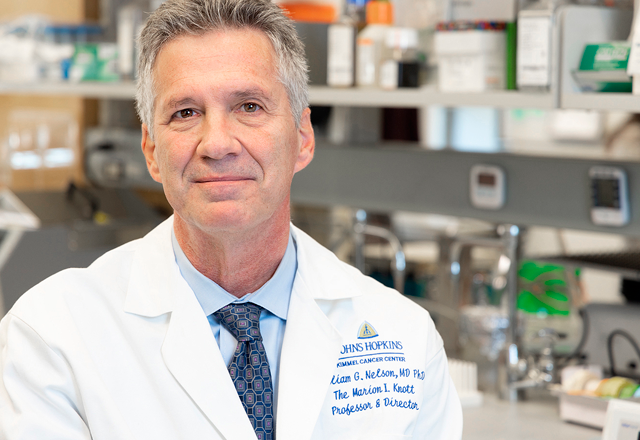
William G. Nelson, M.D., Ph.D.
The Marion I Knott Professor and Director
The Sidney Kimmel Comprehensive Cancer Center at Johns Hopkins