
Untangling a Nest of Neutrophils
Imagine a growing tumor, getting larger, and developing dying, necrotic regions. Such tumors usually result in a bad prognosis for people who have them. Scientists have long thought that a lack of nutrients and blood vessels feeding parts of the tumor plays a passive role in causing cancer cells in those areas to die off.
Sientists at Johns Hopkins Medicine, Cold Spring Harbor Laboratory and the Francis Crick Institute say they have found that poor vasculature and lack of nutrients in a tumor may not be the whole story.
“The most important thing we found is that tumor necrosis, which is associated with poor prognosis across the board of cancer types, is not a passive phenomenon that happens because aggressive tumors grow very quickly,” says Jose M. Adrover, Ph.D., who worked on this research at Cold Spring Harbor Laboratory and Johns Hopkins Medicine and is now at the Francis Crick Institute. “Necrosis is an active phenomenon driven by neutrophils that we can now target.”
Their new study of experiments in mice and tissue from people with triple negative breast cancer was published July 16 in Nature and funded, in part, by the National Institutes of Health and Johns Hopkins Giovanis Institute.
The study points to blood clots as the driver of a tumor’s necrotic regions. Such clots may also enable tumor cells to more quickly and easily break off from the main tumor and spread elsewhere.
At the center of the new study are neutrophils, the most common white blood cell in the immune system. They’re the first responders to infections or wounds. Neutrophils rapidly emerge from the blood stream and attack the invading infectious organisms, releasing so-called granula that are like mini hand grenades that cause tissue damage. Then, like a spider releases its web, neutrophils expel a tangled web of DNA coated with toxic compounds that covers a broad area of the infection.
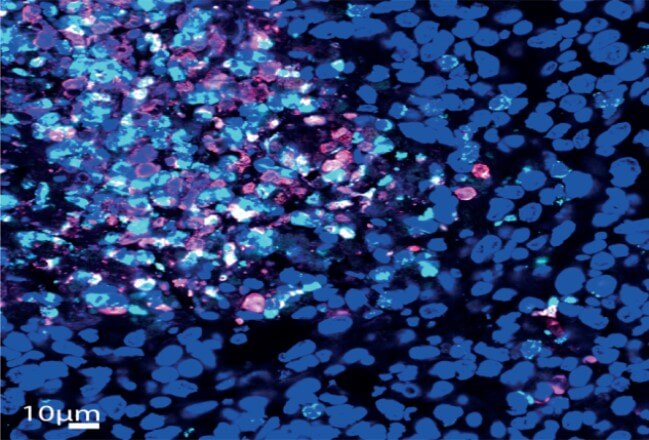
Scientists say these sticky webs, called neutrophil extracellular traps (NETs), can block blood flow inside a tumor; this, in turn, causes tumor necrosis. When platelets interact with the NETs, they become activated and draw more neutrophils and platelets to the area, forming more clots. “We see this type of clotting in severe COVID cases,” says study leader Mikala Egeblad, Ph.D., Bloomberg Distinguished Professor at Johns Hopkins.
Egeblad and Adrover found a new type of clot-causing neutrophil in mice with implanted triple negative breast cancers and in people with the same tumor type. This new type of neutrophil is unable to exit the blood stream and, by forming NETs, causes tumor necrosis, says Adrover.
The research team says these neutrophils stimulate a cycle in which the tumor prompts the immune system to produce more of the new type of neutrophil and send them to the area. When neutrophils get to the tumor, they find an unusual environment, causing them to form NETs and build clots that result in tumor necrosis.
“The necrotic region of the tumor drives cancer cells to leave the hypoxic area, enabling cancer cells to spread,” says Egeblad. “When we target this phenomenon, the necrotic regions of the tumor decrease, and this reduces the spread of cancer to distant metastatic sites.”
