
More Research Clinical Trials Coming to Sibley
In a time of uncertain federal funding for medical research, “there’s a need now for philanthropy that we haven’t had before.”
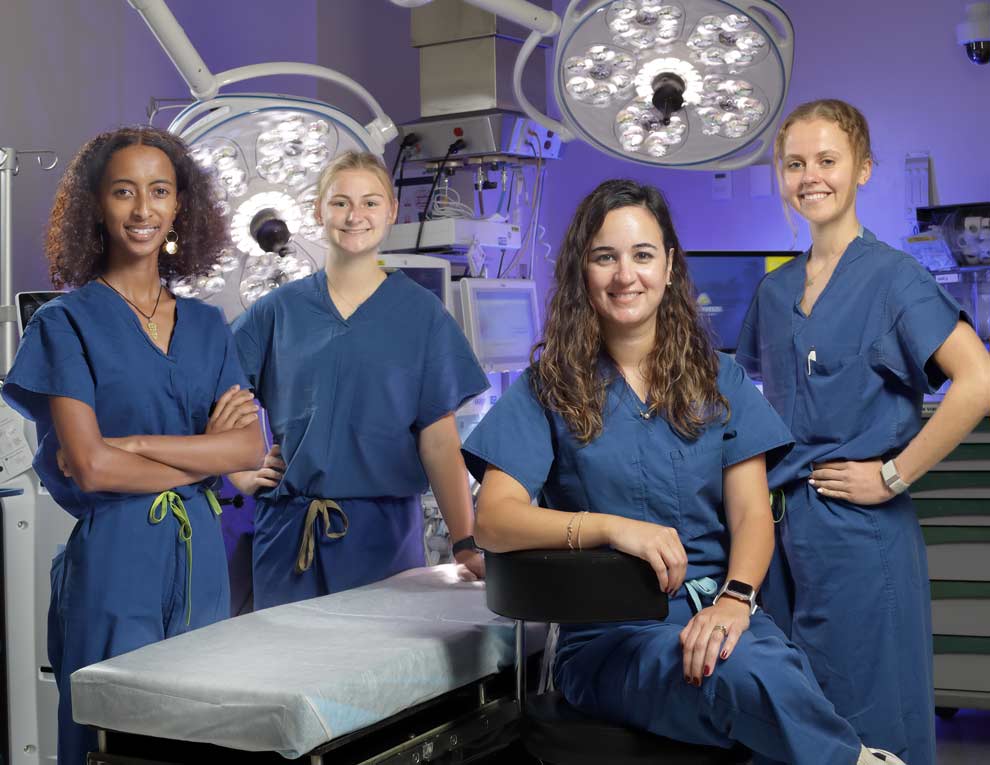
Harb with (L-R) Sara Naizghi, Ashley Coard, and Riley Haines, part of her army of 20 people who manage the urology clinical trials unit and Brady repository.
Brady physicians at Sibley Memorial Hospital in Washington, D.C., offer world-class care. Now, thanks to generous philanthropy, Sibley urologists and urologic oncologists will also be able to conduct more research, and their patients will be able to take part in more clinical trials.
“If you are a patient with a urological disease and there is a clinical trial that you want to be part of, chances are that you can find it at Hopkins,” says Urologist-in-Chief Mohammad Allaf, M.D., “Some of these are Brady science-initiated trials, answering important questions for our own home-grown investigations. Others are evaluating new drugs or new technology, testing them against the standard of care. But we have not been able to offer them all at Sibley.”
Sibley, a trusted community hospital that has long served the National Capital Region, has lacked space and infrastructure for academic medical research. “We want to do more research there,” says Allaf, “and because of investment by generous donors, we can now expand our footprint in clinical trials and representation from Sibley patients in our biorepository.”
The main Brady biorepository is a rich treasure trove of tissue, blood, urine, hair, and cell samples, genetic material and proteins. A new biospecimen collection lab is already being built and equipped at Sibley, says urologist Armine Smith, M.D., Sibley’s Director of Urologic Oncology.
“The Sibley lab we built not only collects but processes samples, and has a limited but meaningful ability to do basic experimentation,” Smith continues, “and I hope to further advance our capabilities on-site in the near future. For more advanced work we collaborate with Baltimore,” but she notes that Sibley is not simply a “pass-through site.” In fact, “we have our own internal review boards separate from the main Hopkins campus, and regularly serve as a site for joint studies.”
“I am proud of the scope and independence of the work happening here.”
Armine Smith, M.D.
Rana Harb, M.Sc., leads an army of about 20 people who manage the urology clinical trials unit and Brady biorepository. “At Sibley, we mostly use shared storage space with the Oncology Department,” she says, “and most samples are shipped to the main campus in Baltimore. This support will allow us to have a bigger space for Urology specifically. We will be able to collect more samples for more projects that we’re working on in prostate, kidney, bladder, and testicular cancer, and have them processed and stored at Sibley. Expanding the space and having extra resources will help so many projects.”
Beyond collecting and storing specimens, the urology team at Sibley is working to expand its reach in the community by offering more clinical trials. Brady at the main Hopkins campus offers 35 to 40 clinical trials at any given time, compared to about five to eight at Sibley, Harb continues. “We are not able to offer all of these at Sibley due to limited space and equipment. You need space to store medications, which sometimes need to be kept in freezers that are not available at Sibley right now. Dr. Smith tried to open a study for bladder cancer, but there wasn’t a freezer that could handle the study drug, and it’s not stable enough to transport. We opened it at the main campus instead, making the drug inaccessible to some patients in the D.C. area.” Soon, many patients at Sibley won’t need to drive all the way to Baltimore to take part in cutting-edge trials. “With this support, we are very excited to expand to do full-scale scientific discovery.”
The gifts that made this possible come from Judy and Peter Kovler and from Leo and Judy Zickler. Both of these couples live in the D.C. area, have strong ties to Johns Hopkins and to Sibley as patients, and have given very generously to support many projects for decades.
The Zicklers have been supporting the Brady with gifts for more than 25 years. In fact, their donation of a sophisticated piece of equipment that enables microsurgeries is named after their great-granddaughter: Kara’s Microscope. “We have focused on gifts that can nudge researchers in a direction they want to go,” says Leo Zickler. “We don’t tell them where they should go; we just do something to help them get started. Then that tends to generate its own momentum.”
The Kovlers have served on boards at Hopkins, Sibley, the D.C. Hospital Association and the Foundation for the National Institute of Health, and in addition to gifts to Johns Hopkins from the Judy and Peter Blum Kovler Foundation, they have established a professorship in breast cancer at Sibley and one in pancreatic cancer research at Hopkins. “The doctors at Sibley are great,” says Judy Kovler; “they just need the opportunity to do more research.”
“One of the great things about giving to Hopkins medicine is the ripple effect,” says Peter Kovler. “You’re giving to something local, and something regional, but it’s an unusual opportunity to give to something that also has a national and international effect.” Private philanthropy is needed now more than ever, he adds. “I’ve never seen a time where it’s more important for people in the private sector to step up.” In a time of uncertain federal funding for medical research, “there’s a need now for philanthropy that we haven’t had before.”