
Matthew Poy Receives Endowed Chair, Peavy Diabetes Center Dedicated at Johns Hopkins All Children’s
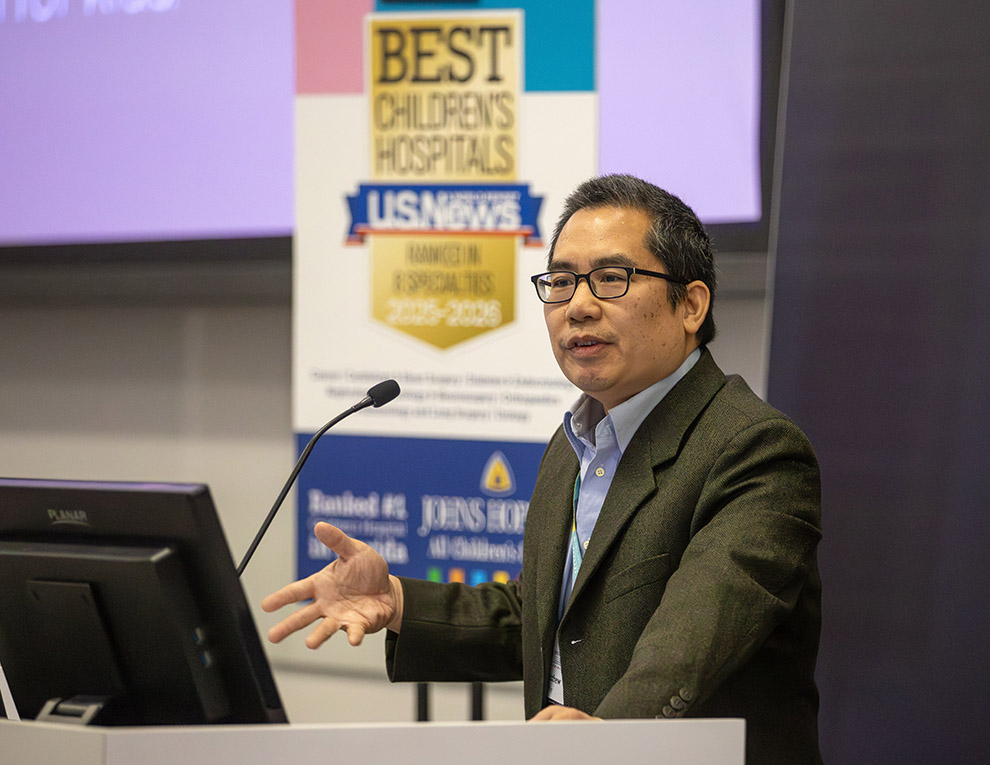
Matthew Poy, Ph.D., was born into a research career, just a “stone’s throw” from the National Institutes of Health in Bethesda, Maryland.
His father, George, spent his 54-year career as a researcher in the National Institute of Diabetes Digestive and Kidney Diseases. The younger Poy has passionately pursued the same topic but at locations around the globe, including New York, Berlin and St. Petersburg, Florida.
Poy reached the pinnacle of academic excellence Nov. 20, 2025, when he was installed as the Peavy Endowed Chair in Diabetes at a ceremony at Johns Hopkins All Children’s Hospital where Poy was based until transferring to Johns Hopkins’ Baltimore campus this year.
The endowment is funded by Bonnie Peavy, who has supported Johns Hopkins All Children’s since 2018 and is part of four generations of her family with type 1 diabetes. She also donated to the Peavy Center for Diabetes and Endocrinology, which was dedicated at a ribbon-cutting ceremony after Poy was installed.
Endowed professorships were established nearly 500 years ago with the creation of the Lady Margaret chairs in divinity at Oxford and Cambridge.
“Endowments matter because they enable us to hire and retain the very best minds,” says Landon King, M.D., executive vice dean of Johns Hopkins School of Medicine. “Our faculty are the reason for our preeminence, and the key to our ongoing success.”
Poy’s pioneering work on molecular and genetic mechanisms that regulate metabolism and diabetes has been instrumental in shaping contemporary diabetes research. He and his lab are leading the way toward developing new treatments for both type 1 and type 2 diabetes, which affect millions of children and adults.
“For more than 25 years now, my goal has been unchanged, to identify molecular targets and devise and develop potential strategies that may one day become therapies for countering this disease,” says Poy, who came to Johns Hopkins All Children’s in 2018 after a decade at the Max Delbrueck Center in Berlin. “As many of you here in this audience as well as throughout the type 1 diabetes field are aware, my lab has focused on a membrane protein called CADM1 as a cellular target. …
“With our proof-of-concept strategy in hand, this chair position now enables further testing as well as the development of additional antibodies that may one day move toward a clinical trial. As many in this room will attest, these specific types of awards are now often necessary to give potential breakthroughs the final push.”
Sonia Najjar, M.S., Ph.D., who encountered Poy early in his career and became his Ph.D. adviser, told Peavy she had a worthy recipient of her gift.
“Donors don’t understand how important it is for recipients to take the responsibility of delivering your vision, and I’ll tell you Bonnie, you couldn’t have picked a better person worthy of every penny you are donating to this wonderful institution,” Najjar says.
Poy’s work is designed to benefit all patients with diabetes, including those in the Peavy Center for Diabetes and Endocrinology. The Center cares for more than 1,600 patients with type 1 and type 2 diabetes, including about 100 new diagnoses a year. The program ranked #17 nationally for 2025-2026, according to U.S. News & World Report’s Best Children’s Hospitals. It marks the highest ranking ever for a program at Johns Hopkins All Children’s, which ranked as the #1 hospital in the state for the third consecutive year and the only nationally ranked children’s hospital in the Tampa Bay region.
“None of her family members ever received a service from our division,” says SupamitUkarapong, M.D., chief of pediatric endocrinology, of Peavy. “Her generosity came from the pure good of her heart. I had several opportunities to meet her in person, and it was quite obvious that she only gives and does not ask anything in return.”
Speaking of the legacy of her gifts over the next century, Peavy says: “I believe we will have a cure, and I really believe it will take less than 100 years.”
Peavy’s generosity already is having an impact on patients.
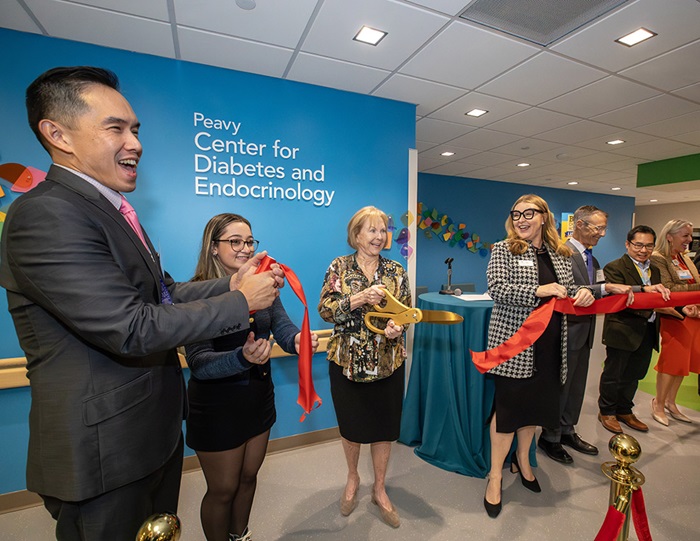
“The Peavy Center has become a source of strength,” says Kaitlin, a diabetes patient whose journey inspires her to pursue a career in nursing. “It comforted us when we needed it most, and it reminded us that healing isn’t only about medicine — it’s about the people and the moments of connection, the encouraging words, and the quiet reassurance that you’re not on this journey by yourself.
“My hope for the future is that this Center will be the kind of place where children can find laughter even on hard days, and where parents can take a deep breath knowing their family is surrounded by people who care — that they are not just patients, but part of a community that believes in them.
“I see a place filled with potential. A place where healing begins, where hope grows, and where stories like mine will continue to unfold for years to come.”