
In the Flow
Inside the pediatric command center, a clinician team working 24/7 provides ‘air traffic control’ for maximizing beds and improving access for young patients.

When a pediatric patient from outside Johns Hopkins Children’s Center needs specialty care, their medical team calls the Johns Hopkins Access Line (HAL). A nurse takes a case history, evaluates the case with other nurses, consults with a physician, checks bed capacity and arranges to receive and admit the patient — all in one phone call.
That’s thanks to the Johns Hopkins Pediatric Satellite Capacity Command Center, a small but crucially important room on the eighth floor of The Charlotte R. Bloomberg Children’s Center Building. There, a team of four nurses works around the clock, seven days a week, to monitor the center’s 189 beds (not including psychiatry), patients in the pediatric emergency department (ED), discharges, operating room statuses and more. An on-call physician also consults on cases and solves roadblocks as they come up.
“It’s air traffic control for patient flow,” says David Stockwell, chief medical officer at the Children’s Center.
The impetus for such a center came in winter 2022, when the “tripledemic” — the surge in COVID-19, flu and respiratory syncytial virus (RSV) — overwhelmed hospitals all over the country.
“Everything, from a bed management perspective, was being done with pen and paper, and there was no broad way for anyone in the Children’s Center other than nurse shift coordinators to really know what was going on from a bed capacity standpoint,” says Chrissy Fletcher, manager of operations for the command center and a nursing coordinator. “We needed something that was transparent and organized that we were able to monitor closely.”
Saying ‘Yes’
Nestled among offices at the Children’s Center, the pediatric command center has four large, wall-mounted monitors displaying Epic dashboards, and five workstations — one of which is for the on-call physician, who is not always in the room. The four roles for nurses, who have someone at the command center at all times, are multifaceted to ensure that communication flows smoothly and all relevant care teams are in the loop (see sidebar).
“It really does allow us to say ‘yes’ more because we know exactly what’s going on,” Fletcher says. “It’s all there. We have discharge numbers, we have the number of open beds, how many kids are in the ED … that used to involve flipping through different screens in Epic and writing it down.”
A system such as this allows the Children’s Center to expediently accept patients not just from within the Johns Hopkins system, but from around the state and region. During the tripledemic, calls to send patients to Baltimore came in from as far away as Ohio.
With centralized communication and decision-making, clinical teams are able to spring into action, ready to address patient needs before patients even arrive at the hospital. The process has also allowed a higher number of patients to skip the ED and go straight to an inpatient bed if appropriate. Stockwell says that about 8%–10% of patients go straight into inpatient rooms; the number used to be only 2%.
By putting the shift coordinator and transport teams together in one room, the command center streamlined a process that often would entail a series of back-and-forth phone calls to providers and clinicians working throughout the Children’s Center. Previously, it could have taken up to an hour or more to let outside teams know if the center would take their patient.
“It would be about six or seven phone calls, and we rarely said yes at the end of the call,” says Philomena Costabile, assistant nurse manager of the pediatric transport team. “Now, we’re able to say yes at the end of the initial phone call. That is so imperatively important to the outside hospital because they’re struggling with critical children, and they don’t want to hear, ‘We’ll call you back.’”
To get an accurate bed count of the entire Children’s Center under the old system, nurse coordinators would have to go to each unit, from the 12th floor to the emergency department on the ground floor.
“Nurse coordinators would literally work off of paper and go from unit to unit. It just wasn’t efficient,” says Dawn Luzetsky, who oversees the command center and is the associate chief nursing officer at the Children’s Center. “By the time they got down to the ED, it was old news from the 12th, 11th and 10th floors.”
While not a perfect system, working off pen and paper and Epic worked, at least until the tripledemic, when it became hard to keep track of patient movement and coordinate certain services, says Eric Biondi, director of the Johns Hopkins Division of Pediatric Hospital Medicine and an on-call physician for the command center.
“That’s when we were constantly at 100% and over 100% capacity, and it really became important to use all of our beds the best we could,” Biondi says. “We realized we needed to add some coordination to this.”
(The Children’s Center is typically at 85%–90% capacity October–May, and 75%-85% capacity May–September, Fletcher says).
Biondi, Fletcher and nursing shift coordinator Shannon Wunder met with the leaders of the Judy Reitz Capacity Command Center, Johns Hopkins’ adult command center, which was one of the first of its kind when it launched in 2016. In the 5,500-square-foot space, staff members facilitate transfers to Johns Hopkins, manage bed capacity and monitor 22 digital screens with real-time, actionable information.
For the Children’s Center, the group was looking at creating a scaled-down version of the adult center, with similar dashboards.
Enter Ray Lewis. The former Baltimore Ravens linebacker and Super Bowl XXXV MVP raised $134,166 for the Children’s Center by spending 15 days in the Panamanian jungle, competing on CBS reality show Beyond the Edge. (He came in second place). A portion of the money raised was used to pay for the pediatric command center’s equipment.
More than two years in, the center is now overseen by a steering committee, which is led by Luzetsky and Stockwell and also includes Fletcher; pediatric surgeon Mark Slidell, who was recently named the Children’s Center’s associate chief medical officer; and Leticia Ryan, director of pediatric emergency medicine.
The efficiencies have also resulted in better communication with member hospitals Johns Hopkins Howard County Medical Center and Johns Hopkins Bayview Medical Center, as well as Ascension Saint Agnes Hospital in Baltimore (where Johns Hopkins residents and hospitalists work). Howard County and Bayview send patients to the Children’s Center, and the Children’s Center sends patients to Bayview and Saint Agnes if they don’t require the center’s specialty care.
By working in conjunction with the nursing resource office, the command center has also been able to deploy staff members where they are most needed, based on the center’s real-time data. What’s more, by having detailed discharge information — including which patients are expected to be discharged, the status of their discharge and whether the order or discharge is being delayed — command center staff can deploy nurses and/or physicians to move discharges along.
Expanding Possibilities
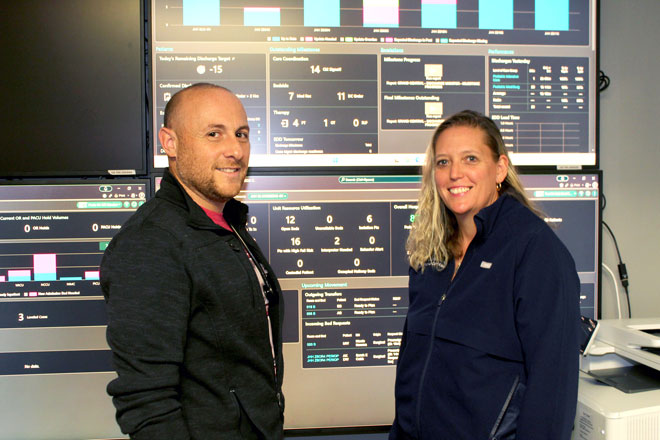 Eric Biondi and Chrissy Fletcher
The command center dashboards allow the team to drill down beyond basic statistics — they can see the number of unavailable beds; how many beds are in each unit; the day’s expected admissions, transfers in and out, and discharges; as well as the number of expected open beds at the end of the day. On their desktop computers, nurses can pull up more information, including cases in which discharge orders have been placed, but patients haven’t yet been discharged.
Command center staff can also send alerts throughout the Children’s Center — one for high bed occupancy awareness and an elevated alert for very low bed capacity, which gets teams including social work and case management involved to help figure out how to safely open up some beds.
The pediatric and adult command centers recently relaunched their systems so that both facilities have the same Epic dashboards, and the teams can see each other’s capacities. At the pediatric center, other newly launched dashboards allow even more insight into bed capacity, and further the team’s ability to troubleshoot delays in real time. Dashboards with predictive analytics based on historic data were also launched, and are being tested for accuracy.
A new systemwide capacity dashboard includes bed capacity and other information from Bayview Medical Center, Howard County Medical Center and Sibley Memorial Hospital in Washington, D.C.
For Costabile, getting a system like this in place was essential for the Children’s Center.
“We are the referral center for the state of Maryland,” she says, “and we had a moral obligation to really address the issue of where we put patients to be appropriately care for.”