
GBCI 2.0: Hahn and Kates Lead New Era for the Greenberg Bladder Cancer Institute
The GBCI studies and treats all forms of bladder and upper urinary tract cancers, from the most common to the rarest forms.
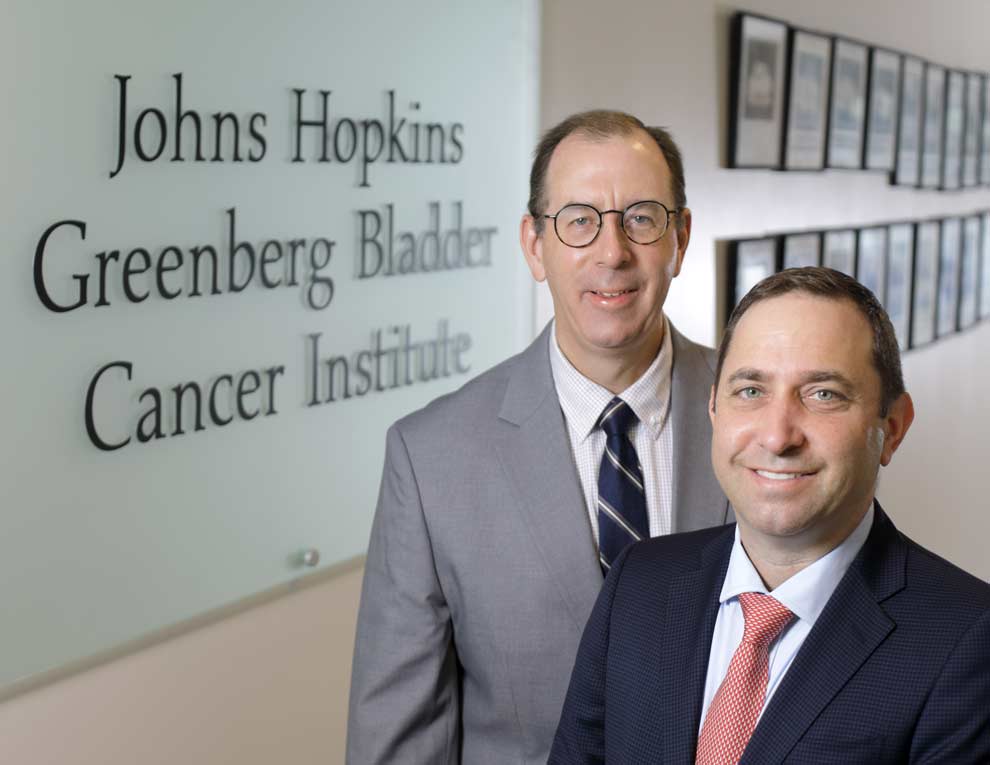
Hahn and Kates: The GBCI has always approached bladder cancer as a complex disease that spans specialties.
In May 2014, the generosity of philanthropists Erwin Greenberg and his wife, Stephanie Cooper Greenberg, made possible the creation of the Johns Hopkins Greenberg Bladder Cancer Institute (GBCI). Nearly 12 years ago, bladder cancer was an understudied and underfunded area of urology and oncology. The Greenbergs helped meet a great need: the multidisciplinary GBCI became the first institute of its kind dedicated to improving the lives of patients with cancers of the bladder and upper urinary tract.
Under the leadership of its first director, David McConkey, Ph.D., the GBCI has done great things. Its world-class research, patient care and education, and training of young doctors and scientists have helped transform the field of bladder cancer. In 2025, McConkey became Vice Chair for Research in Urology at the University of Rochester, and Johns Hopkins has named two of its finest physician-scientists to lead the GBCI’s next era: Medical oncologist Noah Hahn, M.D., and urologist Max Kates, M.D. the R. Christian B. Evensen Professor of Urology.
Two directors, two specialties
Because the GBCI has always approached bladder cancer as a complex disease that spans specialties, “there is very little that we do that doesn’t have a multidisciplinary angle,” says Hahn, “even for the earliest stages of bladder cancer,” which used to be treated primarily by urologists. Metastatic bladder cancer, in turn, was long considered the sole province of medical oncologists. Not anymore.
Today, patients with metastatic cancers of the bladder and upper urinary tract that once were considered inoperable, after combination treatment with the antibody drug conjugate enfortumab vedotin (EV) and the immunotherapy drug pembrolizumab, are achieving “response rates higher than we’ve ever seen before,” says Hahn. “Roughly 30 percent of patients have a complete response! Previously, that number was around five to 10 percent.”
“Night and Day”
Kates, Hahn, and colleagues are routinely navigating possibilities that did not exist a decade ago. “Unfortunately,” says Hahn, “it used to be that for many patients with metastatic disease, we started them on the best chemotherapy medicines that we had, and we didn’t have anything after that. I saw a lot of my patients pass away; there were only a few long-term survivors, we weren’t able to predict who they were, and we didn’t understand how to move that bar.”
What a difference in “GBCI 2.0”
As Kates calls it: Some patients who would have been considered incurable a decade ago are now doing so well that “surgery is back on the table.” In patients who still have some disease in the bladder or upper urinary tract, “do we consider surgery to remove the bladder? Do we need to think about bringing in radiation? Is a cure possible?”
Better surgery
With improved surgical techniques, adds Kates, “we’re very interested in finding new ways to preserve a patient’s bladder, kidneys, and surrounding organs. “We are actively engaged in novel trial designs with our amazing scientists and clinicians. We believe we have the best team in the world; we’re uniquely positioned to do this.” And yet, he is quick to add, “While we’re working to make surgery better, we’re also trying to obviate the need for surgery in the first place.” Kates, Hahn, and medical oncologist Jeannie Hoffman-Censits, M.D., are national leaders in clinical trials for drug development. Their goal: “How do we apply these drugs in a new way,” says Kates, “to get long-term, complete responses for our patients with invasive cancers of the bladder or upper urinary tract, so surgery is not necessary?”
Several years ago, the National Cancer Institute led a landmark effort, The Cancer Genome Atlas (TCGA) project, to profile the genetic changes in cancers. “That gave us our first roadmap of the unique biologic drivers of bladder cancer,” says Hahn. Next, “some of the larger pharmaceutical companies, seeing the genetic profile of bladder cancer coming out of the TCGA project, predicted that bladder cancer would respond well to immunotherapy. They started launching some of the first clinical trials in decades,” aimed at developing drugs specific to bladder cancer – “not trying to get something approved in other diseases and saying, ‘Let’s try it in bladder cancer.’ Bladder cancer was the number one priority of these trials, and thankfully, they were successful.”
Much remains to be done, Hahn adds. “We haven’t fixed everything. There are still unanswered questions. But where we are is night and day compared to the beginning of my career. When I was a fellow attending urologic cancer conferences and presenting an abstract,” says Hahn, “you could fit everybody in the world who was doing bladder cancer research in a relatively small conference room. That has changed dramatically. Now we have conferences that are devoted only to bladder cancer. Those did not exist before. And because of that, our residents, junior faculty, and fellows are seeing opportunities and spaces for them to grow and expand their research. We no longer can fit in that small room, and that’s a very good thing.”
A Clinical Trial Available for Every Patient
If you have bladder cancer and want to be part of a clinical trial, chances are excellent that you can find it at the GBCI. Says Kates, “We are determined to have a clinical trial available for every patient with bladder cancer, regardless of what stage they’re in or what treatment they’ve had. We want to offer standard of care options and a cutting-edge option that they may not otherwise have access to, which may be very promising. We generally have 10 to 15 trials for bladder and upper urinary tract cancer patients. We lead these trials; we don’t just sign onto them. And we help write the trials.”
The GBCI studies and treats all forms of bladder and upper urinary tract cancers, from the most common to the rarest forms. Of note, “Jeannie Hoffman-Censits and Nirmish Singla have carved out a strong international presence in upper urinary tract urothelial cancers,” another area that was long understudied, Hahn adds. “We’re very proud of what the GBCI has accomplished in its first decade. People can be successful in their own individual silos, but not as impactful. The GBCI provides the glue to bring people together. That has created a critical level of expertise that doesn’t exist in a lot of places. We also thank Erwin Greenberg and Stephanie Cooper Greenberg. They could have established this anywhere, but they chose Hopkins. We’re just as excited about what the next decade holds. Things are changing fast.”