
Epilepsy Doesn’t Dim Layton’s Light
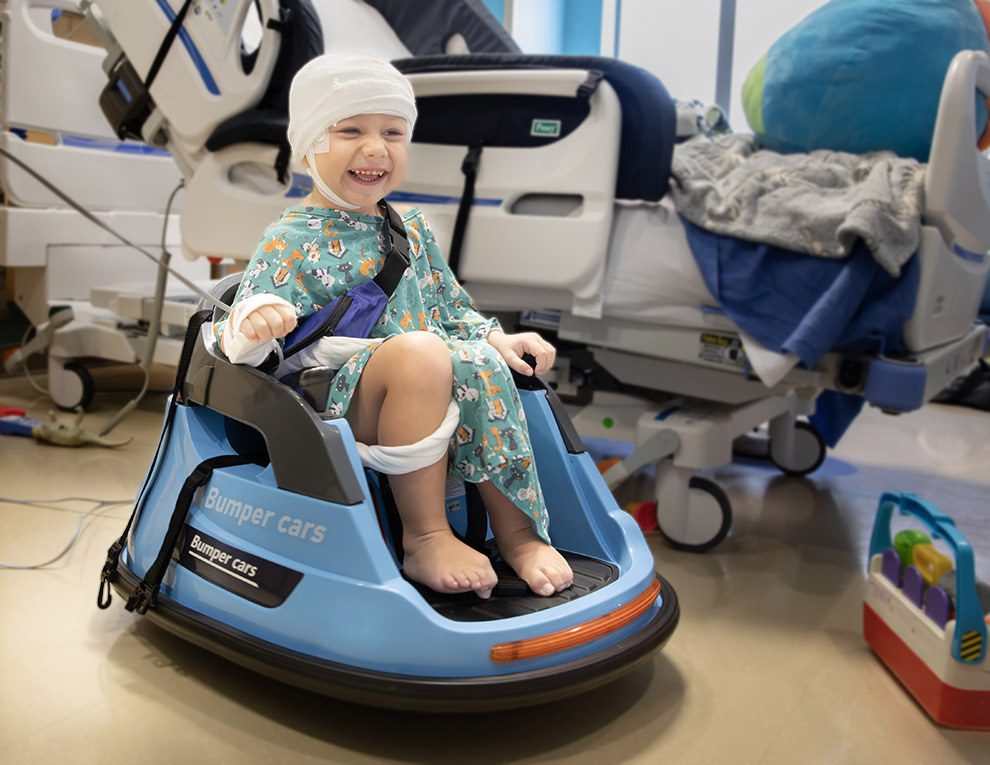
Three-year-old Layton is finding his fun.
On the seventh floor of Johns Hopkins All Children’s Hospital in St. Petersburg, Florida, the little boy is tooling around on a battery-powered toy bumper car, exploring his temporary home away from home.
Despite the electrodes attached to his scalp to measure brain activity, Layton’s megawatt smile indicates that this is, indeed, a joy ride.
“Layton is the most loving, energetic, playful little boy I’ve ever met,” says his mom, Kaylee.
This, despite a young life marked by epileptic seizures that would frighten his mom and — at first — confound his doctors.
Early Signs
Kaylee recalls the first moment she realized something was not right with her boy.
Layton was a few months old. Mother and baby were enjoying a favorite ritual, watching Ms. Rachel, a beloved YouTube personality, known for her videos for babies and toddlers.
“Helloooo! Hi!”
All of a sudden, Kaylee’s normally happy and responsive baby seemed to stiffen in her arms and stare off, as if in a kind of trance. His head inclined to his right side.
“I was like, ‘Layton! Layton!’” Kaylee says, “but I wasn’t getting his attention. I knew in my gut there was something wrong.”
Kaylee rushed her son to a Tampa hospital, where he was admitted for several days of testing and observation.
A neurologist prescribed various medications, but as weeks turned into months, Layton’s seizures continued and became even more frequent. At their worst, he was having as many as 20 seizures a day.
Only heavy medication seemed to have an impact, but that left her baby sleeping almost all the time.
This wasn’t the life Kaylee had imagined for her son.
She needed more answers.
Finding Answers
When Layton was about 18 months old, his neurologist in Tampa recommended a higher level of care for this patient. The Pediatric Epilepsy and Seizure Management program at Johns Hopkins All Children’s offers a team of highly-skilled pediatric neurologists with specialty training in epilepsy (pediatric epileptologists), neurosurgeons, neuropsychologists and other clinical professionals who specialize in hard-to-treat and drug-resistant epilepsy.
The program is the only accredited level IV pediatric epilepsy center by the National Association of Epilepsy Centers (NAEC) in the Tampa Bay area, the highest accreditation given to centers for expertise in diagnosing, evaluating and treating the most complex forms of epilepsy.
Pediatric Neurology and Neurosurgery at Johns Hopkins All Children’s is ranked nationally for 2025-2026 on U.S. News & World Report’s Best Children’s Hospitals list.
Layton became a patient at All Children’s starting in the fall of 2024. Very quickly, his mom began to feel as if she were coming out of the dark.
Genetic testing had provided the basis for a diagnosis that would help explain Layton’s brain condition: a mutation in the gene DEP-DC5. This mutation can cause epilepsy and a brain malformation called focal cortical dysplasia (FCD), a key cause of drug-resistant epilepsy.
“This helps us to better understand Layton’s epilepsy and the reason he was born with a brain malformation,” says Angel Hernandez, M.D., the pediatric neurologist and epileptologist currently caring for Layton.
To help mitigate Layton’s seizures, pediatric neurosurgeon Matthew Smyth, M.D., performed a procedure called a frontal lobe disconnection — a process of cutting the nerve pathways that transmit the abnormal electrical activity.
“By doing that, any abnormal activity in the frontal lobe should not be connecting to any other part of his brain, Hernandez says. “It can reduce the frequency and severity of seizures and improve quality of life.”
Soon after Layton’s surgery in November, his mom noticed a dramatic change. He went from one or more seizures a day to only one or two a week.
“He started talking more, playing more, communicating in a way he had not before,” Kaylee says. “His personality started sprouting and blossoming. It was just so beautiful to watch my son come alive in this way.”
While some types of epilepsy in children can be controlled and at times outgrown, there is not yet a cure for epilepsy caused by genetic mutation. But with ongoing research, scientists and clinicians are continuing to identify the clues that will lead to more gene-based therapies, specialized medications and surgeries that will improve the quality of life of these patients.
“Twenty years ago, there were only a handful of mutations we could diagnose,” Hernandez says. “Today we can identify more than a thousand.”
Kaylee knows her son’s medical journey will be lifelong.
He may have more surgery in the future. He may be on medication throughout his life. But Kaylee rests in the comfort of knowing that she has a partner in the clinical team at All Children’s.
“We are getting an amazing level of care at Johns Hopkins All Children’s,” Kaylee says. “They have done nothing but fight for my son.”
During her lengthy commutes to the hospital in St. Petersburg from her home in Dade City, Kaylee is excited to watch the progress of a new Johns Hopkins All Children’s campus being built in Wesley Chapel.
A hospital with trusted care that is closer to home will be a welcome addition.
For other parents navigating the complexities of having a child with epilepsy, she shares her optimism.
“There is always light at the end of the tunnel,” Kaylee says.
“There is hope.”