
Cutting-Edge Technology for Head and Neck Surgery
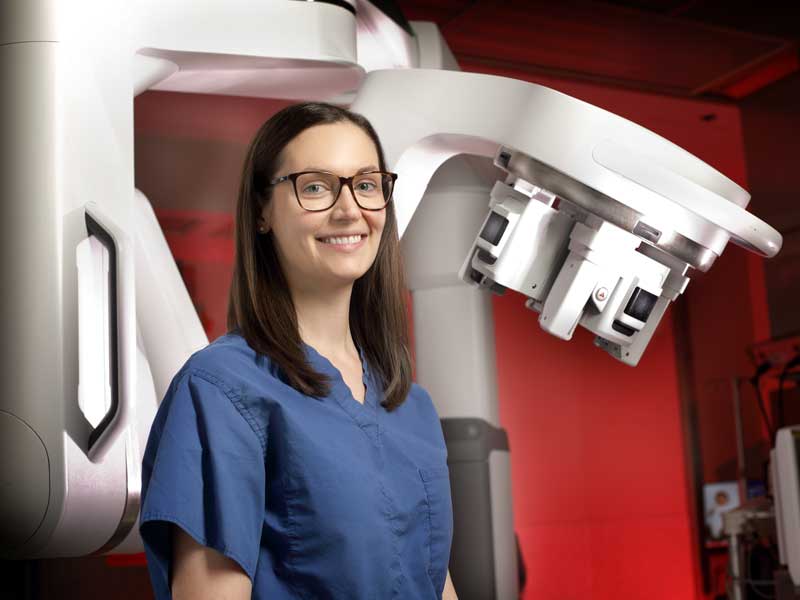
Transoral robotic surgery (TORS) revolutionized head and neck surgeries when it was approved for adults by the U.S. Food and Drug Administration in 2009. Mostly used for cancer therapy, TORS allow surgeons to avoid significantly more invasive operations that require splitting the mandible and approaching tumors through the jaw and neck.
TORS also holds significant advantages for pediatric head and neck surgery. However, only a handful of centers across the country offer pediatric TORS, says Johns Hopkins pediatric otolaryngology surgeon Carolyn Jenks. When she joined Johns Hopkins Children’s Center in 2021, Jenks introduced this type of surgery to the hospital’s repertoire and began treating children using the technique.
“I was lucky enough to train at the right places at the right times,” says Jenks, who began training in TORS during her residency at the University of Pennsylvania, the birthplace of this surgery. She learned how to use it to treat children during her fellowship at Lurie Children’s Hospital of Chicago, under the mentorship of Douglas Johnston, a trailblazer for pediatric TORS.
Besides lingual tonsillectomies — a treatment for refractory sleep apnea that’s the most common indication for this approach — TORS can be used to treat vascular malformations in the mouth and throat, benign and malignant cysts and masses, and various laryngeal pathologies.
During these operations, Jenks serves as the primary surgeon, sitting behind the robot’s controls. A second surgeon is stationed at the patient’s head, observing at the bedside for safety and performing additional duties including suctioning and tissue retraction. Jenks says that she feels fortunate to partner with experienced TORS surgeons such as Leila Mady.
During TORS surgery, three surgical tools of Jenks’ choice and a 3D, high-definition camera emerge from the robot through a single 2½-centimeter port, allowing her significantly greater visualization and maneuverability than other minimally invasive approaches provide. Although the risks are similar compared with conventional endoscopic surgery, TORS can help avoid the increased risk of complications, prolonged recovery and scars that can result from open procedures.
“The patients for whom I’ve been able to offer this cutting-edge technology have been referred to me with refractory problems that many well-trained pediatric otolaryngologists can’t help them with,” Jenks says. “It’s really fulfilling to see these children have great outcomes with TORS.”