
Courage, Capes and a Cure: Miles’ Story of Overcoming Epilepsy
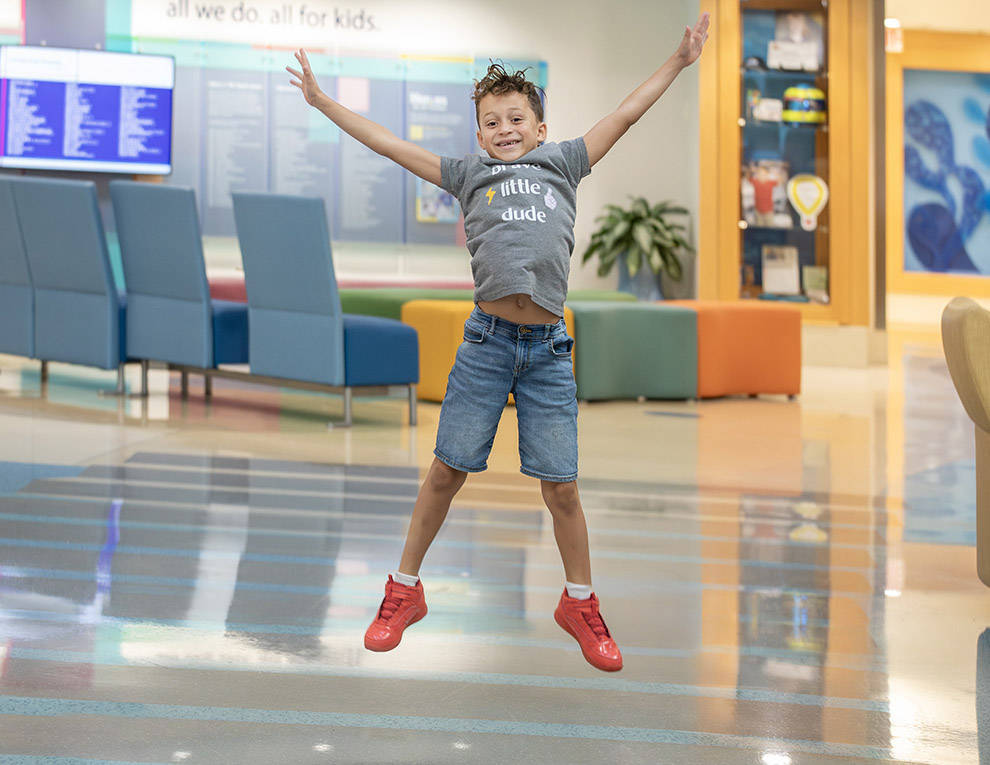
Constance looks over in awe at her 7-year-old son, Miles, who jumps up high and spreads his arms and legs like a starfish. His smile stretches from ear to ear. As he poses for a photo in the lobby at Johns Hopkins All Children’s Hospital in St. Petersburg, Florida, Constance takes a moment to reflect on how far Miles has come. This is what life without seizures looks like, she thought.
An Unforgettable Anniversary
Constance will never forget the scariest call she ever received. It was July 3, 2022, and she and her husband, Andre, were in Fort Myers on a short anniversary getaway. Constance’s mom was watching Miles, then 4, and his younger sister, Mariah. The phone rang and almost instantly panic set in.
“My mom told me Miles had thrown up all over the floor and was not really responding to her,” Constance remembers. “She called 911 and we realized he was having a seizure. Andre and I got in the car and drove very fast to get to our local hospital. Miles took six hours to wake up. We honestly didn't know if he was going to wake up at all. It was a terrifying feeling.”
Doctors at that hospital believed Miles had a fever-induced seizure. “But something deep down didn't feel right.” Constance recalls. “I'm a nurse practitioner, and I had worked in the NICU, and so I kind of know a lot about medicine, and I thought, but he didn't have a fever, and he wasn't sick.”
CT scans and bloodwork didn’t detect any abnormalities, so the family returned home. Just three months later, Constance says Miles started acting strangely again. This time he also suddenly vomited and awkwardly started moving his fingers. Andre called 911. By the time emergency crews arrived, Miles was foaming at the mouth and turning blue. “I ran outside, holding him in my arms waiting for the ambulance. This time, we insisted that he go straight to Johns Hopkins All Children’s,” Constance recalls. "At this point I knew, something is wrong with my child."
The Search for Answers
Once Miles was stable, doctors ordered an MRI scan and EEG (a test that measures the electrical activity of the brain), but again tests didn’t seem to show anything unusual. There was some discussion about starting seizure medications, but a decision was made to hold off. “Then the third seizure came,” Constance remembers. “It was December, right before Miles’ fifth birthday, and this time, an issue was spotted on Miles’ MRI.
“Doctors found a lesion on his brain,” Constance says. “Dysplasia, as doctors called it, and, so at that point, we realized that this is probably what's causing his seizures, and we started him on a medication.”
Miles continued having seizures, and they were becoming more frequent … about every 10 to 14 days for the next two years. “A lot of them were small,” Constance says. “They were anywhere from 30 seconds to two minutes and they would resolve.”
‘Mommy, the Nightmares Are Coming’
Constance says the frequent seizures were terrifying as a parent.
“Moments before having a seizure, Miles would tell me, ‘Mommy, the nightmares are coming,’” Constance says. “That’s when I’d dash over and grab his seizure rescue medication, hold him and say, ‘Mommy's here and I won’t let anything happen to you’, but the seizures kept getting increasingly significant to the point where the rescue medicine wasn't working.”
Doctors prescribed a second medication and that’s when the family was introduced to Neel Parikh, M.D., a pediatric neurologist at Johns Hopkins All Children’s who specializes in epilepsy.
Surgical Interventions
Parikh explained to the family that brain surgery would be a viable option to give Miles relief from seizures. “The type of surgery we suggested for Miles is called anterior temporal lobectomy. The chance of eliminating seizures is close to 70-80%. None of the anti-seizure medicines that are available on the market can offer that much relief,” Parikh adds.
“I was like, well, that's great,” Constance remembers thinking. “I mean, I don't want my kid to have brain surgery, but I also don’t want him to suffer from seizures for years and years and I thought that’s a pretty high success rate.”
Parikh explains before surgery occurs, there is a lengthy evaluation including several potential tests: neuropsychological, prolong EEG (to capture seizures on the EEG), PET scan (which uses a tracer to visualize and access the function of organs and tissues in the body), SPECT scan (which creates 3D images of organs and tissues), fMRI (which measures brain activity by detecting changes in blood flow) or a MEG scan (which measures the weak magnetic fields produced by electrical activity in the brain to map brain function). These tests help the team at Johns Hopkins All Children’s distinguish between normal brain function and abnormal brain function. It also helps to localize where the seizures come from in the brain.
From there, doctors gathered in an epilepsy surgery conference where the neurosurgeon, neurologist, neuropsychologist, radiologist, pathologist and other clinical leaders met to review the data. “We decide if the patient will need direct surgery and what kind of surgery would be the best option,” Parikh explains. “Sometimes we can offer another step. It's called stereotypic EEG, which is where electrodes are placed surgically into the brain to record the brain activity and that helps to show exactly where the seizures are coming from. These kinds of testing and evaluation are not offered everywhere, and if you are seeing a community neurologist, they may not be aware of all this testing. Our program is a Level 4 in epilepsy care, which is the highest level available.”
Constance remembers the date of Miles’ surgery off the top of her head: May 22. Just one day before, Miles graduated from kindergarten. “We were all so nervous,” Constance remembers, “but everyone here at the hospital was absolutely wonderful.”
Matthew Smyth, M.D., the chief of the Pediatric Neurosurgery division at Johns Hopkins All Children’s Hospital, was the lead doctor during Miles’ operation. “Surgical techniques have changed a lot since I first started performing surgeries to treat epilepsy,” Smyth explains. “In the late 1990s and early 2000s, surgical techniques focused on removing a portion of the skull to access a patient’s brain. Now, we can use minimally invasive technology in some surgeries such as using stereo electroencephalography (SEEG) and laser ablation to target certain tissue in the brain without needing a craniotomy.”
Miles’ seizures originated from his left temporal lobe. Surgeons performed an anterior temporal lobectomy, which involves removing a portion of the anterior temporal lobe of the brain. The surgery went well, without any complications.
“When Dr. Smyth did the surgery and sent the results to pathology, it came back as a focal cortical dysplasia that means this issue should not come back again and if Miles continues to be seizure free in the short term, then he will hopefully stay seizure free for the rest of his life,” Parikh explains.
A Remarkable Turnaround
“Miles’ resilience and his healing since the day of surgery have been amazing,” Constance adds. “Now, he’s completely weaned off his medication since August. He still hasn't had a seizure post-surgery, and he's doing so well.”
Constance worried initially that Miles could have memory loss or language difficulty, but so far, he’s doing great. “He scores very high on everything, especially math. He did have a little bit of word memory recovery, but he did speech language intervention, and he's back to testing high.” Constance says Miles’ personality is coming back too. “Before the seizures, he was always a very happy, confident kid, and now that's starting to come back, and it's beautiful.”
“As a mom,” Constance adds, “you just want your child to be happy. You want them to experience life and not feel scared all the time. He felt scared in his own body. We were all living in a state of fight or flight and constant anxiety for more than two years and now a weight is lifted.”
“It makes us grateful to do the work we do,” Smyth elaborates. “There are two instances where you can see that most directly. The first is after a successful surgery when I speak with the parents and tell them everything went well. The second is when the child returns for their one-year post-surgical visit, and they are seizure free, and you can see the relief in both the child and their parents’ faces. I’ve had patients obtain their driver’s licenses, get a job, or be able to return to school after surgery and do remarkably well. It’s very gratifying. In most cases, these patients are going to be perfectly OK, and that’s wonderful.”
Inspiring Other Families
Constance and Andre decided to co-author a children’s book to help other families deal with challenging situations.
“Miles loved dressing up as a superhero,” Constance explains. “I thought about when kids dress up as superheroes or wear capes, they can embody bravery and fun and play. The book pairs emotions with colorful capes and helps children express their feelings even when they’re difficult to verbalize.”
Constance also hopes other parents will advocate for their children and push for solutions, as she and her husband did with Miles’ care.
“I truly believe Miles wouldn't be alive without the doctors, care teams and this hospital. Johns Hopkins All Children’s Hospital knows children best. Every person we have interacted with here has made me feel better as a parent, and made my child feel seen, and that's important. When people go through scary situations, they feel lost, but Dr. Smyth and Dr. Parikh always took the time to listen to us, so I mean it when I say this hospital saved my son's life.”
“It feels really good to have this kind of outcome, and we are really happy for Miles and happy that his family trusted us,” Parikh adds.
The Future of Epilepsy Care
Both Parikh and Smyth are excited about what the future holds for epilepsy treatment and surgical interventions.
“Laser ablation is a newer technology, which has been a game changer for surgery,” Parikh says. “You used to sometimes have to sacrifice some good tissue to access the bad tissue in the brain. Now, with laser ablation, you can put a probe that produces heat in the brain, and the issues can be addressed through a small hole. With these minimally invasive technologies, there's not a lot of scarring. Up next, we’re looking into more radio frequency ablation, which is approved in Europe but not approved in the United States yet. We are starting to learn more about it and potentially implement that in the future.”
Smyth is studying the use of focal cooling devices. “You can imagine an abnormal electric discharge in the brain; the brain is locally very hyperactive. You can decrease the brain’s activity by cooling it. So, we physically cool a region of the brain with an implantable cooling device. It’s something we have looked at in the laboratory, and it is effective. The challenge is getting that concept and device into an implantable device that has FDA approval. So, that’s kind of the next step is bringing these devices to patients.”
Both doctors are grateful to be on the cutting edge of new technology and techniques that they know will improve the lives of children with epilepsy and make a huge difference for their families.