
Big Plans for Brady Research
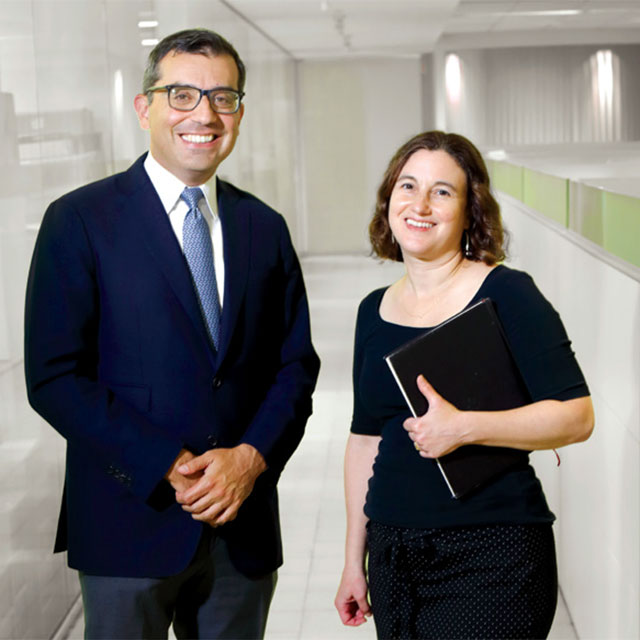
Allaf and Lotan: Seeking answers in the Brady’s unrivaled trove of patient data to help patients at every stage of disease.
Tamara Lotan, M.D., the Rose-Lee and Keith Reinhard Professor of Urologic Pathology, is the Brady’s new Director of Research. She is the first pathologist and the first woman to hold this position, and only the sixth research director in the Brady’s history.
An internationally renowned physician-scientist in the field of urologic pathology and the co-author of more than 200 scholarly publications, Lotan is also Co-Director of the Schaufeld Program for Prostate Cancer in Black Men, with Urologist-in-Chief Mohammad Allaf, M.D., the Jakurski Family Director, and is a dedicated mentor of the program’s Schaufeld Scholars.
Lotan is the operational definition of someone who wears many hats, all of them well. Having a non-urologist as the Brady’s Research Director may be unconventional, says Allaf, but it’s not unprecedented; Kenneth Pienta, M.D., the Donald S. Coffey Professor of Urology, her predecessor, is a medical oncologist. “The Brady’s forward-thinking approach looks for answers through team science and multidisciplinary work – we see beyond just urology. The diseases we treat bridge urology, pathology, medical oncology, radiation oncology, basic and clinical science, and data science.”
Allaf and Lotan have big plans for Brady research. “My goal is to elevate and support a number of flagship research programs,” says Lotan, “and within each one, to have a partnership between clinical researchers and translational researchers, and then the third leg of the triad is data scientists. Large data sets are critical to facilitating new discoveries in research.”
So Much Data
The Brady has an unrivaled trove of patient data – blood, tissue, and urine samples; genetic test results; and imaging scans – available for study down to the molecular level. “Urologic pathology really started at Hopkins, and grew along with Patrick Walsh, M.D., in a program where he
transformed the radical prostatectomy. More than 30,000 prostatectomies have been performed at the Brady – an enormous scale unmatched by most other institutions. In addition to tissue, a large number of these prostatectomy patients have detailed information about their clinical outcomes after surgery,” many of them collected over decades.
What Can Be Learned From This Data? So Many Things!
For example: Patient A is 58, with a family history of prostate cancer. His father had a radical prostatectomy at the Brady 30 years ago, performed by Walsh. His father’s initial PSA test, plus years of follow-up PSA tests, his initial biopsy slides, a CT scan, and prostatectomy specimen are stored at the Brady. Patient A was diagnosed with localized prostate cancer, Gleason 8. His biopsy slides and tissue samples from the robotic prostatectomy performed by Allaf are also at the Brady, plus his prostate MRI.
Patient B, age 74, was diagnosed with metastatic, Gleason 9 prostate cancer and is being treated by medical oncologist Sam Denmeade, M.D. Four years ago, William Isaacs, Ph.D., did a complete analysis of his germline DNA and found a mutated BRCA2 gene. Using biopsies of tumors from metastatic sites, Lotan and others have conducted analysis of the somatic DNA changes – alterations in the tumor that happened as his cancer evolved – and cataloged many epigenetic changes that helped drive his cancer to become more aggressive. The cancer in these sites was different from that sampled in his original prostate biopsy. Patient B also underwent a PSMA-PET scan as part of a clinical trial, and has had a prostate MRI, a CT scan, and a nuclear medicine bone scan.
Patient C has Gleason 6 prostate cancer, and is being closely followed in the Active Surveillance Program by his urologist, Christian Pavlovich, M.D. He has had three prostate biopsies, four prostate MRIs, and six PSA tests, as well as germline testing.
Alone, each of these patients has innumerable data points that may yield clues to how prostate cancer develops, spreads, or simply percolates within the prostate. Combining clinical data with the rich data stored in the pathology and radiology images will yield even more information. Multiply that by the many thousands of Brady patients – over the spectrum of urologic diseases, malignant and benign – and it’s too much for any individual scientist to begin to mine.
“We need artificial intelligence (AI) and deep (machine) learning,” says Lotan, “to integrate the big clinical data with the pathology and radiology imaging data – which is billions of pixels on many thousands of slides and images – times all of those patients. There are research platforms that will generate more data on those histologic images, the genomic data from the pathologic specimens or from the germline DNA of the patients. We can layer on to that by interrogating the proteins and immune cells we see in the tumor microenvironment. With newer spatial technologies, we can even look at the DNA alterations within individual cells in relation to their neighbors. Start with 30,000 patients, if we created detailed maps of all those tumors at the protein level, each one would have trillions of data points. AI, or deep learning, can then be leveraged to learn from these – better predicting which patients have aggressive tumors or are likely to respond to a particular therapy. Then, can we further identify these patients while their tumors are still localized to the prostate, or maybe before they even develop cancer?”
There are millions more data points from Brady bladder cancer, kidney cancer and testicular cancer patients. Millions of patient data points from benign diseases; for example, Walsh has kept a registry of patients with hereditary benign prostatic hyperplasia (BPH) for decades. Millions of patient data points from pediatric urology patients, and from female urology patients.
And yet: Lotan is quick to note that “All of this is only as good as the questions we’re asking.” To help ask and answer these questions, Lotan is working closely with urologist Arun Rai, M.D., M.B.A., M.S., who is the Brady’s new Clinical Director for the Division of Quantitative Science. “In terms of the questions we’re asking, they will be clustered in disease-specific programs, levering a multidisciplinary approach.”
In bladder cancer alone, there are several research working groups, says Lotan. One centers around liquid biopsy, looking at circulating DNA in urine and in the blood, to predict which cancers are likely to progress. “Another group is studying organ preservation, similar to focal therapy in prostate cancer. They also have their own AI and digital pathology program. We have to do a lot of work to digitize all the images of the tumors across various tumor types, to use AI to identify underlying molecular alterations – and hopefully discover biomarkers to predict progression, further fueling our multidisciplinary clinical research programs.”
Lotan is excited about the Brady’s Division of Quantitative Science, “which was established with a donation from a generous philanthropist about a year ago.” Newly hired bioinformatician Eddie Imada, Ph.D., an expert on computational genomics, will help make possible “a lot of our digital pathology efforts, our genomics efforts, and then some of the AI efforts with the goal of supporting Dr. Rai to develop tools that patients can use to predict their risk of developing cancer, or their risk of recurrence. They can ask questions of our data using their own data, and interrogate it by an AI algorithm.” “Before we can do that, we are busy updating all of the clinical databases, genomics databases, and modernizing everything – so we don’t have to manually go into the clinical record, which dates back to Dr. Walsh’s early patients.”
In addition to overseeing research and conducting active research herself, Lotan and a team of urologic pathologists see about 8,000 consultations a year from men around the world who seek second opinions on their prostate biopsies. “We have a very active consensus conference,” she says. “We meet every day to talk about difficult cases. Frequently we make some really significant changes that alter clinical management of the patient’s tumor,” either upgrading, when a man’s prostate cancer is more aggressive than originally thought, or occasionally downgrading, when abnormal benign cells are misdiagnosed as cancerous.
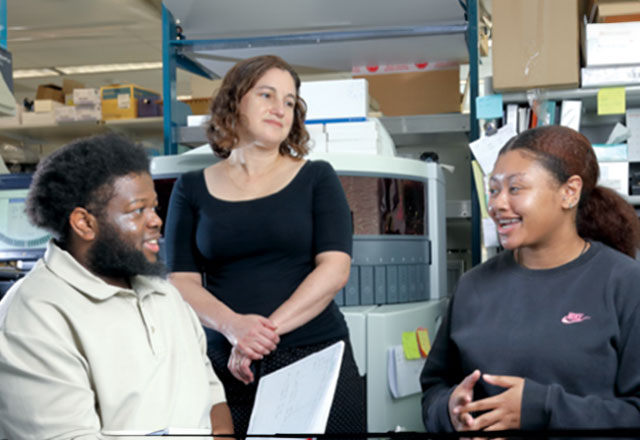
Of all her many roles, co-directing the Schaufeld Program is perhaps closest to her heart. Lotan helps place scholars – recent college graduates who are interested in biomedical careers – in research labs throughout Hopkins Medicine, spends time mentoring them, and sets up numerous mentorship, educational, and professional development opportunities for them.
The program is growing, Lotan says. “We have an additional Schaufeld scholar; we had six, and we are moving to seven. We’ve had five scholars graduate, and four have already matriculated to medical school!”
Using AI to Standardize Prostate Cancer Grading
Lotan’s team is working to develop AI algorithms that can predict lethal prostate cancer after prostatectomy independent of grading, perhaps even at the time of biopsy.
“Digital pathology is revolutionizing the way that pathologists assess prostate tumors, and making it possible to use histopathology-based AI algorithms to improve pathologic diagnosis and grading,” says pathologist Tamara Lotan, M.D.
These computer algorithms learn from human pathologists’ notes and from patients’ clinical outcomes, then make predictions about how aggressive prostate tumors may be.
In a project sponsored by the Prostate Cancer Foundation, Lotan’s team has been working with an Indian pathology AI company called AIRA Matrix to move histopathology AI tools into routine clinical use.
“Gleason grading can be subjective,” Lotan notes, “since it involves a pathologist looking at patterns of prostate cancer cells and determining which type is the most common, and which type is the second most common. There is room for error.”
In a recent study published in European Urology Oncology, Lotan’s team compared traditional visual Gleason grading and AI-based grading for predicting metastases after prostatectomy. Their study found that AI grading is already indistinguishable from human pathologist grading in doing this. “AI grading could make specialist grading available at centers that lack dedicated urologic pathologists.”
Now, Lotan’s team is working to develop AI algorithms that can predict lethal prostate cancer after prostatectomy independent of grading, perhaps even at the time of biopsy. In a manuscript recently accepted by European Urology, Lotan’s team showed that their algorithms can be trained to directly predict risk of lethal prostate cancer from diagnostic pathology images, and can use biopsy samples to help determine cancer risk. The team validated these findings in a larger patient population with collaborators at Harvard University.