
A Lifetime of Care for Patients Born with Bladder Exstrophy
Johns Hopkins Children’s Center has long been a national leader in treating this rare condition.
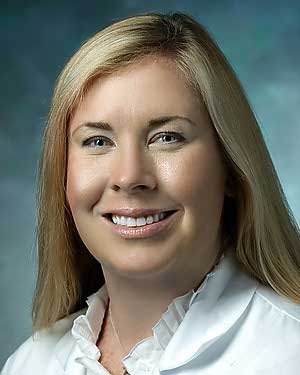 Heather Di Carlo
Johns Hopkins has been a national leader in bladder exstrophy care since 1975, when Robert Jeffs, who pioneered a staged approach to correcting exstrophy birth defects, joined the Children’s Center faculty as director of pediatric urology.
Today, Heather DiCarlo follows in the august footsteps of Jeffs and John Gearhart, director of pediatric urology from 1991 to 2025. DiCarlo, who joined the pediatric urology faculty in 2014 following a pediatric urology fellowship at the James Buchanan Brady Urological Institute, is now director of pediatric urology research and interim division director of pediatric urology.
The center’s long history provides a rich database of more than 1,500 patients over the past 50 years, she says, allowing clinicians and researchers to continually improve care by following patients throughout their lives and studying long-term outcomes.
Treatment typically includes multiple surgeries; a program to help children overcome the physical and psychological barriers to continence, both before and after surgeries; and continued medical involvement even after the patient graduates to adult urology care. Care may begin with parental consultations before their baby is born, and continues throughout a patient’s life with a multidisciplinary team that includes orthopaedic and plastic surgeons, psychologists, radiologists and nephrologists.
“Being proactive helps us care for these patients into adulthood,” says DiCarlo. “We don’t just operate and say ‘see you later.’ We’re following them for the rest of their lives. We basically follow them longitudinally, which has really been amazing.”
About 1 in 50,000 babies — more male than female — are born with their bladder flat and open outside their bodies, usually with imperfectly formed abdominal walls and genitalia. The condition is serious, but treatable.
The pediatric urology team operates on about 20 children with bladder exstrophy a year, says DiCarlo, and provides ongoing care to many more people born with the condition. Patients come from across the country and the globe, some of whom are diagnosed in utero, others who are seeking care as teenagers or older.
“We have had patients come to us in their 20s who were never closed, and we take care of them. Of course, that’s more complicated because you’re doing an osteotomy on an adult pelvis,” notes DiCarlo.
Typically, surgeries take place in stages, with the first one focused on rebuilding the bladder and pelvic bones, and moving the bladder to the abdomen. These are not necessarily done right away.
“After the baby is born and stable, we do an exam under anesthesia so we can manipulate the hips and the pelvis to see how closeable the bladder is,” DiCarlo explains. “We’re seeing if it’s soft enough that we can turn it into a sphere and tuck it into the abdomen. Sometimes it’s too small to be closed, so we have to wait a few months for the baby to grow. It’s very individualized for each patient.”
Genital surgeries, which are linked to continence and sexual function, follow.
“We do a lot of genital reconstruction in these patients, particularly in boys, who will often need more reconstructive surgery to be able to have normal sexual function,” she says.
Another important milestone is continence. “The majority of these patients do need to have a surgery to make them continent or drive urine,” she says. “The reason for that is even though we close the pelvis, the pelvic floor is still not the same as it is for patients without bladder exstrophy. As the child is closer to being interested in continence, we have them see our Pediatric Voiding Improvement Program. They do the hard work to set them up for success.”
DiCarlo says she is inspired by the children she sees running around and playing at the bladder exstrophy picnic that Johns Hopkins hosts each year for patients, families and clinicians.
“It’s a life-changing diagnosis, but these kids do amazing things,” she says. “You can’t tell which children have exstrophy and which are their siblings who do not. What we learn from our families and what we’re doing to make it better for them and for future patients is just so remarkable and rewarding. I’m grateful to be part of this.”