
A Cancer-Causing Gene Mutation and its Achilles Heel
The HOXB13 X285K mutation, found mainly in men of West African descent, relies heavily on male hormones – which makes it more vulnerable to hormonal therapy.
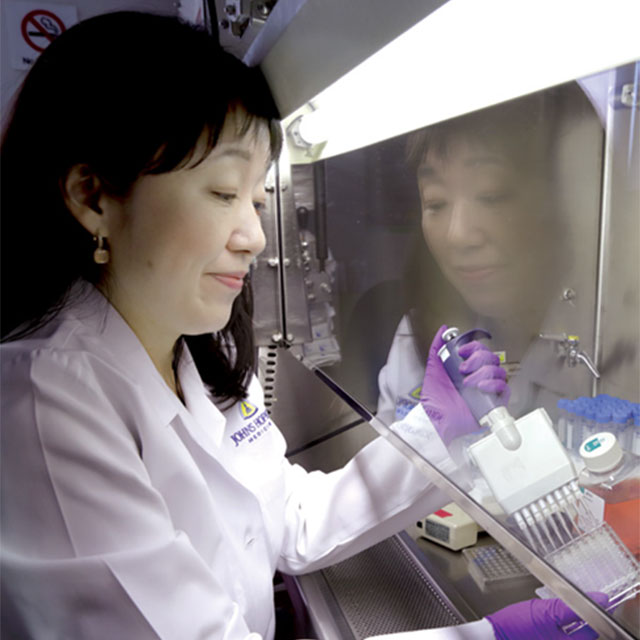
Kanayama: Men with the X285K mutation respond better to prostate cancer therapies targeting the androgen receptor.
Men who are born with a rare genetic change, the X285K mutation of the HOXB13 gene, are not only more likely to develop prostate cancer, but to have an aggressive form of it. In encouraging news, Brady scientists have discovered that this mutation has an Achilles’ heel: because cancers with this mutation rely heavily on male hormones (called androgens), they are more susceptible to hormonal therapy.
In a recent study, “we looked for prostate cancer patients who carry the X285K mutation and who were treated with hormone-blocking therapies,” says research associate Mayuko Kanayama, M.D., Ph.D. “Although this mutation is rare – found in about one to two percent of prostate cancer cases, mainly in West African men – we were able to find 21 patients with this mutation, and had detailed treatment records for six of them.”
They found that although men with this mutation tended to have high-grade prostate cancer with aggressive features similar to those in men with a faulty BRCA2 gene, “these patients generally show favorable and longer responses to therapies targeting the androgen receptor (AR),” drugs such as enzalutamide and abiraterone, says Kanayama. “Our results suggest that men with the X285K mutation may especially benefit from treatments that target male hormones, because their cancer depends more on these hormones. Since this is the first study to investigate how patients with this mutation respond to treatment, we plan to conduct further research to confirm these findings and determine if the mutation predicts who will benefit more from hormone-blocking therapies.”
Because of research conducted at the Brady, “several genetic testing labs now list the HOXB13 X285K mutation as one that likely increases prostate cancer risk,” adds Kanayama. “This is now being reported on genetic tests, and our findings could help doctors and patients choose more personalized treatments in the future.” These results underscore the importance of germline genetic testing for all men with metastatic prostate cancer, “and offer new hope for a population disproportionately affected by the disease.”
This work was reported in Prostate Cancer and Prostatic Diseases. Kanayama, first author of that paper, also presented this research in a poster session at the Prostate Cancer Foundation’s annual scientific conference.
Two More Genes of Interest
Scientist Mayuko Kanayama, M.D., Ph.D., has received a Schaufeld Program award to conduct pilot studies of two genes: MMS22L and TONSL. “The products of these two genes act together to repair DNA,” says Kanayama. “But a change in these genes may result in a defective product, and may compromise DNA repair.”
These alterations can raise a man’s risk of getting prostate cancer – but here again, there may be an Achilles’ heel: “They also may sensitize the cancer cells to effective treatments,” Kanayama says. She and colleagues have identified rare inherited mutations in both of these genes that are noteworthy for their links to specific ancestry: “For MMS22L, individuals of Jewish heritage may benefit from genetic testing for this mutation,” which is more common in this population. “For TONSL, we found a novel mutation limited to men of African ancestry.”
TONSL functions through MMS22L, Kanayama explains. The pilot study will help shed light on the interaction and activity of these genes, which one day may be helpful biomarkers to help shape treatment decisions in prostate cancer.