
The 27th Annual Technician Course — An Enlightening Experience
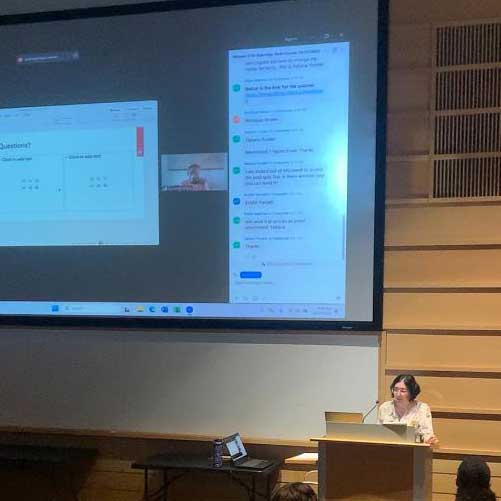
Heather Connors, certified low vision therapist, hosting Wilmer’s 27th Annual Technician Course
On Saturday, October 25, 2025, the Wilmer Eye Institute, Johns Hopkins Medicine hosted its 27th Annual Technician Course — virtually and in person — at the Albert H. Owens Jr. Auditorium. The yearly meeting provides an opportunity for ophthalmic technicians to learn from some of the preeminent ophthalmology experts and for certified ophthalmic technicians to earn 6.25 IJCAHPO Group A continuing education credits.
This year’s presentations included Evaluation and Disorders of the Pupils by Michael Carper, M.D., assistant professor of ophthalmology; Not Enough Tears to Cry - Are My Eyes Dry? by Sezen Karakus, M.D., assistant professor of ophthalmology; Pediatric Glaucoma - Latest Surgical Procedures by Courtney Kraus, M.D., associate professor of ophthalmology; The Ocular Angle Structure by Bryce Chiang, M.D., assistant professor of ophthalmology; The Ophthalmic Technician’s Role In Vision Rehabilitation by Judith Goldstein, O.D., the Dr. Arnall Patz Endowed Professor for the Lions Low Vision Center; and Understanding Strabismus & Amblyopia in Children by Bo Wang, M.D., Ph.D., assistant professor of ophthalmology.
Israel Constantino, ophthalmic technician at Wilmer at Johns Hopkins Care, Arlington, Virginia, is new to Wilmer but not unfamiliar with the topic of retinal detachments. Before joining the Wilmer team, Constantino spent three years as a technician at a retina practice and says What's Behind the Curtain - Vitreous/Retinal Detachment by Joana Andoh, M.D., ophthalmology resident, was both refreshing and enlightening. Furthermore, Constantino believes the Annual Technician Course provides a constructive learning setting and encourages thought-provoking conversation.
“As ophthalmic technicians, we have a duty to always learn and improve,” he says. “This event opens the door to learn from your providers and creates an environment where professionals can learn from each other.”
Marianne Cowley, M.D., clinical associate of ophthalmology and retina specialist, was in person at the event to complement Andoh’s presentation and to field any real-time questions from participants. Cowley says that because technicians are the first practitioners a patient sees, it is important for them to obtain a detailed medical history and to provide a thorough examination before they meet with the ophthalmologist — especially with something as critical as a retinal detachment.
Additionally, she says meetings like the Annual Technician Course are paramount to the success of ophthalmic technicians. “This is an opportunity to sit down and really reflect on what they're doing, the importance of what they're doing and what it means,” says Cowley. “It arms technicians with the information that makes their exam makes sense. I don't think that we can do a good job at anything unless we understand why we are doing what we are doing.”
Jessica Sanchez, ophthalmic technician at Wilmer-Green Spring Station, says Droopy Eyelid, What's the Difference? by Chris Cho, M.D., Ph.D., ophthalmic plastic and reconstructive surgery fellow, was a highlight. For Sanchez, it illuminated the option to use phenylephrine — an eye drop used to dilate the eyes of patients in clinic — as a treatment mechanism for a droopy eye lid (ptosis), the prospect that ptosis can be indicative of other serious health conditions like cranial third nerve palsy, and the importance of recognizing the clinical signs of ptosis during examination and reporting those to the doctor.
Ptosis is one of the most common conditions presented in clinic and one of the most important diagnoses he treats as an oculoplastic surgeon, asserts Cho, who stresses that ptosis is much more nuanced than its common misconceptions as an aesthetic problem or an age-related condition. “There are so many different etiologies that can result in the same physical findings,” he says. “Some of them could be life-threatening medical emergencies and others can be a genetic disorder.”
This year, the course saw a 20 percent increase in the number of participants. Nidia Adames, ophthalmic training manager, says that because of the attendance growth in recent years, she is looking for a larger space in which to host the event in person next year. Adames adds that the growth is a testament to the added value the three-decades long program brings to Wilmer and the greater community.
“This event is a tradition that technicians look forward to in order to broaden their knowledge in ophthalmology, engage in meaningful discourse with experts and have the opportunity to earn continuing education credits.” she says.
The 28th Annual Technician Course is scheduled for Saturday, October 24, 2026.


