
Rx: Fixing AI’s ‘Superhuman Burden’ on Doctors
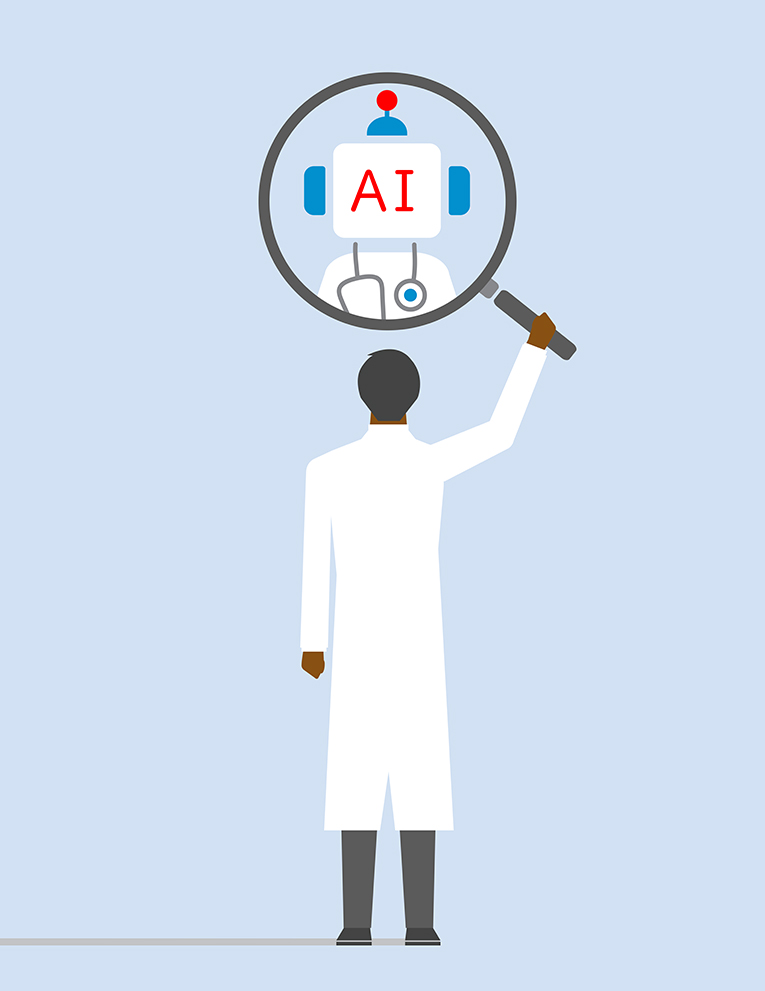
Advances in artificial intelligence hold the promise to transform the delivery of health care, by reducing medical error and improving the accuracy of diagnoses while alleviating physician fatigue by freeing time from mundane tasks.
In practice, however, implementation of assistive AI technology risks having the opposite impact on doctors, imposing “an immense, almost superhuman, burden on physicians,” according to Christopher Myers, professor at Johns Hopkins Carey Business School, with a joint appointment in Anesthesiology and Critical Care Medicine.
In a Viewpoint article published recently in JAMA Health Forum, he and two co-authors* explain why — and offer a path forward:
The Problem: Health care organizations are adopting AI technology at a much faster pace than laws governing its use can be put in place, Myers says. Thus, “[doctors] are expected to rely on AI to minimize medical errors, yet bear responsibility for determining when to override or defer to these systems,” the researchers note.
“The narrative is that AI will lighten the burden on doctors,” says Myers. “But the reality is that AI-generated guidance is just one more thing for physicians to consider and it adds pressure to always reach the right answer.”
Complicating the picture for physicians is the “black box” nature of AI systems, which obscures how recommendations are generated. Myers notes that doctors frequently “express concerns about the lack of interpretability and transparency in AI outputs: ‘Sometimes it’s right and sometimes it’s wrong, and I don’t know when or why.’”
Sussing out an accurate conclusion requires considerable extra work on the part of physicians, he says, which can exacerbate issues of burnout. In doing that extra work, they must navigate two opposing error risks: false positives, in which they rely on erroneous AI guidance; and false negatives, involving an under-reliance on accurate AI guidance.
Such decision-making places a disproportionate moral responsibility on physicians, say Myers and his co-authors. They point to research showing that when it comes to adverse outcomes involving AI inputs, physicians are consistently viewed as the most liable party — more than health care organizations, AI vendors or regulatory bodies. “AI risks heightening the potential for increased burnout and errors, and ultimately undermining the very goals assistive AI seeks to achieve,” the authors write.
Shifting the Burden: In “the next frontier,” Myers and colleagues note, health care organizations must step up to shoulder more of the burden to support doctors’ calibration efforts, so physicians know how and when to leverage AI to avoid issues of liability.
Organizations could begin to implement standard practices such as checklists and guidelines for doctors to evaluate AI inputs, then use gathered data to track clinical outcomes and identify patterns of effective and ineffective AI applications. The insights gained could then be shared with doctors and further refined through input from interdisciplinary teams involving physicians, administrators, data scientists, AI engineers and legal experts.
The authors also suggest integrating AI training into medical education and on-site programs through simulation training, providing “a low-stakes environment for experimentation” that would allow doctors to build their confidence and familiarity with AI systems while reducing the risks involved with treating actual patients.
Myers says the ultimate goal should be to create an environment “where physicians are supported, not superhumanized,” when incorporating AI into their decision-making.
*Co-authors are Johns Hopkins otolaryngology–head and neck surgeon Yemeng-Lu Myers and Shefali V. Pail (University of Texas at Austin).