
Power Surge
How measuring rhythmic waves on the membranes of cancer cells could yield insights to better stage cancer — and develop drugs to slow or halt its spread.
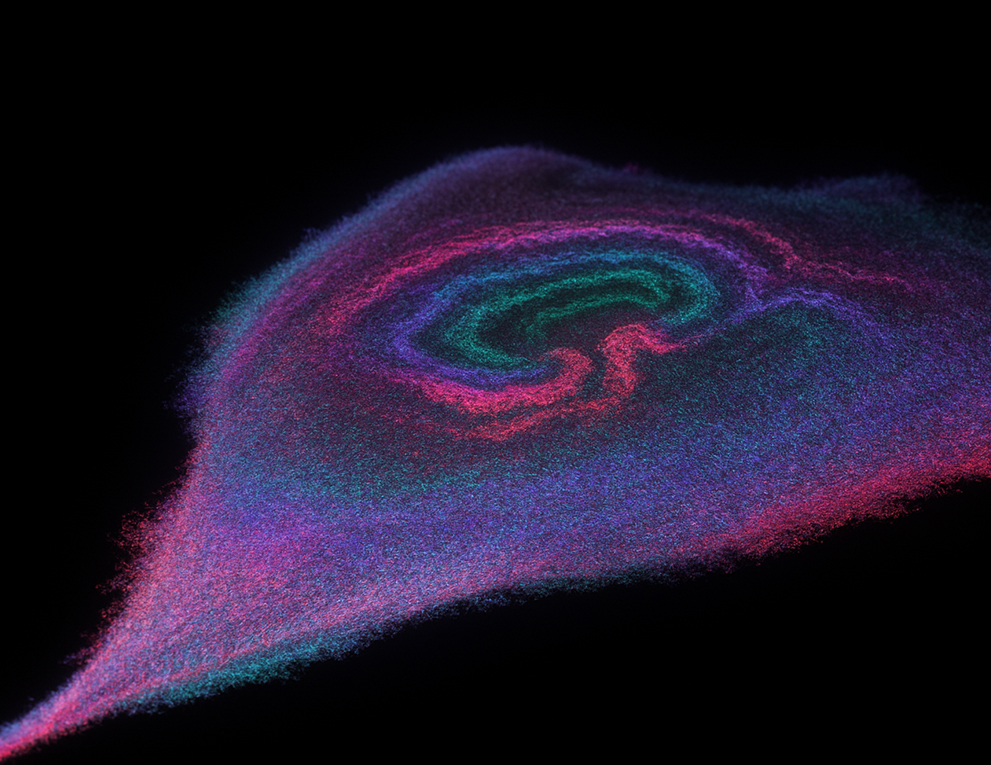
Glycolytic waves drive and fuel cancer cell migration. The image, captured with a high-powered microscope over 9-minute intervals, is color-coded from early to late time points showing wave activity (green, blue, purple, pink, red). Credit: David Huiwang Zhan
Just what powers the explosive growth and spread of cancer cells?
New research by a Johns Hopkins team points to power-generating waves on the covering, or membrane, of these cells. The scientists say the waves, generated by rhythmic propagation of enzymes that produce energy from glucose, could potentially be used to better stage cancers, and as targets of drugs designed to slow down or halt the spread of cancer.
In experiments with human cancer cells grown in the laboratory, the researchers also suggest that measuring the energy-producing waves could help to stage cancers in a more universal and standardized way, regardless of subtypes and genetic mutations.
“Our findings suggest a correlation between higher levels of the energy-producing waves and a greater severity of the cancer, or the cancer’s potential to spread to other organs,” says cell biologist Peter Devreotes, corresponding author of a report of the team’s findings, which appeared in Nature Communications.
In cancer biology, scientists have long known of the Warburg effect, a process in which cancer cells utilize more energy from a less efficient pathway — glycolysis — rather than the more efficient mechanism, oxidative phosphorylation.
“That appears to be a paradox for cancer because cancer cells need much more energy to grow than normal cells,” says team member David Zhan, a postdoctoral researcher in Devreotes’ lab who has since joined cancer drug developer BeOne Medicines.
The researchers say it was taught in biochemistry class for many decades that glycolysis occurred uniformly in the cytosol, or the fluid matrix of the cell. But when the team examined cancer cells grown in the lab, they found that energy-generating enzymes gather and move as waves on the cell membrane, suggesting a more fine-tuned energy production process.
“This finding may challenge the canonical textbook knowledge that we all learn from the biochemistry course,” Zhan says.
Next, Devreotes says his team plans to investigate exactly how the energy-producing waves occur in the cell membrane.
“Our findings suggest a correlation between higher levels of the energy-producing waves and a greater severity of the cancer, or the cancer’s potential to spread to other organs.”
Peter Devreotes