
Measure by Measure
Specialists are leading national efforts to define standards for music-related injuries and health care.
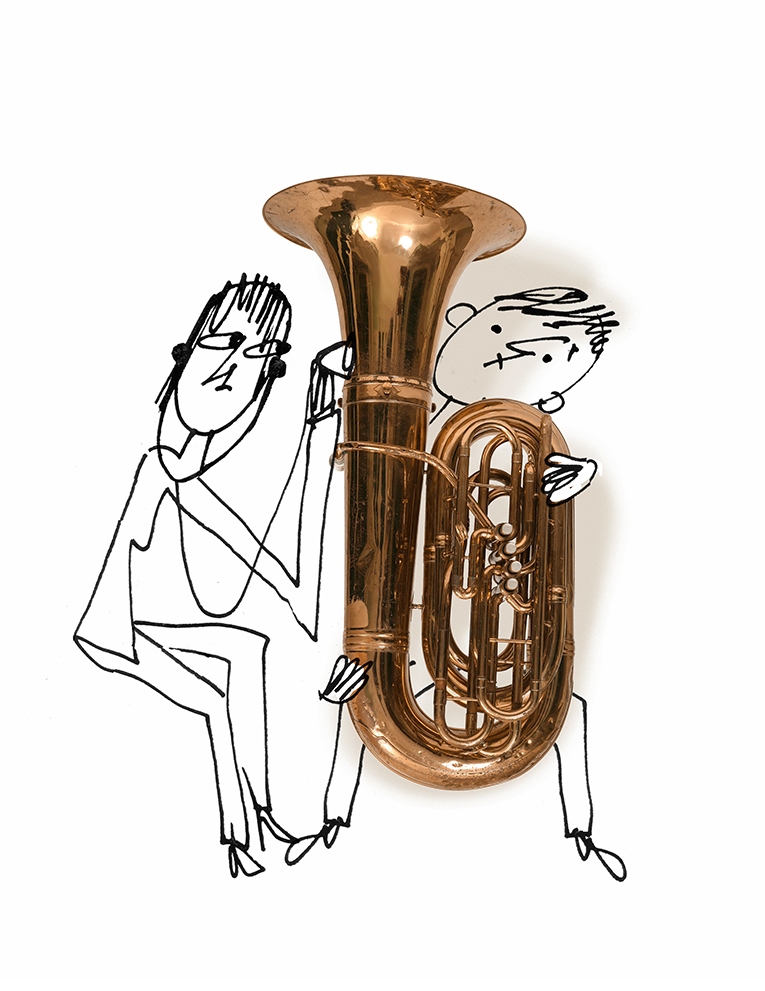
Illustrations by Serge Bloch
In the physical therapy wing of The Johns Hopkins Hospital, patients receive treatment in an open-plan office. One physician tests the mobility in a man’s knee; at a table next to them, a woman answers questions about her chronic wrist pain. All of them lift their heads at the sound of a flute deftly played by another patient across the room.
This patient is Shawn Manley, a 26-year-old student in flute and piccolo performance at the Peabody Institute. He’s been receiving treatment for a performance-related pain in his left arm since he started his master’s degree two years prior. Manley suffers from tennis elbow and irritation of the ulnar nerve — conditions caused by repetitive use, like swinging a tennis racket, or, in his case, playing the flute for hours a day.
He’s part of a growing number of musicians seeking treatment at the Johns Hopkins Rehabilitation Network Clinic for Performing Artists, an outpatient program designed to treat the specific injuries that arise from performance. Roughly half of the clinic’s 650 annual patients seek treatment for ailments related to playing a musical instrument; the other half are dancers. With locations throughout the greater Baltimore metro area, the clinic treats musicians ranging from grade school ages to professionals. Patients come from all over, sometimes traveling from out of state to receive care.
Overuse injuries rank among the most common complaints, along with lower back pain, but according to specialists currently working in the field, musician-specific health care is an area of medicine that’s vastly under-researched and underdeveloped. In the coming years, Johns Hopkins — which includes one of the country’s leading music conservatories in Peabody — is uniquely positioned to define standards of care for music-related injuries and health care.

Serap Bastepe-Gray, the physician treating Manley, is one of those specialists. She started her career in medicine, left it to pursue studies in classical guitar, and now holds joint appointments at Peabody and at the Johns Hopkins Department of Neurology, where she focuses on musculoskeletal and neurological disorders affecting musicians.
After two years working with Manley, her manner is familiar and gently teasing as she leads him through stretches, hot beeswax therapy and work with a “sound blaster” machine she’s affectionately named Chloe. Via a wand-like device, Chloe pulses soundwaves into knotted tissue, breaking it up via a process called mechanotransduction. Manley describes the sensation as a thousand little beestings — startling, but not always unpleasant.
Bastepe-Gray also enquires into Manley’s extramusical activities. She scolds him for doing handstands in CrossFit (“Would you stand on your iPhone? No? Then why would you stand on your precision hand?”) and checks Manley’s pencil grip. Manley picks up work at the Baltimore Symphony Orchestra, marking bowings into the string players’ parts — more hours of small, repeated hand movements. Apparently, Manley learned, his grip is “all wrong” and channels extra tension into his forearm, so he’s had to retrain himself how to write with the help of an ergonomic pencil grip.
Their work is paying off: Manley is gradually increasing his daily playing time. He plans to be up to two and a half hours within the next week. It’s progress — but still way off the number of hours musicians are expected to play to succeed in a school or professional setting. Between individual practice, lessons and ensemble playing, it’s not uncommon for professional-track musicians to play for four to eight hours — or more — every day.
Take that kind of pressure and combine it with the fact that most musical instruments are fundamentally non-ergonomic, and you’ve created a breeding ground for injuries and chronic pain.
But if the need for music-specific medicine is apparent, the method of treatment is not. Every instrument is different and creates unique ailments, Bastepe-Gray notes. Players of wind instruments, for instance, don’t have to worry about “fiddler’s neck,” or the hickey-like sores that develop under the chins of violin and viola players, and instrumentalists in general don’t have to be concerned about polyps developing on their vocal cords the way vocalists do. The most common conditions that Bastepe-Gray treats at the clinic include specific tendinopathies and neuropathies, like bicep tendonitis and carpal tunnel syndrome, as well as “nonspecific overuse syndromes of distal upper limbs” — or, painful conditions that “do not meet established criteria for specific disorders,” she says.

That there are so many nonspecific conditions requiring treatment underscores the need for both breadth and expertise in the developing field of musician health care. It’s a problem that’s top of mind for Andrea Lasner, a physical therapist and the manager of the Clinic for Performing Artists. Lasner danced professionally in her early career and throughout the duration of her studies in physical therapy. When the Johns Hopkins clinic opened in 2018, Lasner applied that background in treating dancers to the clinic’s work with musicians by creating a screening program — one that would assess a musician’s physical wellness and use it to measure progress over the course of treatment.
They’ve since paused those screenings. Said Lasner, “We’re trying to restructure it because we felt the screen was not giving us specific information.” She and Bastepe-Gray have discussed “how to make it more instrument-specific.”
“We don’t know whether what we’re doing is working,” said Bastepe-Gray. “We don’t have outcomes that can actually measure the change in the health status or symptoms or quality of life of these musicians based on the clinical care given to them. The field is not formalized.”
“We don’t have outcomes that can actually measure the change in the health status or symptoms or quality of life of these musicians based on the clinical care given to them. The field is not formalized.”
Serap Bastepe-Gray
‘Something to Pay Attention To’
Both Lasner and Bastepe-Gray compare the field to that of sports medicine, as musicians are athletes of fine muscle movements. In Bastepe-Gray’s estimate, “We’re talking about 20 years of work to come up with something that is as solid as more advanced fields in health care.”
One of the hurdles specialists in the field face is that “musicians’ health care is still being taught as a niche area,” she continues. While it’s true that a minority of people pursue music with the fervor of someone like Shawn Manley, surveys estimate that roughly two-thirds of Americans play musical instruments at some point in their lives.
“We know that injury rates are, I don’t know, from 36% to 92%,” says Bastepe-Gray. “If so many people are walking around with musculoskeletal disorders because they’re playing instruments, it’s something to pay attention to.”

Someone who knows a lot about the kind of research that would further musician health care is Kris Chesky, who joined Johns Hopkins as a Bloomberg Distinguished Professor in 2023. He serves a joint position with both Peabody and the Department of Physical Medicine and Rehabilitation. A jazz trumpet player, Chesky became interested in the intersection of music and health while pursuing graduate studies at the University of North Texas. He then spent the bulk of his career at UNT, pursuing research into safety standards for musicians and advocating for the implementation of those standards within music schools and programs.
Chesky is nothing if not passionate about the importance of music schools being the ones to lead the charge in musician health, rather than have students take on the individual burden for adapting to unrealistic standards. But that, too, requires reliable data.
Take hearing health, the area of musician wellness to which Chesky has dedicated most of his research. In 2010, Chesky was awarded the Safe & Sound Award from the National Institute for Occupational Safety and Health for his work measuring sound levels in UNT’s music programs.
“I was able to assess risk for hearing health in 600 different ensemble-based learning activities,” Chesky says. “It was the biggest data set like this ever collected.” What he found was that even when accounting for things like genre, instrumentation and acoustic space, essentially, “one teacher could be riskier than another.”
Why? “It was fascinating,” Chesky says. “What happened temporarily is the basis for elevated or reduced risk. It’s not necessarily just because you got too loud. It may be that you didn’t spend any time playing pianissimo.”
It’s not that these teachers had ill intent: Safety standards for things like hearing health simply weren’t included in their training.
As the field of musician health care advances, it will be just as important to change the culture around music education, he notes. “One of the major faults with the music discipline is it hangs onto these traditions,” Chesky says. In the “master-apprentice” style of instruction, “the burden is on the musician to rise up to these standards.” Those are attained through hours of daily practice. And that may help a musician win the next competition or job, but have a deleterious effect on longevity.

Setting National Standards
Changing a culture requires a sea change — and lots of teamwork. To that end, in July, Johns Hopkins held a Global Summit on Occupational Health in Music at the Bloomberg Center in Washington, D.C. Organized by Chesky, the summit invited musicians, physicians, educators and other experts from all over the world who are working at the intersection of music and health. Their discussion of the field’s challenges and solutions was directed towards one goal: pushing music institutions to adopt health standards and systems of accountability. It’s key to the broader goal of the specialists working at Hopkins to create and set national standards.
That includes within Johns Hopkins’ own music programs. At the Peabody Institute, Sarah Hoover serves as the associate dean for innovation in the arts and health. She’s tasked with leading the charge in changing Peabody’s culture, prioritizing the creation of a school-wide strategy and implementation of musician health standards.
Just over the last decade, Hoover has witnessed — and helped usher in — a change in their approach. “We’ve moved from thinking about [musician health as] that model that equips students with resources towards a much more holistic and system-wide model,” she says. “We need to become a campus that incorporates health and well-being into every aspect of how a student’s learning takes place.”
Chesky was hired in part to help build out a research enterprise in musician health, which Hoover envisions as informing Peabody’s immediate strategy in the years to come. With Chesky’s arrival, Peabody created a new academic department in Performing Arts and Health, which Chesky chairs. “It still has a very small profile because we don’t have funding to add new faculty lines there yet,” Hoover explains. “But we anticipate there will be a performance psychology position that will offer coursework in research and serve as a resource [to students].”
It would be easy for this work to feel overwhelming. There are so many aspects to musician health that need focused study, and spearheading culture change is not for the faint of heart. But for Hoover and the specialists working across Johns Hopkins Medicine and Peabody, it’s also “exciting.”
“It’s a stormy time,” Hoover says. “In a good way. We’re dismantling and rebuilding these models. It’s time for us to rethink this.”
For Clinicians Clinical Connection
Clinicians, discover the latest in research and clinical innovation from Johns Hopkins experts. Access educational videos, articles, CME courses and other resources from our world-renowned institution.