
A Special Journey: Helping Savannah Breathe on Her Own
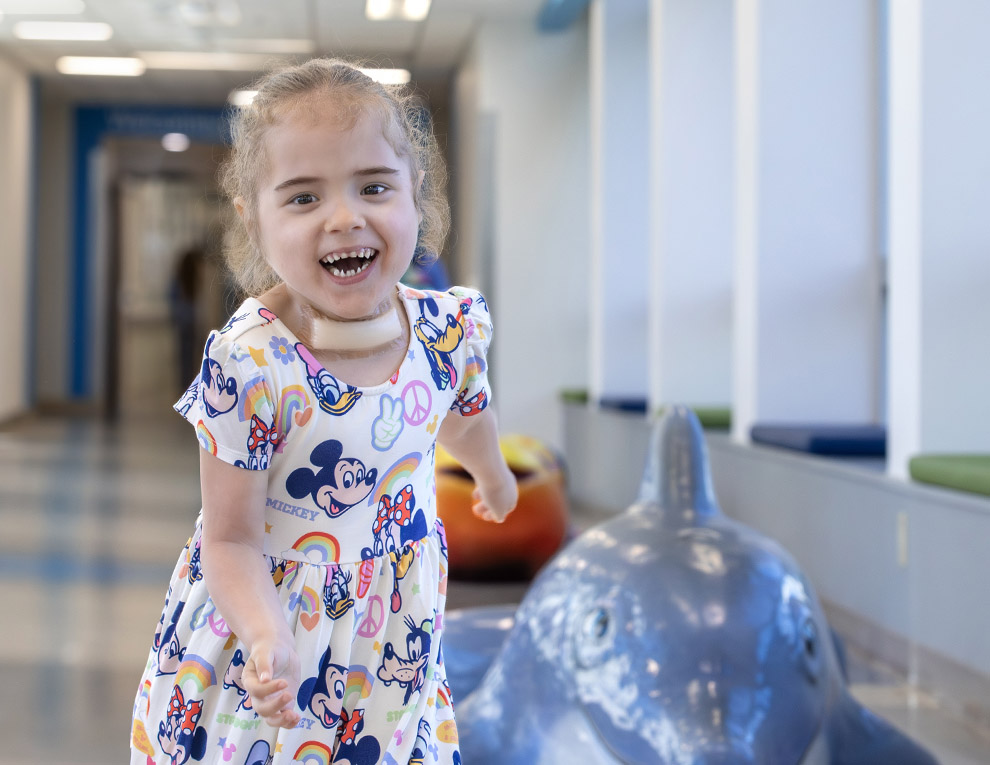
When Savannah arrived at Johns Hopkins All Children’s Hospital in St. Petersburg, Florida, for care, she had spent most of her 13 months of life in multiple hospitals across several states.
She had chronic lung disease, pulmonary hypertension and trouble feeding. She breathed through a tracheostomy — a surgically-created opening in the neck — and needed the help of a ventilator, especially at night.
Born prematurely in October 2021, weighing only 1 pound, 4 ounces, Savannah’s fragile lungs needed all the help they could get to overcome bronchopulmonary dysplasia (BPD), which is common in premature infants.
At Johns Hopkins All Children’s, she began to receive care through the pulmonology and lung surgery team, which has been ranked nationally in U.S. News & World Report’s Best Children’s Hospital rankings in that specialty.
“The hospital told me they had the team and resources to take care of Savannah,” her mom, Sara, says. “That meant everything to us.” Many specialists at Johns Hopkins All Children’s, including the pediatric pulmonology team, collaborated to take care of Savannah, and by Christmas Eve 2022, she was finally ready to go home for the very first time.”
From there, Savannah’s long-term pulmonary care transitioned to the Pediatric Home Ventilator Clinic at Johns Hopkins All Children’s, which specializes in helping families manage the many complex needs of children who need long-term ventilator support to breathe. The multidisciplinary clinic, led by Nicholas Jabre, M.D. — a pediatric pulmonologist who completed his residency training at Johns Hopkins All Children’s and fellowship at Johns Hopkins University in Baltimore — worked closely with Savannah and her family over the next one and a half years.
After transitioning to the clinic, Jabre and his team consisting of respiratory therapists, speech pathologists, and complex care nurses, helped Savannah slowly reduce her amount of time on the ventilator. By June 2023, she started going short periods without nighttime support. By December, she was using a speaking valve during the day — allowing her to make sounds and begin to “talk.”
Overall, Savannah was making progress, but she hit another bump in the road to recovery. The medical team discovered her airway was being blocked by enlarged adenoids. Through collaboration with colleagues in Ear, Nose and Throat (ENT) at Johns Hopkins All Children’s, her tonsils and adenoids were able to be removed by Peter Karempelis, M.D. After surgery, her breathing — and her voice — improved dramatically.
By spring 2024, a sleep study showed her lungs were strong enough, and doctors were finally able to remove her tracheostomy tube. For the first time, Savannah could breathe completely on her own.
“She’s done so well and now only needs a small amount of oxygen at night,” Jabre says. “We expect that, with time and growth, she won’t need any oxygen at all.”
Now almost 4 years old, Savannah continues to amaze everyone around her. She’s in speech therapy, uses a communication device, and never stops trying.
“She’s our miracle,” Sara says. “She’s come so far. Dr. Jabre has been such a blessing — he listens, he cares, and he believes in her.”
Jabre agrees that Savannah’s success is the result of incredible teamwork. “This is a story of persistence, hope, and a mother’s determination,” he says. However, he also notes that, “being able to remove the tracheostomy tube may not be possible for every child who needs a ventilator — and that’s OK. Each child’s story is different, and we want to work with families to meet their specific needs and help each child meet their fullest potential.”
Together, Savannah, her family, and the Pediatric Home Ventilator Clinic team achieved what once seemed impossible — helping Savannah breathe on her own.
Peter Karempelis, M.D., is on the medical staff of Johns Hopkins All Children’s Hospital, Inc. (“JHACH”) but is an independent practitioner who is not an employee or agent of JHACH.