
A Link in the Chain
Decades after his training at Johns Hopkins, a seasoned preceptor continues to share the insights he gained from medicine’s ‘founding fathers.’
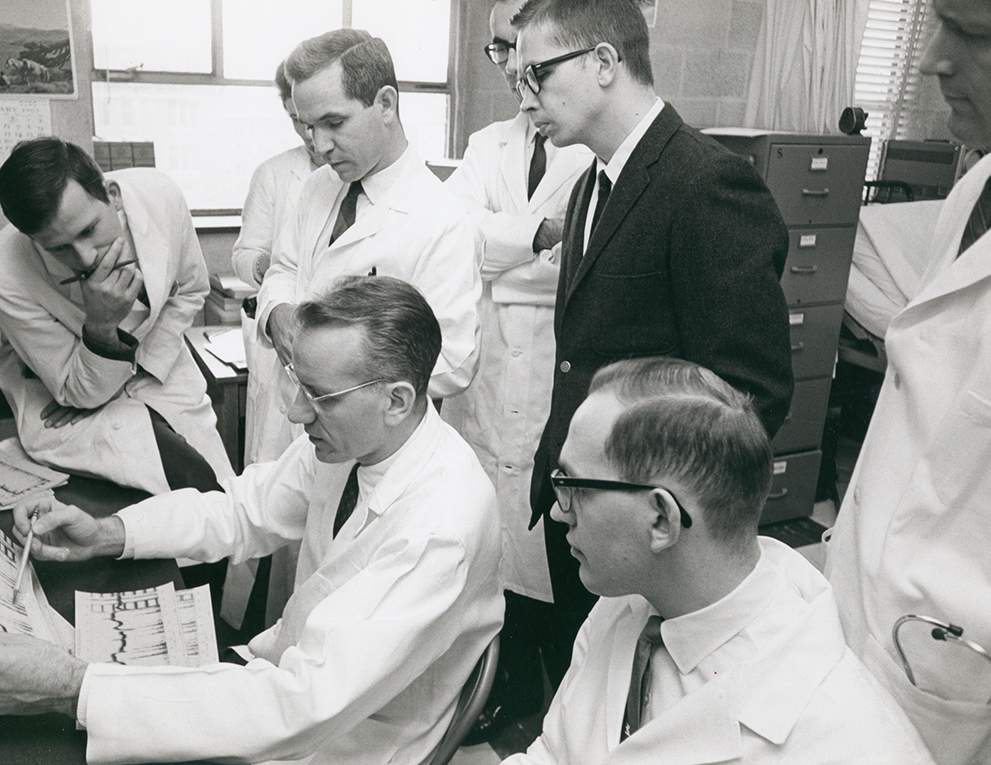
Victor McKusick ’46, seated at center, with Johns Hopkins trainees, ca. 1965.
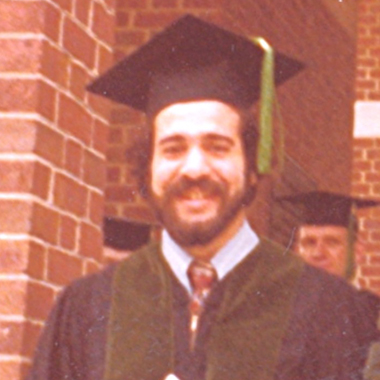 The author, on his Johns Hopkins medical school graduation day in 1975.
¡Hola, amigo! ¿Cómo estás?
I turned to see Raoul Velasquez striding down the clinic hallway toward me. Stopping inches short of bowling me over, he embraced me with an exuberant bear hug. “You’re still here!” he exclaimed with delight. I instantly inferred his meaning — that I had not yet succumbed to the infirmities of old age, the perils of institutional politics, or the ever-present specter of burnout.
“Raoul! You grew a beard! How distinguished!”
“Well, I’m old enough to qualify as a gray beard, so I thought, ‘Why not grow one?’”
We had met during an endless orientation day when we joined the faculty three decades earlier — I from Boston via Johns Hopkins, he from Cuba via the University of Miami. We had become good friends, and now we were among the oldest members of the faculty. My fellows were off seeing their first patients, so we stood outside the doctor’s workroom, exchanging updates on our children, sharing tidbits of institutional gossip, and comparing recent ailments like school kids trading baseball cards at recess.
“How did we make it this far, Raoul?” I asked, only half in jest.
“Well, my mentor in Cuba always said, ‘Stay close to the students — for they are pure.’”
Seeing that several fellows had returned to the workroom, Raoul took my arm and escorted me inside. “Do you know how lucky you doctors are to have Dr. Weinberg as your preceptor?” he announced to all. “This man trained with the founding fathers.”
I could tell that my fellows had no idea what he was talking about.

Pearl: Trailblazing Geneticist
A founding father of medical genetics, Victor McKusick ’46 (left) established the nation’s first medical genetics program and clinic at Johns Hopkins, in 1957. He is renowned for creating “Mendelian Inheritance in Man,” a comprehensive catalog of human genes and genetic disorders, now available online as “Online Mendelian Inheritance in Man.” It remains a definitive source of information on human genes and genetic disorders.
“So, who were the founding fathers?” one of them inquired after Raoul had departed.
“They wrote the Declaration of Independence,” volunteered one of his colleagues.
“No, they’re an indie rock band,” rejoined another.
“Yeah, I heard them last summer. They’re really cool!” a third fellow opined.
Sadly, their bemusement did not surprise me. The history of medicine is seldom taught in medical schools now, so this generation has little knowledge of the great minds of 20th-century internal medicine whose brilliance laid the foundation upon which our practice rests. Those of us who trained with them, however, still speak their names — Harrison, Stead, Oates, Seldin, Woodward — with reverence and recall their encyclopedic knowledge and bedside skill with awe. My nostalgic reflection was interrupted by Dr. Samantha Grace, a gastrointestinal fellow whose quiet demeanor hid an intense scholarly curiosity.

Sir William Osler, a founding father of modern medicine, famously stated, “The good physician treats the disease; the great physician treats the patient who has the disease.”
At this revelation, a deeply buried ember of memory reignited into flame. “Have there been any sudden, unexplained deaths in your family?”
“My mother’s older sister suddenly choked to death. They never figured
out why.”
Smiling inwardly with recognition, I told her, “I think I know what’s going on here. You have hereditary angioedema.” I then proceeded to explain the disease, its cause, and how we could diagnose and treat it — as much to Dr. Grace as to the patient.
We entered orders for C1-esterase assays and sent the patient off to the lab. “How did you know this, Dr. Weinberg?” Dr. Grace asked with a tone of respectful wonder.
“Hereditary angioedema is a once-in-a-lifetime diagnosis, but I’ve been a physician for over 50 years now and, fortunately, I can still remember what I’ve seen once before.”
“Was that in the time of the founding fathers?” she asked without a trace of irony or sarcasm.
“Yes, it was,” I said, and with exquisite clarity of memory, I told her: I am a third-year medical student, anxiously waiting outside my patient’s room on Osler 3 for attending rounds to begin. The door at the end of the ward bursts open, and I watch as Dr. Victor McKusick — physician-in-chief at Johns Hopkins University School of Medicine and founding father of medical genetics — sweeps down the hallway toward me, his entourage in tow. I stand opposite the great physician at the bedside and present the case: a 25-year-old woman with chronic abdominal pain that has mystified her doctors. Dr. McKusick listens carefully, and then asks if she ever gets facial swelling. “No,” she replies, “but my hands swell up before the pain starts.” Dr. McKusick nods. He knows the diagnosis. “This is hereditary angioedema, first described by William Osler,” he tells us. We listen to him in rapt attention as he expounds upon its clinical features, pathophysiology and genetics. I glance at my patient. She is crying. Finally, someone knows what is wrong with her.
Dr. Grace listened attentively. When I had finished my story, she was silent for a moment and then remarked, “I wish I could have been there with Dr. McKusick.” Her wistful earnestness touched me, and for a fleeting moment I imagined myself a blacksmith, forging one more link in a chain of medical knowledge spanning the centuries. I smiled back at her.
“Today, you were.”
Richard B. Weinberg is a professor of Internal Medicine–Gastroenterology and Integrative Physiology & Pharmacology at Wake Forest University School of Medicine. This essay first appeared in the American Journal of Medicine and is reprinted with permission.