
Carson’s Journey: Positivity, Purpose and the Power of Giving
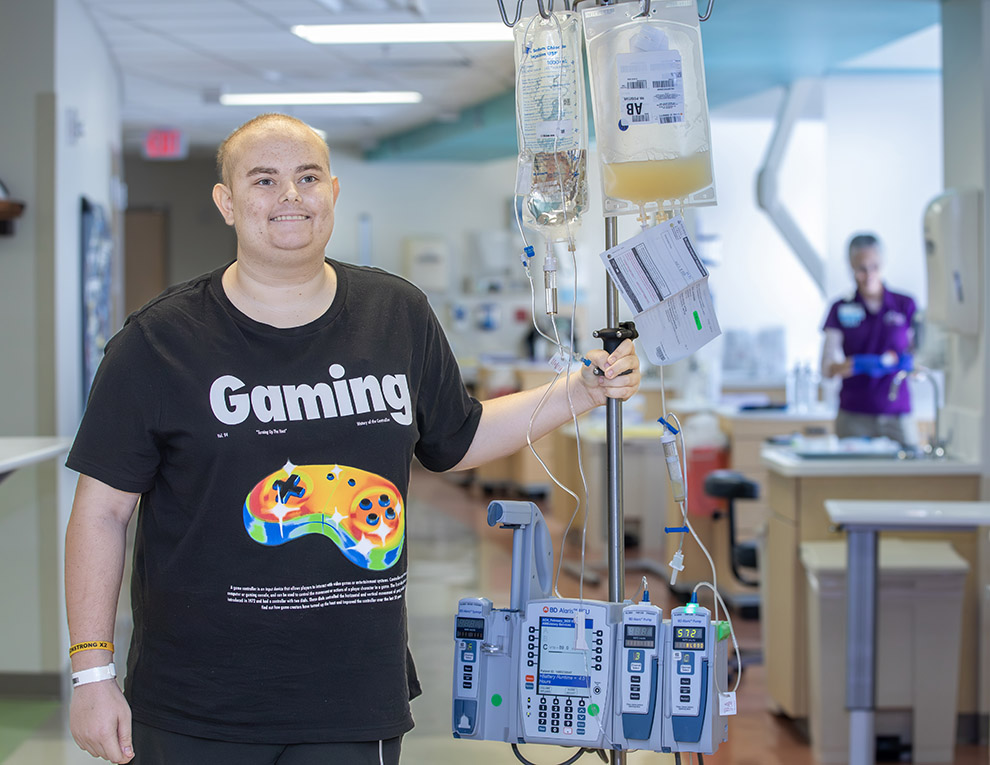
Sixteen-year-old Carson Scoville is strong. Through setbacks, difficult medical news, and long treatments, his positivity doesn’t wane. Carson’s mom, Casey, says her son is always looking for the bright side. That’s despite two cancer diagnoses and just receiving test results this summer that show he is positive for Li-Fraumeni syndrome (LFS), which Johns Hopkins All Children’s Hospital’s Brian Guedes, a pediatric hematologist-oncologist in the Cancer & Blood Disorders Institute, says puts Carson at “a very high risk of developing some other kind of cancer later on in life.”
Guedes says Li-Fraumeni is rare and is an inherited genetic condition that is caused by mutations in the TP53 tumor suppressor gene. This gene normally controls cell growth and division, but Guedes adds mutations to it can cause uncontrolled cell division and tumors.
An Escape
In the toughest moments, Carson relies on his escape: gaming. Video games have always been his savior … a way to move into a new realm where cancer isn’t on the forefront. He wanted to give other kids an escape too, so he and his family started the ScovilleStrong Foundation. The Foundation raises money to purchase and donate gaming systems to Johns Hopkins All Children’s Hospital.
In August, Carson dropped off two gaming systems to the Johns Hopkins All Children’s Outpatient Care Center in Tampa where some pediatric patients go for infusions. The previous month, he donated six systems and 27 games to Johns Hopkins All Children’s Hospital’s St. Petersburg, Florida, campus.
Both drop-offs occurred between Carson’s own infusion sessions as he battles leukemia.
“Gaming gives me a little outlet from the real world and giving that to kids battling cancer is a big thing for me,” Carson explains. “Seeing people happy and giving them a chance to have fun and smile and have some part of a normal life, that’s important to me.”
A Second Round of Cancer
In May, doctors at Johns Hopkins All Children’s diagnosed Carson with B-cell acute lymphoblastic leukemia. Hearing the word “cancer” again brought strong emotions to his mom. It was less than two years earlier that her then 14-year-old son rang the bell signaling the end of his treatment for osteosarcoma, an aggressive bone cancer, for which Carson had chemotherapy and major surgery.
“Compared to other childhood cancers, osteosarcoma carries a relatively high risk of coming back, but as time goes on, the chances of this happening will continue to go down,” Guedes says. “His scans thus far have been negative — so far, so good.”
Casey hoped her son was in the clear, until a back injury from cheerleading sent Carson to the Emergency Department.
“Carson could no longer play football after his battle with osteosarcoma, so he became a cheerleader, and he was throwing some girls in the air and his back popped,” she explains.
As the weeks went on, the back pain worsened. Carson ended up back at Johns Hopkins All Children’s in May when the pain got so severe that he could barely stand or walk.
“The leukemia was found really by happenstance because had he not injured his back, it might have been a long time before it was discovered,” Casey says. “We also found osteosarcoma by happenstance when Carson fell playing basketball with friends. In our minds it's like divine intervention both times you know because if neither of those injuries happened, I don't know if we would be where we are now.”
Even so, hearing the diagnosis of cancer twice by age 16, wasn’t easy for Carson or his family. “My family keeps me strong. The kids I’m helping keep me strong,” Carson says. “I just stay strong for everyone, to inspire others to keep fighting on.”
Casey is proud of her son’s resilience. “He’s so courageous. He’s always worried about others, and he helps the rest of us keep our heads held high,” she adds.
The Road Ahead
Guedes says Carson’s previous cancer treatments also dictate how they treat the leukemia. “We are having to omit part of the treatment because of his prior exposure to chemo during his bone cancer treatment. That said, Carson is already in remission after just the first month of treatment, which is a very good sign.”
On the hospital cancer unit and in the infusion clinics, where Carson spends the most time inside Johns Hopkins All Children’s Hospital, the 16-year-old’s shirts are a constant topic of interest. During Carson’s latest cancer battle, his football coach gifted him with a brightly colored Hawaiian shirt to make port access a little easier while adding some flair. Carson’s collection has grown to include shirts with sloths wearing straw hats and flower crowns, dinosaurs devouring tacos and brightly hued game controllers.
Casey says it’s one of a handful of beautiful things to emerge from the difficult diagnosis. “I mourn the life that he could and should be having as a 16 year old, but I do understand that the life he's creating and the legacy and courage he’s found to start his own foundation and give back, is because of what’s happened,” she says, adding that Carson’s mottos are live one day at a time and live your best life.
Ultimately, that’s what inspired Carson to start giving back. It started as a toy drive where friends and neighbors chipped in to buy about 100 toys for patients at Johns Hopkins All Children’s during the holiday season. Carson was hooked. The next year he donated more than 400 toys. His new goal is to fill up a moving truck.
“He's going through very adult type situations with his cancer treatments, but it's just so cool that he wants to give to other kids and he obviously has the thought process of thinking beyond himself, and it just makes me proud,” Casey explains.
Carson hopes to see his foundation grow. He would love to get a wish list underway to help patients, especially those battling cancer, with bigger asks like laptops to help complete schoolwork while they are in the hospital. He also has career aspirations to become a pediatric oncology nurse and possibly work at Johns Hopkins All Children’s alongside the very nurses helping him find strength and resilience through long days of treatment.
“I want to ensure no kid feels lonely and I want them to have opportunities to feel normal even when what they’re going through is difficult. I want to make a difference,” Carson adds with a smile.
Carson’s family credits the Johns Hopkins All Children’s team for making their journey as seamless as possible. “I mean honestly, I can't say a bad thing about Johns Hopkins. I'm a very straight shooter, and I like to tell it like it is, but we’ve had nothing but great experiences. The nurses, doctors and entire team are fabulous.
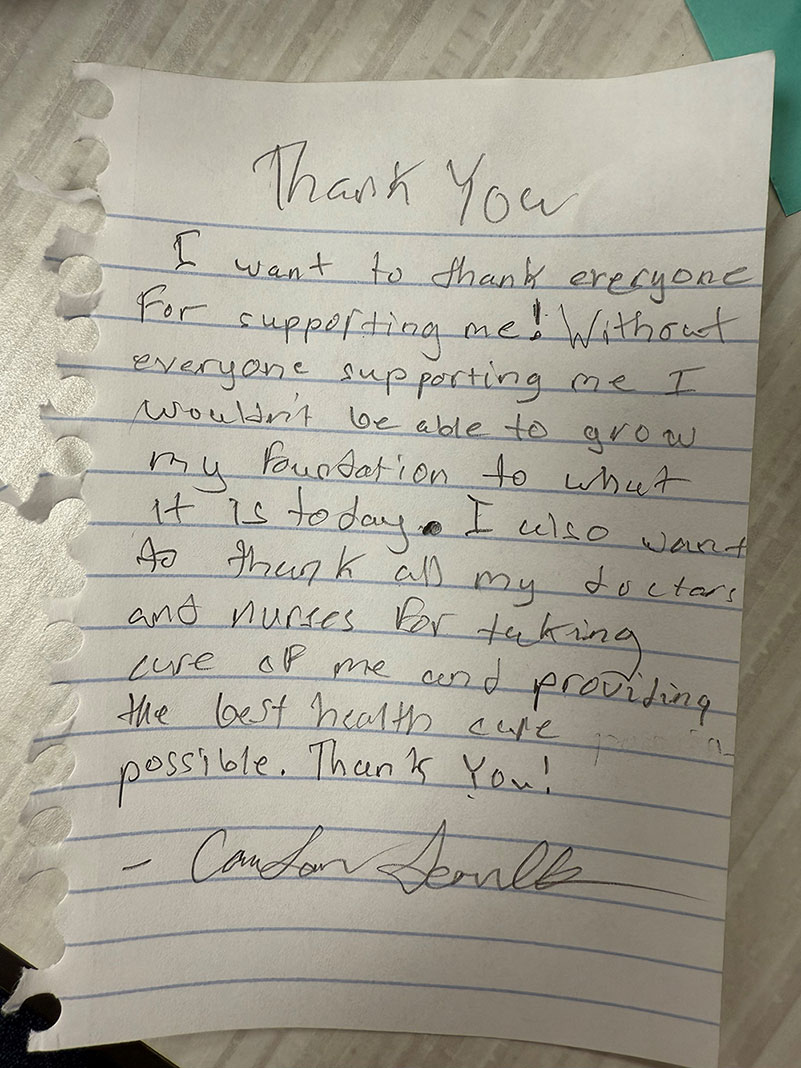 Carson's Handwritten note to Johns Hopkins All Children's Hospital