
Blake’s Brave Journey
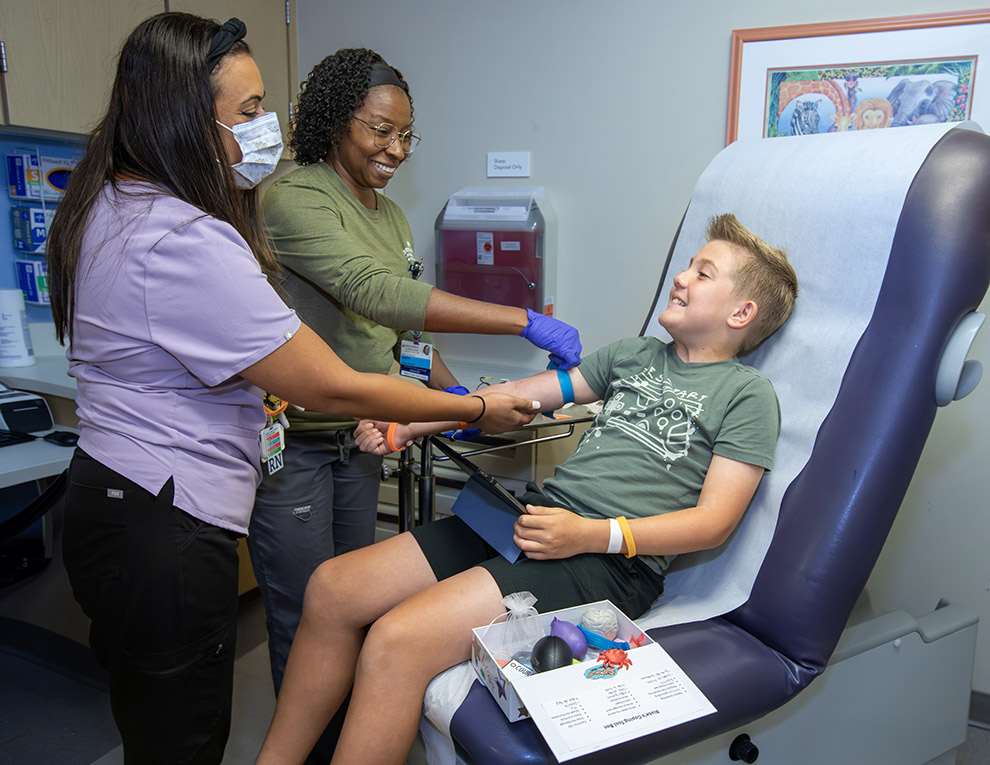
Ten-year-old Blake is perched on an exam table inside the Hematology/Oncology Clinic at Johns Hopkins All Children’s Outpatient Care Center, in St. Petersburg, Florida, building up his courage.
It’s time for a blood draw. Not his favorite thing.
“Mom, I’m scared,” Blake confides.
Sometimes it helps to just say it out loud.
Needle pokes are a real challenge for this child. But he has come prepared.
On his iPad, a favorite upbeat music video called “Crab Rave” is playing, featuring dozens of bright orange computer-generated crabs dancing to a fist-pumping techno beat.
In Blake’s lap is a small box designed just for him. It’s filled with fun distractions, including stress balls, tiny toy figurines and a list of tips and tricks to help him relieve anxiety.
Blake pulls a thumb-sized toy crab from the box.
“It’s almost time … It’s almost time!” he says to two nurses who are familiar with his rituals and are waiting patiently for his cue.
“3, 2, 1!” The nurses count down with their charge and then slide the needle into his arm.
Blake is the picture of calm, a boy in control.
The music swells, the blood draw is complete. Blake jumps off the exam table in celebration and throws his whole body into the “Crab Rave” dance, inviting others to join in. This is a child who understands that every victory is worth celebrating.
Last year, a life-altering diagnosis would test far more than his courage with needle pokes.
It would require everything he had to give.
Cancer Diagnosis
As the final school holiday break of 2023 ended, something wasn’t adding up.
Blake was complaining of body aches and fatigue that couldn’t be readily explained. It was uncharacteristic of this child, who was normally so vibrant, active and healthy.
“The pain was bouncing around. It was unrelenting,” says Brenda, his mom. She and his dad, Ron, wondered if it might be growing pains — or something more.
In early 2024, repeated doctor visits and consultations revealed nothing conclusive.
Then in mid-February, Blake began to spike high fevers. His mom rushed him to the Emergency Department at Johns Hopkins All Children’s Hospital. Blake tested positive for COVID-19 and was admitted to the hospital. His blood counts were dangerously low.
On Feb. 15, a bone marrow biopsy would confirm the worst kind of news: Blake was diagnosed with acute myeloid leukemia (AML), an aggressive type of blood cancer.
“It was my worst day ever,” Brenda says. “I just fell to the floor. But Dr. Mayer was very calming. She said to me, ‘Take a breath and listen to what I’m saying. I will dance at your son’s wedding.”
Pediatric hematologist-oncologist Jennifer Mayer, M.D., has been offering treatment and hope to young cancer patients and their families at Johns Hopkins All Children’s for decades.
“A diagnosis of cancer is devastating for these families,” Mayer says. “But we’re fortunate to have a health care facility that can provide total care from a medical and surgical perspective, as well as every area of expertise they could possibly need.”
In an instant, Blake’s world had changed.
But there was hope.
Treatment
To fight the cancer cells, Blake would receive five rounds of intensive chemotherapy over a period of six months.
Genetic testing of the leukemia cells helped his care team to better identify how to treat his cancer for the best possible outcome.
The family had decided to participate in a Children’s Oncology Group study of a cutting-edge new therapy as well, after learning that a targeted monoclonal antibody agent was showing promise in cases like Blake’s. Johns Hopkins All Children’s leads the state of Florida in participants in Children’s Oncology Group trials.
For each round of chemotherapy, Blake would be in the hospital for about a month, and then he would go home for a brief respite before the next round.
“In between rounds, he’d come home for four days, and we would party like rock stars, Brenda says. “We’d fill the house with friends and junk food and parties. Then we’d start it all again.”
There was encouraging news early on. Blake went into remission after his very first round of chemotherapy — something his care team didn’t often see in AML patients.
Blake would benefit from a range of support at Johns Hopkins All Children’s. The psychology team helped him with skills to cope with anxiety, Child Life specialists offered toys, music and games to help take his mind off his illness. He received regular visits from Brea, a beloved facility dog.
“He had so much support,” Brenda says. “The staff, the doctors, the nurses, they all kind of figured him out. Blake knew he was loved and that no one was there to hurt him. There was a trust that was built.”
That trust would be even more critical during the second half of Blake’s treatment. The last rounds of chemo were the most challenging for this little boy.
Chemotherapy ultimately weakens the immune system, a byproduct of the treatment as it does its work to destroy cancer cells.
Blake would endure nausea, infections and fevers as he bravely battled to become cancer-free.
“Just being there was tough,” Blake says. “My parents helped me to stay strong — and my doctors.”
In mid-August, a frail but triumphant Blake would ring the bell symbolizing an end to his cancer treatment with a host of family, friends and clinical staff cheering him on.
It was time to get back to life.
Fast Track
Blake’s journey to wellness after his cancer treatment has been more of a sprint than a marathon.
In a flash, he was feeling stronger, back to playing with his friends, back to school, back to the sports he loves.
He has continued to put on weight and is growing as a boy his age is supposed to be.
The likelihood of relapse drops dramatically after the first year post-treatment.
Blake sailed past that one-year mark in July.
“His prognosis is fantastic,” Mayer says. “I anticipate he will have a phenomenally marvelous life.”
Blake’s mom would never have chosen cancer for her child. No one would.
But she understands that this is a part of her son’s story.
“I hope he can live a very long, very normal life — but I also hope he keeps a part of this experience tucked in his back pocket,” Brenda says.
“Every part of this journey has made him a stronger person. He’s so brave and so amazing.”