
An E-Scooter Emergency: Cooper’s Story
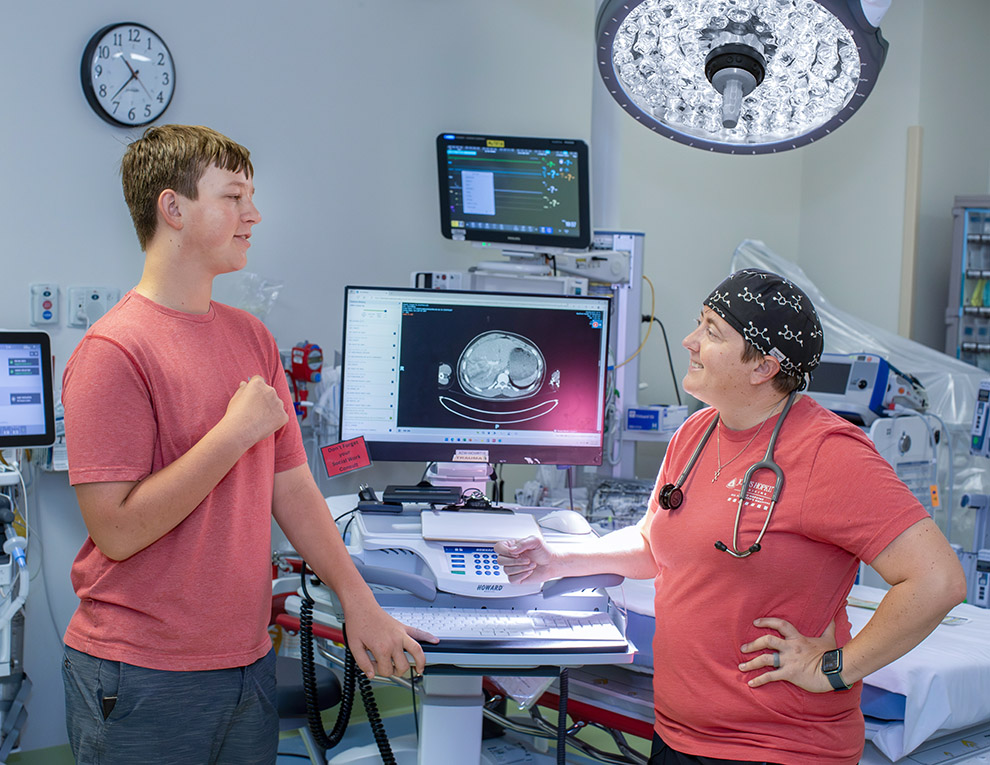
Fourteen-year-old Cooper only wanted one thing for Christmas last year: an electric scooter. He’s among many who likely had it on their holiday wish list—the e-scooter and e-bike popularity has boomed in recent years.
“It was his one and only Christmas present,” says his dad, John.
Cooper enjoyed his new gift for nearly six months, zipping to and from school, the park, confirmation class and nearby stores—but with the caveat of always checking in with his dad when arriving at his destination. But one day, as Cooper was on an afternoon ride, John received an unexpected phone call from him.
“I heard moaning on the phone, then the call dropped,” John says. “I turned back around immediately and went toward where he was supposed to be.”
When he got there, he saw that Cooper had taken a nasty spill on his e-scooter.
“It was absolutely horrible,” John explains. “He was just going down a brick road, hit a bump, and it just threw him off the scooter. He had facial road rash, and cuts on his hand, arm and chin.”
But the worst injury wasn’t on the outside — it was an internal emergency.
“The way he landed, the handlebar hit him perfectly right in his liver,” John says.
They went to the nearest emergency facility just around the block. The doctors there quickly identified the significant injury — a severe liver laceration. That’s when the Emergency Department at Johns Hopkins All Children’s Hospital in St. Petersburg, Florida, was contacted. Pediatric emergency medicine physician Meghan Martin, M.D., answered that initial call.
“The doctor [at the first hospital] was a little bit nervous, because freestanding emergency rooms don't have the resources that we have at a big pediatric hospital,” Martin says. “He said, 'I have a child with a liver laceration that I'd like to transfer.' And I said, 'Absolutely, I'd love to take him.’”
When he arrived at Johns Hopkins All Children’s, the team was ready to care for him. The Emergency Department has seen an uptick in e-bike and e-scooter injuries.
“He looked a little bit uncomfortable,” Martin says. “Obviously, he had some trauma. He was complaining of some shoulder pain, which was like referred pain up from his liver injury and some abdominal pain as well."
The pediatric trauma program, led by Christopher Snyder, M.D., MSPH, was also consulted which is important protocol when there are significant traumatic injuries.
“Having a pediatric trauma team to manage abdominal trauma in kids is really important,” Snyder says. “Injuries to solid organs like the liver and spleen can cause life-threatening internal bleeding. Intestinal injuries may not be apparent right away but can progress over time and turn into sepsis. We have to strike a delicate balance — to identify and treat the injuries appropriately, but at the same time to not subject children to extra radiation or invasive procedures unnecessarily. Pediatric trauma centers like Johns Hopkins All Children’s are trained to strike that balance for kids like Cooper.”
Luckily, Cooper’s vital signs were stable, but Martin and her team started bloodwork.
“The labs showed that his liver enzymes were quite high, which is consistent with having an injury to the liver,” Martin says. “The liver is really involved in some important things like getting rid of toxins, making clotting factors, making proteins and helping digestion. These are the things that we would monitor for in the next couple of days to make sure everything was functioning well."
It was nerve-racking for John who was worried whether or not his son would be OK. Cooper was admitted for monitoring to determine if he would need surgery on his liver.
“It was the worst feeling in the world just sitting in that room not being able to do anything,” he recalls.
“They kept him for a total of seven days, checking bloodwork, scans, and monitoring for any signs of worsening,” John says. “Dr. Snyder would come every morning, do bloodwork, X-rays, CAT scans, MRIs.”
After that week — the otherwise strong and healthy football player was able to move around and go home. The recovery continued at home for another seven weeks, and he won’t be fully healed for six months.
"It feels really good to obviously help kids, see them walk out and not need the surgery,” Martin says. “Hearing about all the things that he's excited to do in the future — starting school, getting a new car, potentially playing football and serving our country in the Navy — it's really exciting to see and be part of his story."
As for e-scooters and e-bikes to get around? Martin points out these are more like motorcycles than a kid-powered bike with speeds of 20, 30 or more miles per hour.
“It’s really important to be aware that these injuries are happening,” she says. “If it’s possible, kiddos under 16 especially shouldn’t be on these at all. If you are going to be on them, it’s important to have appropriate safety gear including a helmet, closed-toe shoes and long sleeves just to help protect your body if you were in an accident.”
For now, the e-scooter is retired at John and Cooper’s house.
“I used to ride it myself,” John says. “I’ve fallen too — not as bad, but it made me realize how sketchy they can be.”
Because of small wheels and unfamiliar terrain, he discourages other parents from buying one. He is now leaning toward a traditional bike for Cooper.