
The Construction Crew of Bacteria Cell Walls
The outer covering of most cells is a squishy, permeable double layer of fat molecules that encloses a cell’s gel-like interior and all its parts. But bacteria cells are different. Their outer covering, like plant cells, is closer to a hard shell than a soft covering.
Such rigidity is important to their survival, says Jie Xiao, Ph.D., professor of biophysics and biophysical chemistry at the Johns Hopkins University School of Medicine. Bacteria use a rigid outer cell wall to maintain their shape and defend themselves from onslaughts by an organism’s immune system and environment.
Like any structure, cell walls can be broken down and rebuilt. This happens, for example, when bacteria divide and multiply.
A cell divides by breaking down old cell wall material and creating a new wall between the splitting cells.
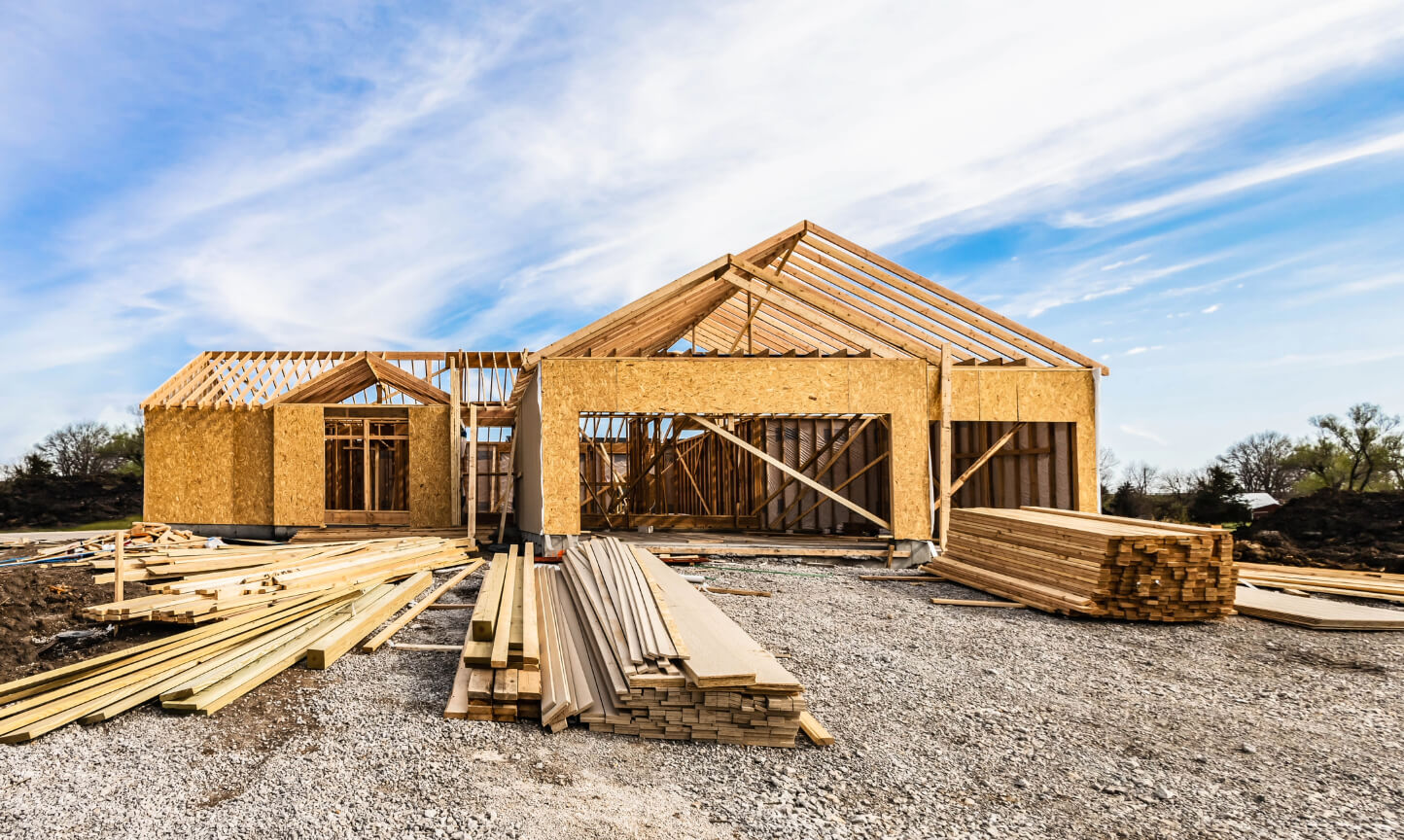
"It’s like trying to take down one old house and replace it with two new ones next to each other,” says Xiao. However, bacteria can’t break down their own walls without new ones in place. Without a wall, bacteria contents will leak out, and the cell will die.
Scientists, including Xiao, have been piecing together the intricate construction steps of bacteria cell walls in fine detail. The information is critical to understanding the science of bacteria, but also has enormous potential for human health. Many antibiotics target the enzymes that help build cell walls, destroying bacteria’s ability to divide and multiply.
“Antibiotic resistance is on the rise, and through research, we may find new enzymes, proteins or other processes involved in bacteria cell wall construction that we can target with new antibiotics to treat bacterial diseases,” says Xiao.
"It’s like trying to take down one old house and replace it with two new ones next to each other.”
Jie Xiao
Breaking Down Cell Walls … and Rebuilding Them
About 30 proteins, including enzymes, are involved in bacteria cell division — a large group working in sync to control three construction phases: shuttling materials, breaking down the old wall and creating a new one.
One aspect of the system involves an assembly line to deliver key construction enzymes to various places along the bacterial wall. Xiao and her postdoctoral fellow Xinxing Yang, Ph.D., discovered in 2017 how a circular molecular structure in bacteria, called the FtsZ-ring, delivers enzymes to points along the wall. They published the research in Science.
In animal cells, movement inside the cell is controlled by tiny, helicopter-like molecules called myosin. “But bacteria don’t have myosin,” says Xiao. Instead, she says, the FtsZ-ring moves like a treadmill, adding molecules at one end of the structure and disassembling them at the other end.
“This finding provided important details on the spatial organization of enzymes along the cell wall,” says Xiao.
Then, four years later, Xiao and Yang published research in Nature Microbiology that showed how FtsZ drops off enzymes along the cell wall at the right place at the right time, much like construction workers being dropped off at building sites.
“There is an intricate organization of the process to ensure that all the construction sites have the right enzymes,” says Xiao.
An Illustration of Bacteria Cell Wall Construction


Three Tracks of Cell Wall Construction
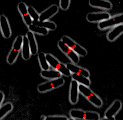 Red fluorescent parts in these bacteria represent cell division planes, where an old cell wall is degraded and a new cell wall is being created. Credit: Dr. Jason Lyu, Johns Hopkins Medicine.
The first track along the construction assembly line discovered by Xiao’s team in 2017 was the construction “train” itself, the FtsZ ring. The next major discovery about how the FtsZ ring deposits enzymes along the cell wall, Xiao refers to as the “second” track.
Her latest work, eight years after the initial discovery of the FtsZ ring, adds a third element to the construction story.
“We wanted to explore how bacteria construct the new cell wall,” says Xiao. “It’s a very coordinated, challenging task for the cells.”
With first author Jason Lyu, Ph.D., Xiao and the research team published new findings May 27 in Nature Microbiology, about a third track critical to cell wall building. Once cell division begins, the FtsZ ring forms. Then, it begins its work, dropping off enzymes at various points. The third track involves a protein called FtsN, which is surrounded by a complex of other proteins, and binds to old parts of the cell wall that are being dismantled.
“FtsN is key to the construction machine,” says Xiao. “But we wanted to find out how FtsN knows where to do its work.”
Funded by the National Institutes of Health, Xiao and her team found that FtsN marks the spots where an old cell wall needs to be destroyed and a new cell wall needs to be constructed. Essentially, it gives orders to the destruction and construction crews to halt or begin these two opposing processes at the same time.
“The whole process is very balanced so that areas of the wall don't become degraded too quickly,” says Xiao, who notes that the process is highly conserved across bacterial species. “Almost every type of bacteria that has a protein like FtsN uses this process.”
Throughout the research, Xiao has been identifying proteins that are essential to the building process. She has been working with chemists and other experts to find ways to target the process with new or existing drugs.
Xiao says another potential avenue for drug development relates to the fragments of bacteria cell walls left behind after it multiplies.
The degraded cell wall bits, she says, are a major cause of inflammation and immune system reactions in the body.
“We also could envision a different type of antibiotic that makes cell wall synthesis overactive, where bacteria degrade the cell wall and self-destruct,” says Xiao.