
Solving the Puzzle of Parkinson's Disease Begins with Research
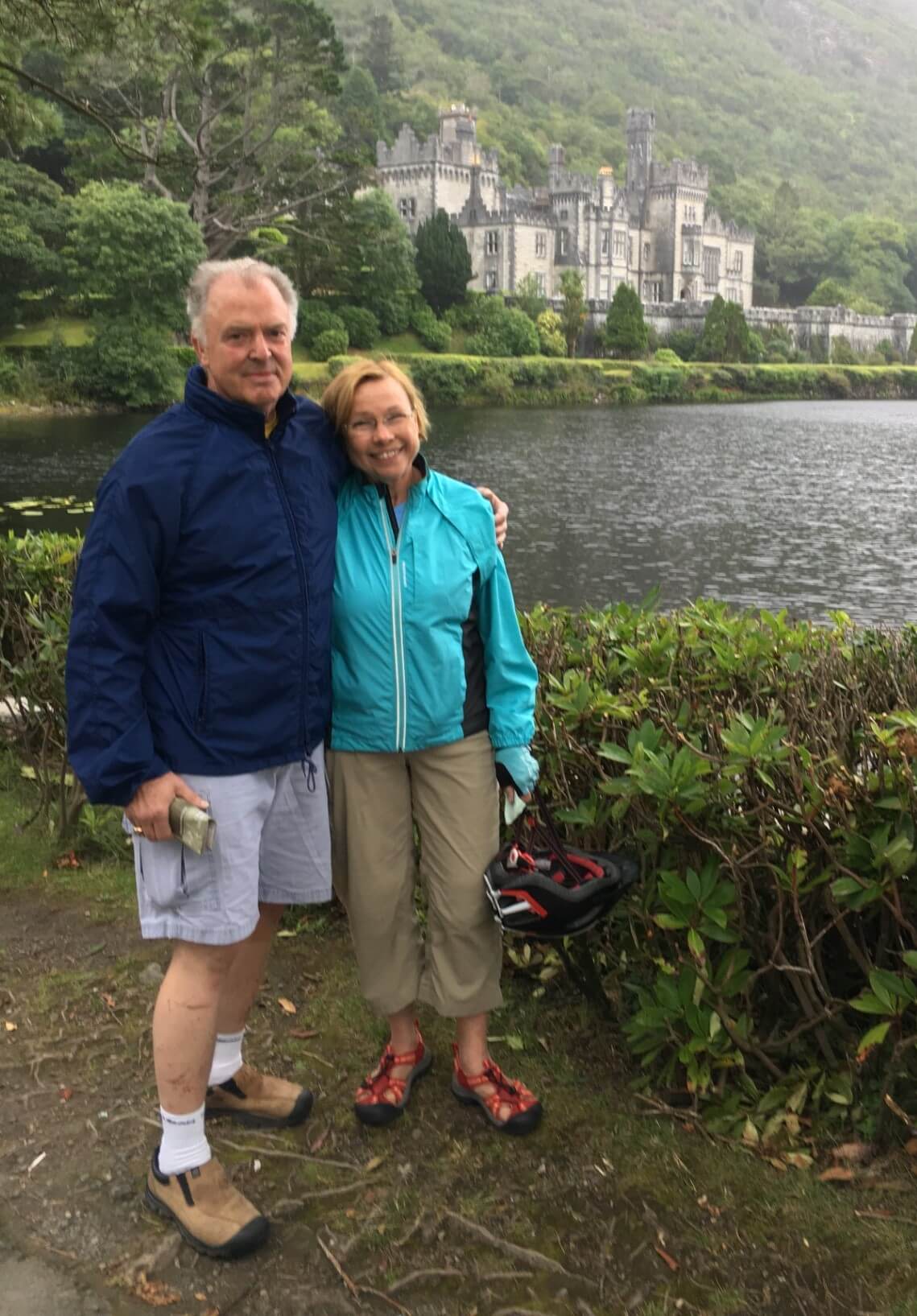
On a 2016 trip to the west coast of Ireland, Richard and Kathleen Truelove enjoy a picturesque scene.
Courtesy of Kathleen Truelove
Kathleen Truelove first noticed it while walking their two terriers around the steep hills of Roland Park: Her husband, Richard, was dragging his foot.
“I realized he probably wasn’t doing it on purpose,” says Kathleen, now retired from working as a pharmacist at Johns Hopkins. She says Richard is her true love, just like their last name.
A physically active person and frequent runner, Richard had a long career as a civil engineer.
His gait problems started not long before they both retired. They saw a neurologist at Johns Hopkins, and Richard was then referred to the Johns Hopkins Parkinson’s Disease and Movement Disorders Center, where he was diagnosed with Parkinson’s disease, a condition marked by movement problems.
Clinicians can give patients with Parkinson’s disease a wide range of medications, surgical options, and speech, occupational and physical therapy to optimize and improve quality of life.
“However, right now, we can’t give medications that will slow or stop the progression of the disease, nor can we predict who will get worse in physical and cognitive decline more quickly than others,” says Liana Rosenthal, M.D., Ph.D., associate professor of neurology and Richard’s neurologist. “We’re trying to address those gaps with research.”
The Rewards of Research
Since the diagnosis 12 years ago, Richard (and Kathleen, as a healthy volunteer) have participated in several clinical trials, most funded by the National Institutes of Health.
“If there are little or no resources dedicated to finding out the causes and cures for Parkinson’s disease or any other condition, we’ll never find out if cutting edge medicines currently in their infancy will work,” says Kathleen.
“The only way to slow or stop disease is through research,” says Rosenthal. “Studies show that the current management of Parkinson’s disease, compared with 30 years ago, has improved the way people can function with the disease. That’s all due to research.”
The only way to slow or stop disease is through research.
Liana Rosenthal, M.D., Ph.D.
It Can Start with a Tremor … But Not Always
Symptoms of Parkinson’s disease vary among individuals. Richard didn’t have one of the most common ones: a tremor in a hand or foot. His initial symptoms were mostly related to walking problems.
“He also experienced depression for about a year before the diagnosis, but, initially, we couldn't figure it out,” says Kathleen.
Parkinson’s disease kills cells in the brain that make dopamine, a chemical linked to muscle movement and feelings of satisfaction, pleasure and motivation. With a lack of dopamine, “his depression started to make sense to us,” says Kathleen.
When Kathleen worked at Johns Hopkins, she was a member of the Johns Hopkins University School of Medicine’s Institutional Review Board (IRB), which reviews applications from researchers planning to start clinical trials.
“I used to look at all the studies coming through the IRB and think, ‘Is there anything here that Richard and I could participate in?’” says Kathleen.
Kathleen and Richard have participated in several studies, including ones that test blood for biomarkers of Parkinson’s disease and its impairment, long-term studies that follow patients over time, research using video-based analyses of movement, and a study to develop better ways to detect Parkinson’s disease with imaging tools.
“Richard even volunteered to give blood for malaria research,” says Kathleen.
Kathleen acknowledges that the research may not help her husband or other people today with their Parkinson’s disease. “But it will help the next person down the line,” she says.
The extra scans and testing that are often part of research studies may reveal other conditions that would not have been caught early without participating in such research.
An MRI that Richard had for a study showed an incidental finding of normal pressure hydrocephalus (NPH), prompting physicians to place a shunt to treat it.
The Case for Research
 Richard and Kathleen Truelove in Cinque Terre, Italy.
Scientists at Johns Hopkins, working in the labs of Ted and Valina Dawson and elsewhere in the Institute for Cell Engineering and other Johns Hopkins departments, have long been leaders in Parkinson’s disease research focused on new compounds and the molecular and cellular development of the disease. Work from the Dawson laboratories has led to multiple biotechnology companies and insights on experimental treatments and the biomolecular mechanisms of Parkinson’s disease in brain cells.
In addition, the Parkinson’s Disease and Movement Disorders Center was named a center of excellence by the Parkinson’s Foundation in 2006.
“Most drugs and treatments for human disease begin with federal government support,” says Rosenthal. “The partnership between the federal government and universities has made our research system one of the best in the world. People come here from all over the world to conduct and participate in our research.”
She adds: “Universities are unique in being able to bring together a collection of experts in different specialties to solve a particular problem. With sufficient resources, we can solve anything.”
Rosenthal says she receives numerous emails from patients looking for the latest treatments and knowledge about Parkinson’s disease. “Our patients are very interested in coming to Johns Hopkins, because they see us as a leader in research, and they want to be on the cutting edge of treatment,” she says.
The Way Forward
Kathleen says Richard has remained stable while taking various medications and doing physical therapy for his Parkinson’s disease. He exercises regularly, as directed by Rosenthal, and especially likes Rock Steady Boxing, a program designed for people with Parkinson’s disease.
Due to the NPH diagnosis, Richard has not been eligible for current Parkinson’s disease studies, but the Trueloves will always be advocates for research and the work of Johns Hopkins scientists.
“Research is the way forward,” says Rosenthal.