
Johns Hopkins Offers Rare Pediatric Transoral Robotic Surgery
Cutting-edge technology offers significant advantages over conventional endoscopic approaches for surgeries such as lingual tonsillectomies.
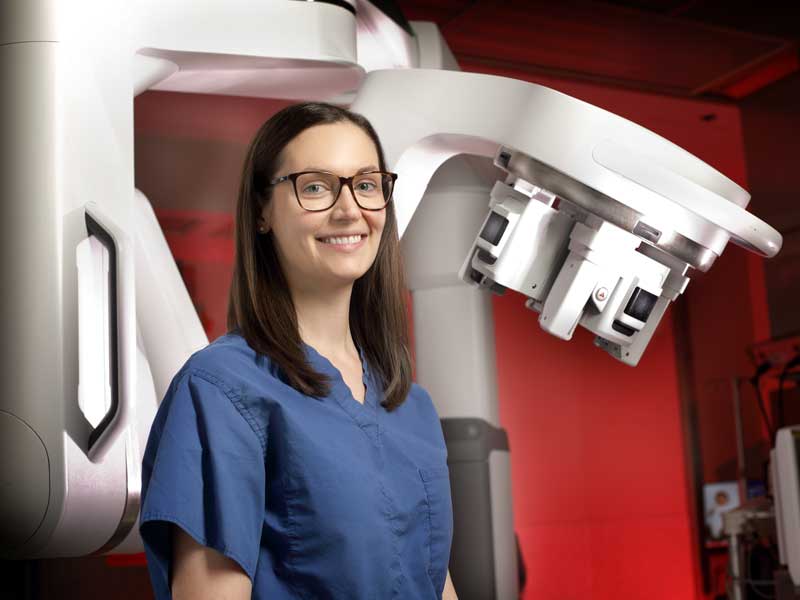
Transoral robotic surgery (TORS) revolutionized head and neck surgeries when it was approved for adults by the U.S. Food and Drug Administration in 2009. Mostly used for cancer therapy, these procedures allow surgeons to avoid significantly more invasive operations that require splitting the mandible and approaching tumors through the jaw and neck.
The transoral robotic approach also holds significant advantages for pediatric head and neck surgery. However, only a handful of centers across the country offer pediatric TORS, says Johns Hopkins pediatric otolaryngology surgeon Carolyn Jenks. When she joined Johns Hopkins Children’s Center in 2021, Jenks introduced this type of surgery to the hospital’s repertoire and began treating children using the technique.
Jenks began training in TORS during her residency at the University of Pennsylvania, the birthplace of this surgery. She learned how to use it to treat children during her fellowship at Lurie Children’s Hospital of Chicago, under the mentorship of Douglas Johnston, a trailblazer for pediatric TORS.
“I was lucky enough to train at the right places at the right times,” she says.
Being able to bring pediatric TORS to Johns Hopkins Children’s Center also required a set of rare circumstances, Jenks adds: The hospital not only has the right equipment, but also collaborative staff members, including a team of nurses, surgical technicians and physicians who are specially trained in TORS procedures.
“It’s really fulfilling to see these children have great outcomes with TORS.”
Carolyn Jenks
A common misconception is that TORS can’t be used in children due to the small opening of their mouths. However, Jenks says, this approach has been used on patients as young as 2 weeks old. To determine whether pediatric patients might be candidates for TORS, she evaluates them through in-office flexible laryngoscopy, reviewing results from exams such as sleep studies, and sometimes performing drug-induced sleep endoscopy to better understand the lesions they’ll be resecting. Besides lingual tonsillectomies — a treatment for refractory sleep apnea that’s the most common indication for this approach — TORS can be used to treat a variety of other conditions, including vascular malformations in the mouth and throat, benign and malignant cysts and masses, and various laryngeal pathologies.
During these operations, Jenks serves as the primary surgeon, sitting behind the robot’s controls. A second surgeon is stationed at the patient’s head, observing at the bedside for safety and performing additional duties including suctioning and tissue retraction. Because the robot lacks haptic feedback — a simulated sense of touch that researchers are working to implement in future generations of surgical robots — having a second surgeon helps prevent inadvertent injury to surrounding structures. Jenks says that she feels lucky to partner with experienced TORS surgeons such as Leila Mady.
During TORS surgery, three surgical tools of Jenks’ choice and a 3D, high-definition camera emerge from the robot through a single 2½-centimeter port, allowing her significantly greater visualization and maneuverability than other minimally invasive approaches provide. Although the risks are similar compared with conventional endoscopic surgery, TORS can help avoid the increased risk of complications, prolonged recovery and scars that can result from open procedures.
“The patients for whom I’ve been able to offer this cutting-edge technology have been referred to me with refractory problems that many well-trained pediatric otolaryngologists can’t help them with,” Jenks says. “It’s really fulfilling to see these children have great outcomes with TORS.”
To refer a patient to pediatric otolaryngology, call 443-997-6467.
For Clinicians Clinical Connection
Clinicians, discover the latest in research and clinical innovation from Johns Hopkins experts. Access educational videos, articles, CME courses and other resources from our world-renowned institution.